Kim Yongbeom to Visit US on the 16th for In-Person Talks with US Commerce Secretary
Two-Month Negotiation Deadlock Continues
Kim: "There Were Even Heated Exchanges Between the Sides"
Revised Proposal Delivered, Addressing Foreign Exchange Market Impact and Public Acceptability
Kim Reflects: "It Made Me Think Deeply About Our History of Envoys Sent During Difficult Times"
Kim Yongbeom, Chief of Policy Office at the Presidential Office, announced that there has been meaningful progress in the follow-up negotiations of the Korea-US tariff talks since October. He stated that on the morning of October 16, he will depart for Washington, D.C. with Minister of Trade, Industry and Energy Kim Jeonggwan to hold in-person working-level discussions with key figures, including US Secretary of Commerce Howard Lutnick. He also expressed his determination to conclude the tariff negotiations ahead of the Korea-US summit, which will take place on the sidelines of the Asia-Pacific Economic Cooperation (APEC) summit at the end of this month.
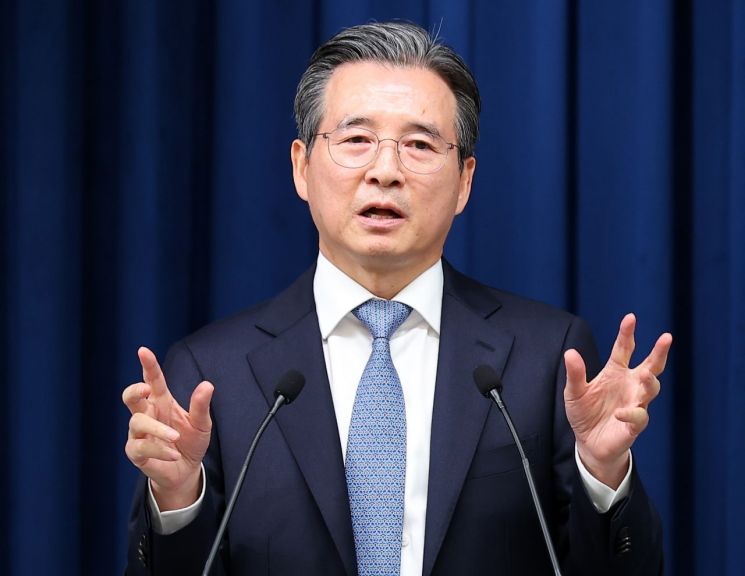
In an interview with SamproTV on October 15, Kim said, "By the time APEC takes place, it will have been three months since the Korea-US tariff agreement was reached on July 31. We are continuing working-level negotiations so that the agreement between the two leaders can be finalized." He added, "There is no specific deadline for concluding the tariff negotiations, but opportunities for the two leaders to meet do not come often, so APEC is effectively our main target."
He explained that the US side has shown a notably positive response over the past two weeks, which led to several internal meetings during the Chuseok holiday period. Although Korea and the US reached a tariff agreement at the end of July, differences arose over the detailed operation of the $350 billion investment package for the US, resulting in a deadlock. The US demanded that most of the investment be in the form of equity, that is, cash investment. In response, Korea sent a revised proposal, arguing that, given the need for foreign exchange market stability and the size of its gross domestic product (GDP), it would be more reasonable to meet the investment limit through loans and guarantees.
Kim stated, "The US responded quite positively to the revised proposal we sent, and a new alternative was presented. Our negotiation team will visit this week to hold substantive discussions."
Regarding the revised proposal sent by the Korean side, he explained that it included points such as: ▲an inevitable shock to the foreign exchange market, ▲conditions that would be unacceptable to the Korean public, and ▲the need for a special law and parliamentary approval. Kim said, "The US side may have thought it was just political rhetoric, but the term 'prepayment' was mentioned, so we had to take even such scenarios into account. We provided a convincing explanation of the impact on the foreign exchange market and clarified what conditions must be included so that our public can understand."
He continued, "If this package is actually implemented, a special law and parliamentary approval will be technically essential. We made sure to clearly convey that the content must be acceptable when reviewed by the National Assembly." He added, "The US must have found this very difficult, but they could not simply ignore Korea's position. If things had been pushed through unilaterally, it would have been impossible for us to handle, so there were even heated exchanges at times."
Kim recalled that immediately after the tariff agreement was reached at the end of July, it was expected that the investment fund for the US would proceed like a typical project. Normally, when establishing a business entity, capital is raised through equity contributions, and the business is launched in earnest with loans and guarantees. Since the negotiations were modeled after the framework used between the US and Japan, detailed communication was held with the Japanese government in advance based on the "fact sheet." Ultimately, however, the US made demands that greatly diverged from what the Korean government had anticipated.
Kim commented, "Some have used the term 'wishful thinking,' but at the time, it was a reasonable expectation. In early August, we received an MOU from the US, but it was in a different format than we had expected. There was no atmosphere of detailed explanation by item, and they were negative about distinguishing between loans and guarantees."
He went on to say about the tariff negotiation process, "It made me reflect a lot on history. I wondered how envoys sent during difficult times in Korean history must have felt-being turned away and humiliated. Those feelings have come to mind a lot recently." However, he emphasized, "The optimal country to truly support the revival of US manufacturing in a mutually beneficial way, and to strengthen the important Korea-US alliance, is Korea."
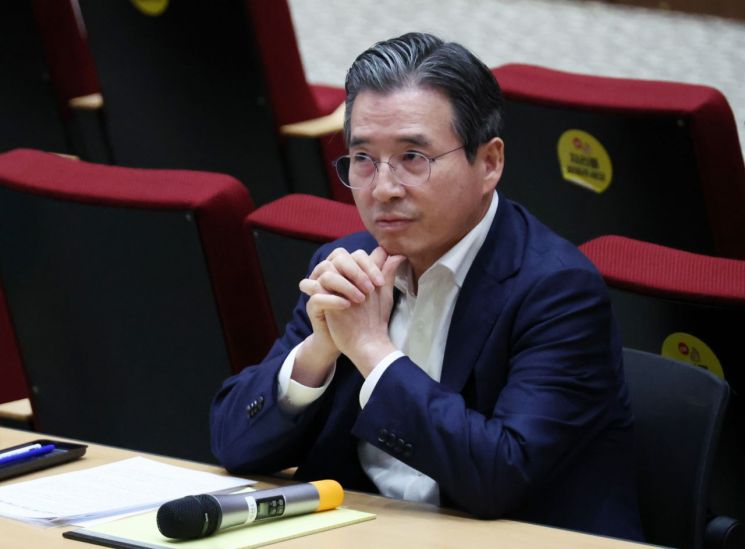
Meanwhile, he assessed that relations with China are recovering rapidly. Regarding Korea's role as a "bridge" between the US and China, Kim said, "'Anti-China' sentiment is unreasonable and unfortunate. Since 2001, the two countries have been the closest neighbors and competitors, helping each other. While China, based on state capitalism, is encroaching on our share, this is why we must move to a higher stage. Cultural exchanges and inter-ministerial relations are also recovering quickly."
Regarding what the Korean government expects from APEC, he said, "I believe Korea's contribution is significant in terms of restoring multilateralism, including the future of Korea-US and Korea-China relations. Gyeongju is a city that connects East and West, and the word 'connectivity' applies. At a time when everyone is at odds, it is a historic moment for the stage of harmony to be set in Gyeongju."
© The Asia Business Daily(www.asiae.co.kr). All rights reserved.


















