As the U.S. Imposes Port Tariffs on Chinese Ships,
China Responds with Sanctions, Signaling a Warning Amid Industry Concerns
"No Immediate Impact, but Prolonged Sanctions Could Undermine Trust"
Following the inclusion of Hanwha Philly Shipyard and other U.S. subsidiaries of Hanwha Ocean in China's sanctions list, there is growing attention on whether these measures could be expanded to the parent company or its Chinese subsidiaries. The U.S. subsidiaries currently have limited direct trade with China, so the immediate impact is minimal. However, if sanctions are extended to the parent company, it could disrupt the procurement of equipment and export networks.
According to the electronic disclosure system on October 15, Hanwha Ocean's Chinese operations recorded sales of 111.075 billion won in the first half of this year. Hanwha Ocean operates a wholly owned subsidiary, Hanwha Ocean Engineering (Shandong) Co., Ltd., in Yantai, Shandong Province, China. This entity is responsible for ship block and component manufacturing, equipment procurement, and technical inspections. Established in 2005 during the Daewoo Shipbuilding & Marine Engineering era, it has been in operation for nearly 20 years. Located in the Yantai bonded port zone, it enables ship blocks manufactured on-site to be shipped directly to the Geoje headquarters shipyard, with customs procedures handled at a single location. Hanwha Ocean recently invested 123.3 billion won in facility upgrades at this site.
Hanwha Ocean primarily sources steel plates and equipment required for shipbuilding from domestic suppliers, but also uses some components from China and Japan. Among imported valves, pumps, and piping in Korea, Chinese products account for about 35-40%. As of the first half of this year, total raw material purchases amounted to 3.5358 trillion won, with the commercial ship segment accounting for 81.4% (about 2.8774 trillion won). The offshore and special ship segment followed at 16.6% (585.3 billion won). Hanwha Ocean is reported to source raw materials such as steel plates from domestic steelmakers like POSCO and Hyundai Steel, as well as from Japanese and Chinese steel companies. Core ship components such as engines are purchased from major domestic ship equipment manufacturers, including HD Hyundai Heavy Industries and Hanwha Engine.
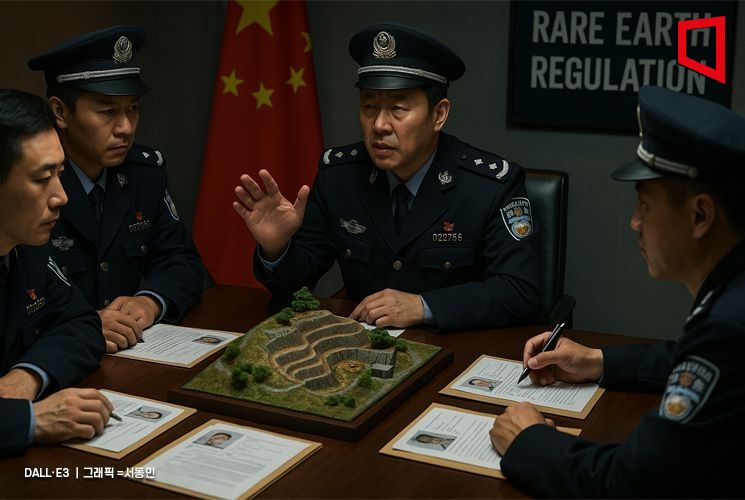
There are also concerns that China's sanctions could extend to the defense industry. Based on its Export Control Law enacted in 2020, China restricts the overseas transfer of rare earth processing and refining technology. As the world's largest producer of rare earths, China accounts for about 70% of global production and 90% of refining capacity. South Korea relies on China for 79.8% of its rare earth imports. Rare earths are extensively used in key defense components such as precision-guided weapons, radar, and communication equipment. The government stated that "major rare earths such as dysprosium and yttrium are stockpiled for more than six months, so the short-term impact is limited." However, industry insiders are concerned that prolonged sanctions could lead to production disruptions once stockpiles are depleted. A defense industry source said, "Rare earths are difficult to substitute, so if sanctions persist, some systems could be affected."
Previously, the Chinese Ministry of Commerce designated five Hanwha Ocean affiliates in the United States as targets of sanctions in response to the U.S. port tariff measures. The list includes Hanwha Philly Shipyard, Hanwha Shipping, Hanwha Ocean USA International, Hanwha Shipping Holdings, and HS USA Holdings. An industry insider commented, "So far, Chinese sanctions have not impacted production at the U.S. subsidiaries, but we are closely monitoring the situation. If sanctions are prolonged, it could affect trust in the domestic defense and shipbuilding industries, making swift government action crucial."
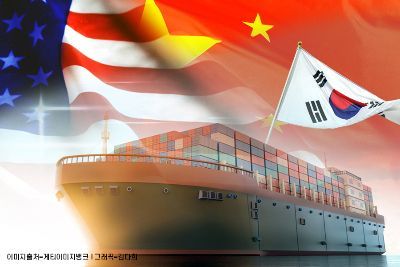
The current sanctions are linked to the "port tariff on China" measures announced by the United States in early October. The U.S. Trade Representative (USTR) decided to impose a port fee of $50 per ton on Chinese ships entering U.S. ports. As a result, global shipping companies ordering vessels for U.S. routes are now more likely to choose shipyards in Korea or Japan over those in China.
© The Asia Business Daily(www.asiae.co.kr). All rights reserved.


















