Restoring the Tax Revenue Base Undermined by the Previous Administration
Calls for Supplementary Measures on Dividend Income for Small Investors
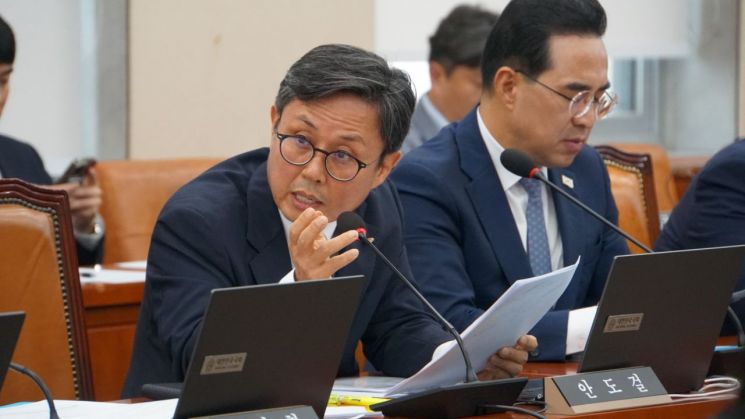 Democratic Party lawmaker Do-Gul Ahn questioning at the Ministry of Strategy and Finance's national audit held on the 14th. Photo by Do-Gul Ahn's office
Assemblyman Do-Gul Ahn (Gwangju Dongnam-eul) of the Democratic Party of Korea highly praised the new government's tax reform during the Ministry of Strategy and Finance's national audit held on October 14, stating that it marked a significant turning point for the "normalization of taxation." He also raised the need to supplement certain tax policies.
Assemblyman Ahn pointed out the massive tax revenue shortfall of 100 trillion won caused by the previous administration's indiscriminate tax cuts, and assessed that the current government's efforts to restructure the tax system have laid the foundation for restoring fiscal soundness. In particular, he noted that the reversal phenomenon in corporate tax, which undermined tax fairness, has been resolved, allowing the tax system to regain its intended function and stabilize.
He analyzed that the government's tax reforms, including the restoration of the corporate tax rate and the reinstatement of the securities transaction tax rate, are producing positive results, as evidenced by the projected recovery of the tax burden ratio to 18.7% next year. He highlighted these efforts as notable achievements in securing "normal tax revenue," enhancing tax fairness, and establishing "targeted taxation."
Assemblyman Ahn emphasized, "The previous administration's tax cut policies were ineffective and only undermined fairness, but the new government has completely overhauled the tax structure by restoring the corporate tax rate, reinstating the securities transaction tax rate, and selectively reducing taxes for future strategic industries, creating a turning point for normalizing the tax revenue base."
However, Assemblyman Ahn expressed concern that the current separate taxation system for dividend income disproportionately benefits high-dividend listed companies, and called for improvements. He argued that, to foster key national industries, the scope of separate taxation should be expanded to include not only major manufacturing companies (with a dividend payout ratio of 20-25%) but also small investors with annual dividends of 20 million won or less, in order to strengthen long-term investment incentives. He explained that this would enhance both tax fairness and the effectiveness of the system.
In response, Deputy Prime Minister and Minister of Strategy and Finance Koo Yooncheol stated, "We will thoroughly review Assemblyman Ahn's proposed bill and suggestions, along with various other opinions, to devise the most reasonable and optimal policy design."
© The Asia Business Daily(www.asiae.co.kr). All rights reserved.

















