15-Kilometer Round-Trip Route, Three-Year Operation
Service Also Running in Seodaemun and Dongjak Districts
Mayor Lee Pilhyung: "Connecting Transportation Blind Spots Expected"
"Is it really safe?"
The self-driving bus (Dongdaemun A01), which officially began operations in Dongdaemun District, Seoul (Mayor Lee Pilhyung) on October 14, is drawing significant attention from local residents on its first day. On the afternoon of the previous day, the district held an opening ceremony in front of the district office plaza, marking the official launch of the autonomous transportation service aimed at resolving local transportation blind spots and realizing a future-oriented transportation city.
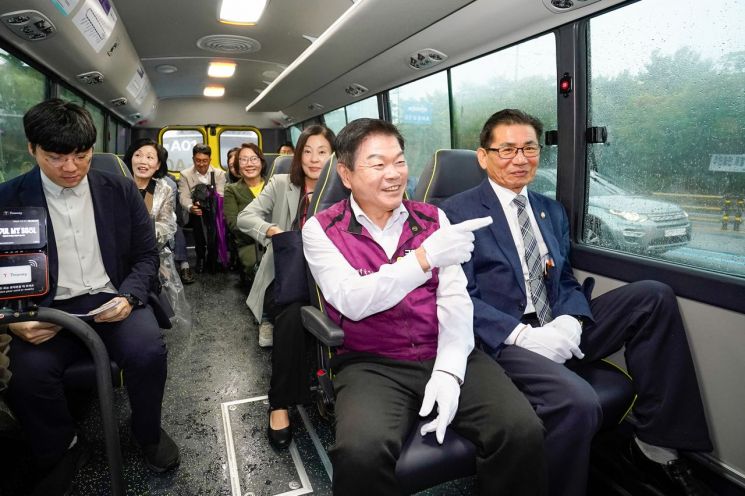 A self-driving bus under trial operation in Dongdaemun-gu. In the front row center is Lee Pilhyung, mayor of Dongdaemun-gu. Provided by Dongdaemun-gu.
The self-driving bus operates on a round-trip 15-kilometer route starting from Janghanpyeong Station on Subway Line 5, passing through Jeonnong Intersection, Cheongnyangni Station, and the King Sejong Memorial Hall, and ending at Kyung Hee Medical Center, serving a total of 23 stops. On weekdays (Monday to Friday), the bus runs six times a day, with the first departure at 9 a.m. and the last at 6:15 p.m. (based on the final stop). All rides will be free until the first half of next year, after which a fare will be charged.
Before the official launch, an opening ceremony and test ride event were held on the afternoon of the 13th in the rain, attended by Mayor Lee Pilhyung, district officials, and city and district council members. After the ceremony, participants boarded the self-driving bus in front of the district office and traveled a 3-4 kilometer section. They commented, "It was fascinating to see the bus stop and start on its own," and "Seeing autonomous driving technology applied to everyday public transportation makes the city of the future feel like a reality."
Dongdaemun District established its autonomous transportation infrastructure after being selected for a Seoul city project and designated as a pilot operation zone by the Ministry of Land, Infrastructure and Transport. The 15-kilometer round-trip route in Dongdaemun District is the longest among the three districts in Seoul operating self-driving buses, and is notable for connecting transportation blind spots in Jangandong and Jeonnongdong with medical institutions, schools, and transit hubs into a single living axis.
Lee Pilhyung, Mayor of Dongdaemun District, stated, "The launch of this self-driving bus is a new milestone for transportation in the northeastern region and an important step toward becoming a future-oriented city," adding, "We will continue to innovate so that residents can enjoy safer and more convenient mobility services."
"25% Manual Driving · Operation Level is Level 3"
Although it is a self-driving bus, a driver is present, and a service manager also boards separately. In regulated zones such as child protection or senior protection areas, the bus must switch to manual driving according to relevant laws and respond to unexpected situations. In addition, the service manager rides along to provide passenger guidance and oversee safety, preparing for any potential accidents.
Lee Byungjin, team leader at Autonomous A2Z, the company that developed the self-driving bus, said, "In accordance with relevant laws, 25% of the entire route is operated manually, while 75% is autonomous. As the technology advances and the system stabilizes, the service manager will eventually be excluded."
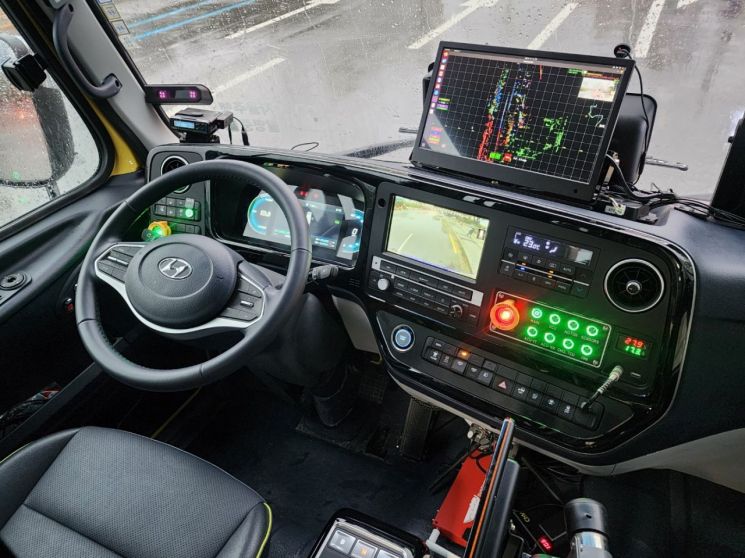
According to district officials, the self-driving bus is based on Hyundai County Electric vehicles and recognizes its surroundings 360 degrees using cameras and radar. The current operation stage is conditional autonomous driving (Level 3), meaning the driver can immediately intervene in emergencies, and the service manager rides along to guide passengers and manage safety.
Plans to improve accessibility for transportation-vulnerable groups will be implemented in stages. Although wheelchair boarding is currently restricted due to the vehicle's structure, the district is considering expanding boarding and alighting facilities for transportation-vulnerable individuals after analyzing route data in the future.
The current interval between buses is 75 minutes. The district stated that the initial focus is on ensuring stable operation, but gradual reduction of the interval will be considered based on operational data from next year onward.
Enhanced Safety and Accident Response System
Mayor Lee repeatedly emphasized two points: resolving transportation blind spots and improving daily convenience. He said, "We have established a new route in an area with a large floating population but poor transportation due to railway barriers, and since it is operated free of charge, we expect a very positive response from residents. Going forward, we will expand routes and advance technology to develop Dongdaemun District into a leader in smart mobility."
This pilot project will run until July 2028. During this period, safety, economic feasibility, and resident satisfaction will be verified, and the district will consult with Seoul City and related agencies on whether to continue operations. The current vehicle in operation is a modified Hyundai County electric vehicle, which is structurally difficult for wheelchair boarding. The district and the company stated that they will continuously review the expansion of boarding and alighting facilities based on future route operation data.
Infants under the age of 6 are not allowed to board due to safety concerns such as vehicle movement and sudden stops. Children under 14 must be accompanied by a legal guardian. While experiences may vary, many users reported a feeling of sudden braking or abrupt stops when the vehicle starts or stops.
The district has established a response system in case of accidents. In the event of an accident, an emergency contact network will be activated to cooperate with the police, fire department, and operating agencies, and accident reporting will be conducted in accordance with the Ministry of Land, Infrastructure and Transport's autonomous vehicle accident reporting standards. All self-driving buses are covered by liability insurance. The district stated that it has comprehensively prepared for the entire process, from prevention and immediate response to prompt compensation.
Currently, three districts in Seoul-Dongdaemun, Seodaemun, and Dongjak-are operating self-driving buses. Seodaemun District also began operations on the 14th, with the Seodaemun A01 bus serving Seodaemun Culture and Sports Center, Seodaemun General Social Welfare Center, Seodaemun District Office and Health Center, and Gajwa Station. The bus circulates 10 stops (5.9 kilometers round-trip), running 14 times a day at 30-minute intervals (80 minutes during lunchtime) on weekdays only. The first bus departs at 9:20 a.m., and the last bus leaves Seodaemun Culture and Sports Center at 4:40 p.m.
The Dongjak A01 route, Seoul's first autonomous village bus, began operation in June and runs between Soongsil University and Chung-Ang University.
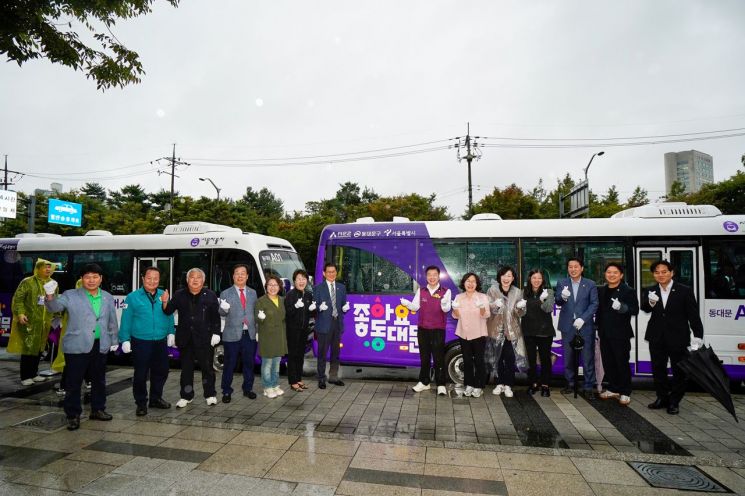 Dongdaemun District held an opening ceremony on the afternoon of the 13th ahead of the official launch of the autonomous bus service on the 14th. Provided by Dongdaemun District.
© The Asia Business Daily(www.asiae.co.kr). All rights reserved.














