Recovery and Rehabilitation Challenges for Returning Israeli Hostages
Hostage in His 20s Suffers Severe Injury, Loses Sight in One Eye
Medical Experts: "Survivors, Families, and Society Must Recover Together"
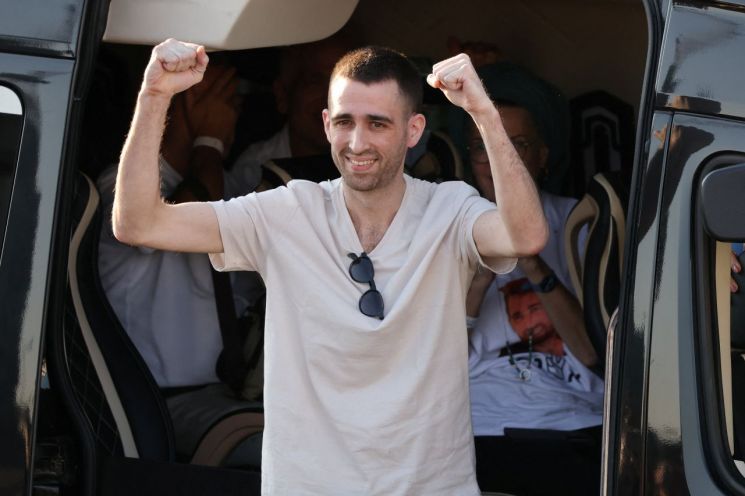 Returned hostage Avinatan Orga arrived at Rabin Medical Center-Beilinson Hospital in Petah Tikva, Israel, on the 13th (local time), raising both hands and showing an emotional expression. He was abducted and held captive during Hamas's attack on October 7, 2023. Photo by Reuters Yonhap News
As 20 Israeli hostages who endured 737 days under extreme conditions in Gaza returned home, their recovery and rehabilitation have become major priorities.
According to The Guardian on the 13th (local time), the returning hostages are men aged between 21 and 48, but their specific health conditions have not yet been disclosed.
The Israeli Ministry of Foreign Affairs reported that among those released, 24-year-old Alon Ohel suffered a severe injury resulting in blindness in one eye. It is believed that shrapnel struck his eye when the place where he was held was attacked.
After being handed over to the International Committee of the Red Cross (ICRC), the returning survivors were transported to the Reim military base in southern Israel, where they reunited with their families and underwent initial health checkups. If necessary, they are urgently airlifted by helicopter to one of three hospitals: Sheba, Ichilov, or Rabin.
According to the Associated Press, one hostage testified that he was kept in chains throughout his captivity by Hamas, with moldy bread as his only food. Another returning hostage, Rom Breslavski, appeared visibly emaciated and begged for his life in tears in a video released by Hamas last July, causing shock.
While some of the returnees appeared healthy, smiling and waving, The Jerusalem Post reported that this could be due to the euphoria of finally escaping prolonged coercion and the fear of death in extreme conditions, or the effects of sudden hormonal changes brought on by the abrupt change in environment.
 A former hostage who was held captive by the armed faction Hamas in the Gaza Strip and later released is being transferred to Ramat Gan Hospital in Israel on the 13th (local time). Photo by Xinhua News Agency
Medical experts agreed that the psychological and physical aftereffects experienced by these individuals could be long-lasting.
Dr. Hagai Levine, who leads the dedicated health team for hostage families, told The Guardian, "We have repeatedly warned about the serious risks to the health of the hostages and their families." He added, "Now that all the hostages have returned, we must begin the full rehabilitation process. Survivors, their families, and society as a whole must recover together."
Yael Frenkel Nir, deputy director of Sheba Medical Center, Israel's largest medical institution, told The Jerusalem Post, "It is clear they were detained for many days, but they are in a condition that allows them to reunite with their families. They will continue to undergo comprehensive examinations depending on their future health status."
Rabin Medical Center, Israel's second-largest medical institution, has established a new "Returning Hostages Department" focused on the rehabilitation of the returnees. According to the hospital, the returned hostages are receiving specialized treatment from a multidisciplinary team of physical therapists, speech therapists, occupational therapists, psychologists, and nutritionists. Accommodation within the hospital ward will also be provided for the families of the hostages.
The Israeli Hostages and Missing Families Forum emphasized, "Release is not the end, but the true beginning of recovery," and stressed, "Since their bodies and minds have been damaged over a long period, recovery in a safe and respectful environment is essential."
© The Asia Business Daily(www.asiae.co.kr). All rights reserved.













