Joel Mokyr: “Korea’s success comes from openness and technology inflow... Low birth rate is the only risk”
Peter Howitt: “The inflow of new ideas and innovation is the solution to low birth rates”
Split views on AI... Howitt: “Regulation is necessary,” Mokyr: “It’s just a tool”
Joel Mokyr (79), professor at Northwestern University, and Peter Howitt (79), professor emeritus at Brown University-both selected as co-recipients of this year’s Nobel Prize in Economic Sciences-identified “openness” as the driving force for Korea’s continued economic growth. They analyzed that cross-border openness and world-class technology are the sources of Korea’s economic success.
The two professors also pointed to the ultra-low birth rate and super-aging population as the most pressing challenges facing Korea. They advised that, along with efforts to raise the birth rate, opening borders to attract foreign technology and research talent could be a solution.
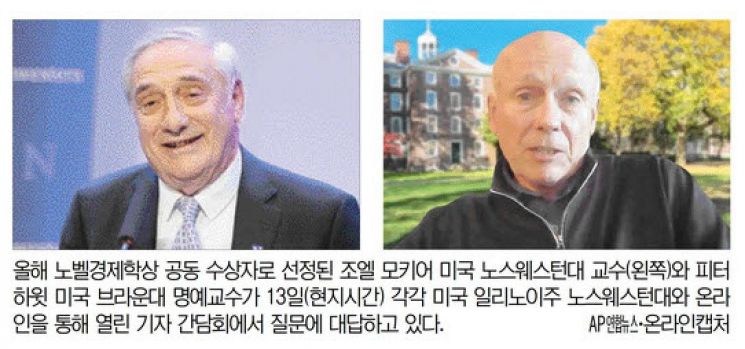
Mokyr: “Openness is the engine of Korea’s growth... The only challenge is the world’s lowest birth rate”
At a press conference held at Northwestern University in Illinois, USA, on the 13th (local time) immediately after the award announcement, Professor Mokyr responded to questions from Korean reporters about innovation and sustainable growth in Korea: “Korea is a successful country and must continue to keep its borders open and remain connected to the world’s best technology, just as it has done so far,” he said. “The only problem is that Korea has the lowest birth rate on the planet, so more children need to be born.”
He cited Korea’s active absorption of world-leading technology through open borders as a key factor in its success. “In the 1950s, Korea’s per capita income was very low, but today it has achieved miraculous growth and joined the ranks of wealthy nations,” he said. “Korea must continue to open its borders and remain connected to the world’s top technology as it has done until now.” As an example of technological innovation, he mentioned the automobile industry: “They (Koreans) make cars that keep running and running. While there are concerns about the future of the Korean economy, many countries would want to trade places with Korea,” he remarked.
Professor Mokyr identified low birth rates as the sole threat to Korea’s growth. “Korea has the lowest fertility rate on earth,” he said, citing the low birth rate and demographic changes as the main issues that could lead to growth stagnation.
He also noted that support from the United States, Korea’s ally, has contributed to Korea’s success amid geopolitical risks posed by proximity to China. “Korea is a small country right next to a very large one, and that (geopolitical position) hasn’t always worked in its favor,” he said. “Korea was able to escape poverty thanks to support from the United States. That’s what had to be done.” He added that he often uses the differences between North and South Korea’s systems as a topic in his lectures: “A country with rational institutions will always do much better than one with poor institutions.”
 Joel Mokyr, professor at Northwestern University in the United States and recipient of the 2025 Nobel Prize in Economic Sciences, held a press conference on the 13th (local time).
Howitt: “Openness beyond borders is also the solution to Korea’s low birth rate... Dynamism must be restored through antitrust policy”
At an online press conference held the same day, Professor Howitt was asked about the limits of innovation in aging countries like Korea. “The key to solving Korea’s aging problem is openness to outside ideas,” he replied. “You must remain open so that the inflow of new ideas and innovation is not restricted.” He added, “Innovation generally tends to be more active among younger generations, so aging can be a disadvantage for innovation overall. However, not all ideas in a country necessarily originate domestically. Ideas can flow across borders, and academia can be an important channel for that.” This implies that Korea can secure innovation drivers through international openness, such as attracting foreign technology and research talent and accepting immigration.
Professor Howitt also emphasized the importance of strong antitrust policy as a way to foster innovation in Korea’s manufacturing- and conglomerate-centered economy. He noted that even in the United States, monopolistic power has grown in certain industries and is restricting innovation. “Joseph Schumpeter once argued that monopoly was a driver of innovation, but our research has shown that escaping competition is a stronger incentive for innovation,” he explained. “The fiercer the competition, the greater the incentive for incumbent market leaders to keep innovating and stay ahead. This is what successful countries like Korea should focus on if they want to continue innovating in the future.”
Regarding former U.S. President Donald Trump’s push for stronger protectionism, Professor Howitt expressed concern that it could hinder innovation. “Maintaining openness in trade is important,” he said. “Extreme changes or restrictions in the trade environment can shrink market size and weaken incentives for research and development (R&D) and innovation.” He also stressed, “We must avoid trade wars and diversify trading partners to keep markets open.” In particular, for export-dependent countries like Korea, “Active trade allows you to learn from the technologies of other countries. If some trading partners try to reduce trade, you should look for other partners.”
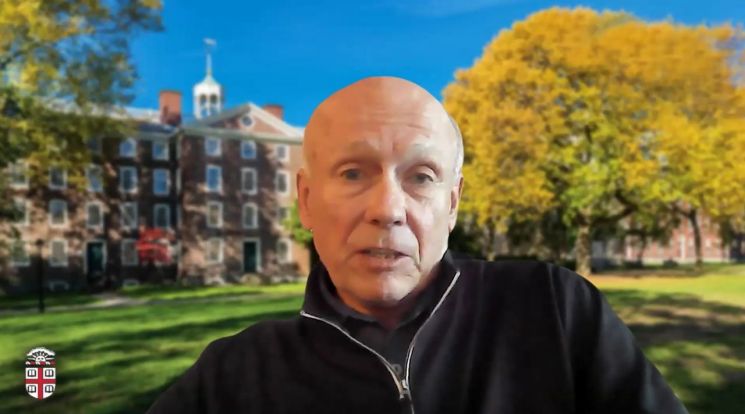 Peter Howitt, professor at Brown University in the United States and co-recipient of the 2025 Nobel Prize in Economic Sciences, held an online press conference on the 13th (local time).
Split opinions on AI... Howitt: “Regulation is necessary,” Mokyr: “It’s just a tool”
The two professors had somewhat differing views on the prospects of artificial intelligence (AI), which is driving technological innovation.
Professor Howitt said, “AI could become another general-purpose technology, following electricity, the steam engine, and the IT revolution of the 20th century.” However, he noted, “We are currently in a ‘big shakeout period’ where it’s unclear who will take the lead or where the effects of creative destruction will head.”
He acknowledged that while AI is a technology with tremendous potential and possibilities, it also carries the risk of replacing or destroying many jobs. “This conflict can only be resolved through regulation. Private incentives in an unregulated market are unlikely to resolve this conflict in the way that is best for society,” Professor Howitt said.
In contrast, Professor Mokyr took a more optimistic view of AI. “AI is not a monster that will destroy humanity and take over the planet-it’s just a tool,” he said. “The idea that machines could be more intelligent than humans is completely absurd. AI can aggregate and process information quickly, but it lacks human initiative, intuition, and ambition.” He continued, “Just as advances in tools like the microscope, telescope, and laser have driven scientific progress, AI is simply one of those tools.”
Regarding the impact of AI on the labor market, Professor Mokyr predicted, “Machines do not replace humans; rather, they allow us to engage in more interesting and challenging work. As AI takes over (simple) work, humans will move to higher-level jobs.” He also argued that the biggest threat is not “technological unemployment” but “labor scarcity.” “There are fewer people to work and pay taxes, and more people receiving social security benefits,” he said. “If the demographic structure cannot solve this, technology will have to do it instead.”
On this day, the Royal Swedish Academy of Sciences’ Nobel Committee selected Professors Howitt and Mokyr, along with Philippe Aghion, professor of economics at the London School of Economics, as this year’s Nobel laureates in Economic Sciences. The committee explained that Professor Mokyr was recognized for his theoretical work on how technological innovation forms the foundation for long-term economic growth. Professors Aghion and Howitt were highly regarded for establishing the theory of sustainable growth through “creative destruction,” explaining how innovation and competition drive economic development.
© The Asia Business Daily(www.asiae.co.kr). All rights reserved.
![User Who Sold Erroneously Deposited Bitcoins to Repay Debt and Fund Entertainment... What Did the Supreme Court Decide in 2021? [Legal Issue Check]](https://cwcontent.asiae.co.kr/asiaresize/183/2026020910431234020_1770601391.png)

















