NH-Amundi Asset Management Selects Beneficiaries of Korea's Major Transformation
Investing in Structurally Growing Industries Driven by the Three Major Transformations: AX, CX, and GX
NH-Amundi Asset Management has launched the "Growth-Driven Korea Fund," targeting the structural transformation of Korean industries. As the government's "KOSPI 5000" vision and capital market system reforms are gaining momentum, this product invests in industries expected to drive growth. The fund will selectively invest in the most preferred domestic companies through team-based active management. The company has identified the AI transformation, capital market transformation, and green transformation as the structural growth engines of the Korean economy.
On October 14, NH-Amundi Asset Management held a press conference at the Korea Financial Investment Association in Yeouido, Seoul, to announce the background and management strategy of the Growth-Driven Korea Fund.
Gil Jeongseop, CEO of NH-Amundi Asset Management, stated, "The government is strongly promoting the leap forward of the Korean capital market by presenting the KOSPI 5000 era as a national vision," adding, "Amid these changes, we have prepared a product that will discover future growth engines for the Korean economy and invest in companies expected to benefit from government policies."
He continued, "NongHyup Mutual Finance, NH NongHyup Bank, and NH Investment & Securities have decided to invest a total of 25 billion won in seed money for the Growth-Driven Korea Fund," and added, "This demonstrates our commitment to responsible management by directly investing group affiliates' funds."
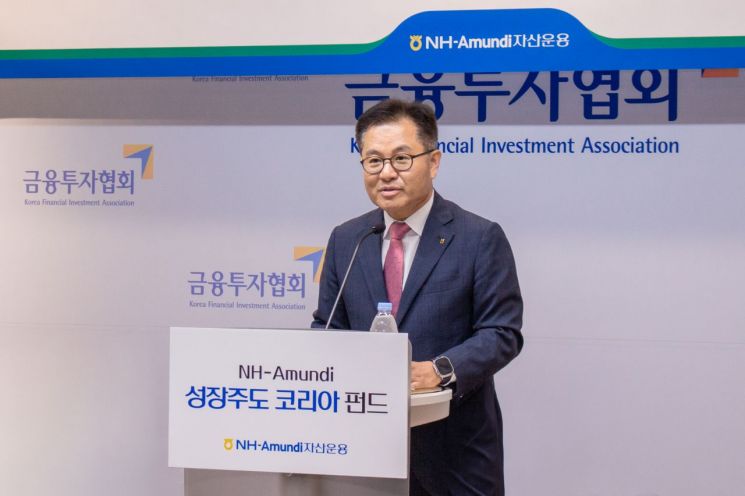 Gil Jeongseop, CEO of NH-Amundi Asset Management, is introducing the newly launched "Growth-Driven Korea Fund."
◆AX·CX·GX: The Three Major Transformations, New Engines for the Korean Economy
The announcement of the Growth-Driven Korea Fund strategy was led by Park Jin-ho, Head of Equity Investment at NH-Amundi Asset Management. He assessed that Korea is entering a phase of three major transformations: the AI transformation (AX), capital market transformation (CX), and green transformation (GX).
AX refers to the industrial transformation driven by the advancement and proliferation of AI. AI technology is evolving beyond the generative stage to agents and even physical AI, with explosive growth in computational and token demand. Token demand, which was only 2,559 trillion last year, is expected to grow at an average annual rate of 334% to reach 17,079 quadrillion by 2030. The importance of platforms related to AI semiconductors, including high-bandwidth memory (HBM), servers, and power infrastructure, is being highlighted.
Capital market transformation (CX) involves changes that fundamentally reshape the Korean capital market, including value-up policies for companies, amendments to the Commercial Act, expanded dividends, governance improvements, and increased supply of venture capital by financial institutions.
Green transformation (GX) refers to the simultaneous expansion of investments in nuclear power, renewable energy, energy storage systems (ESS), and power grids, driven by surging electricity demand and the pursuit of carbon neutrality.
Park Jin-ho explained, "With the new government's deregulation and infrastructure expansion policies, the business environment for companies is improving, which is expected to provide long-term growth momentum for Korean industries that play a key role in global supply chains." He added, "We will broadly diversify investments across structurally growing industries while using competitive analysis to select the most preferred stocks in each sector."
◆'Preferred Stock Selection' Through Industry Competitiveness Analysis
The Growth-Driven Korea Fund invests in industries expected to benefit from the three major transformations: AI semiconductors and infrastructure, defense, shipbuilding, energy, and capital market advancement. The strategy is to focus on the most preferred stocks in each sector that possess global competitiveness and growth potential.
In the AI semiconductor and infrastructure sector, investment targets include companies producing HBM and AI semiconductor packaging, as well as manufacturers of multilayer printed circuit boards (MLB) for high-performance servers. Korean companies are recognized for their technological capabilities, to the extent that they have signed long-term contracts with major big tech companies such as Nvidia, Google, and Microsoft. In the power infrastructure field, companies producing high-voltage and specialized power equipment such as transformers and circuit breakers, as well as AI software platform companies, are included in the portfolio.
The defense sector is expected to benefit from the global trend of increasing defense budgets due to heightened geopolitical risks. As the defense spending of NATO member countries remains below the recommended 5% of GDP, an additional defense expenditure of approximately 690 billion dollars (about 96 trillion won) is projected. Korean defense companies are expanding their presence in the global market by securing large export contracts with Poland, Romania, Australia, and others, leveraging the superior performance and price competitiveness of products such as the K9 self-propelled howitzer, K2 tank, and Redback armored vehicle.
The shipbuilding sector is experiencing a boom as demand for LNG transportation surges, maritime cargo volume increases, and demand for naval vessels rises. Global demand for LNG carriers is expected to fall short by 300 to 400 ships annually after 2028. Korean shipbuilders possess world-class construction capabilities in LNG carriers, container ships, offshore plants, and naval vessels. Additional benefits are anticipated from the United States' Maritime Administration Shipyard Grant Assistance (MASGA) project.
In the energy sector, investment targets include companies across the entire spectrum of nuclear power, solar power, and ESS. The expansion of nuclear power investment by global big tech companies and the carbon neutrality policies of various governments are driving a surge in energy infrastructure investment. Korean companies are securing competitiveness across the entire energy value chain, from nuclear power plant construction and small modular reactor (SMR) development to solar panels and ESS systems.
Beneficiaries of capital market advancement include large holding companies and their affiliates. These companies are expected to be re-evaluated in terms of corporate value due to improved shareholder rights and expanded dividends resulting from amendments to the Commercial Act, as well as improved profitability through business structure reorganization.
NH-Amundi Asset Management selects stocks within these industries through close collaboration between its management and research teams. By adopting a team-based active management approach, the company closely analyzes industry competition and selects the most preferred stocks in each sector. Rather than simply diversifying across growth industries, the strategy is to "select and concentrate" by investing in the most competitive companies within each industry.
Park Jin-ho stated, "We will respond to market changes by utilizing various model portfolios developed through collaboration between our research and management teams," adding, "Our goal is to return the benefits of Korea's transformation to investors through the Growth-Driven Korea Fund."

© The Asia Business Daily(www.asiae.co.kr). All rights reserved.
![User Who Sold Erroneously Deposited Bitcoins to Repay Debt and Fund Entertainment... What Did the Supreme Court Decide in 2021? [Legal Issue Check]](https://cwcontent.asiae.co.kr/asiaresize/183/2026020910431234020_1770601391.png)
















