Sponsor Lost in Lower Courts, Supreme Court Returned Case for Retrial Last Year
Discrepancy Between Donor's Understanding of Agreement and Actual Use Constitutes "Mistake"
The court has ruled that the House of Sharing, a support facility for victims of Japanese military sexual slavery, must return donations to a sponsor. This decision follows the Supreme Court's judgment that the actual use of the donations differed from their intended purpose.
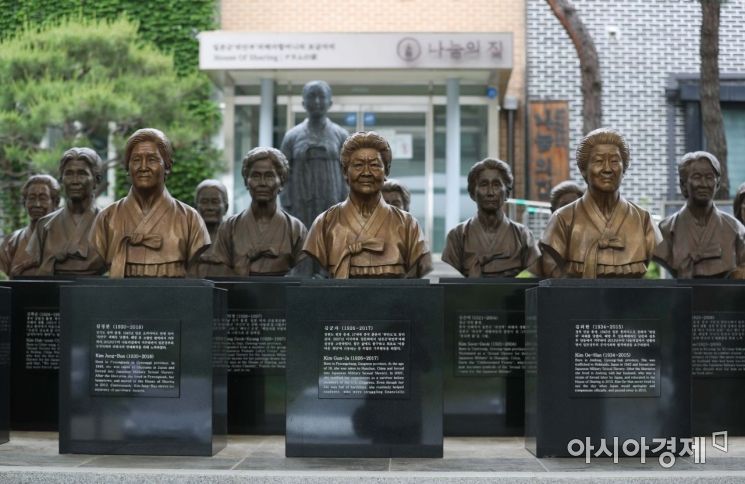 On the 25th, when the second press conference of former Japanese military sexual slavery victim Lee Yongsoo was held, busts of the deceased comfort women victims were erected at the House of Sharing in Gwangju, Gyeonggi Province.
According to legal circles on October 12, the Seoul Central District Court’s Civil Appellate Division 9-2 (Presiding Judges Byun Jiyeong, Yoon Jaenam, and Noh Jinyoung) ruled partially in favor of the plaintiff in a retrial of the donation refund lawsuit filed by a sponsor, identified as Lee, against the House of Sharing on September 24.
The court ordered the House of Sharing to pay Lee 1.55 million won and delayed interest. In 2020, Lee, together with the "Task Force for the Refund of Donations to Comfort Women Victims," filed a lawsuit against the House of Sharing demanding the return of about 90 million won in donations.
At the time, both the House of Sharing and the Korean Council for Justice and Remembrance for the Issues of Military Sexual Slavery by Japan (Justice Council) faced allegations that donations were being accumulated as corporate reserves and not properly used for victims’ living expenses or welfare activities.
The first and second trials ruled against the sponsor, but in August of last year, the Supreme Court overturned the previous rulings and returned the case to the Seoul Central District Court, stating that "there is a recognized discrepancy between the purpose of the donation agreement and its actual use."
The Supreme Court pointed out, "There is a degree of discrepancy between the purpose of the donation agreement indicated by the defendant (House of Sharing) and understood by the plaintiff (Lee), and the actual use of the donations, which can be considered a mistake. If the plaintiff had not been under this misapprehension, she would not have entered into the agreement."
The retrial court reached the same conclusion. The court stated, "The plaintiff likely entered into the agreement believing that most of the donations would be used for the living expenses, welfare, and testimony activities of the comfort women victims. If an average donor had known that most of the funds would be held as corporate reserves, they would not have chosen to donate."
The court added, "Since there is no evidence that the plaintiff’s mistake resulted from gross negligence, the contract can be canceled on the grounds of mistake."
Lee was originally one of 23 sponsors but continued the lawsuit alone after losing in the first and second trials. With this ruling, the first donation refund lawsuit against the House of Sharing has effectively concluded.
Similar lawsuits against the Korean Council for Justice and Remembrance for the Issues of Military Sexual Slavery by Japan (the predecessor of the current Justice Council) and former lawmaker Yoon Mihyang are still ongoing. In January of this year, the Seoul Western District Court recommended a settlement for the return of donations to the Justice Council and former lawmaker Yoon, but as Yoon’s side objected, the trial continues.
Former lawmaker Yoon was indicted on charges of embezzling donations from the Justice Council and, last year, the Supreme Court finalized her sentence at one year and six months in prison, suspended for three years.
© The Asia Business Daily(www.asiae.co.kr). All rights reserved.

















