Vietnam, Laos, and Indonesia Attend
Showcasing That It's "Not Just China and Russia"
Diplomatic Outreach Expands to ASEAN
Concerns Rise Over Weakened Sanctions
On the occasion of the 80th anniversary of the founding of the Workers' Party, North Korea is attempting a return to the diplomatic stage by inviting a large number of delegations not only from China and Russia but also from ASEAN (Association of Southeast Asian Nations) countries such as Vietnam, Laos, and Indonesia.
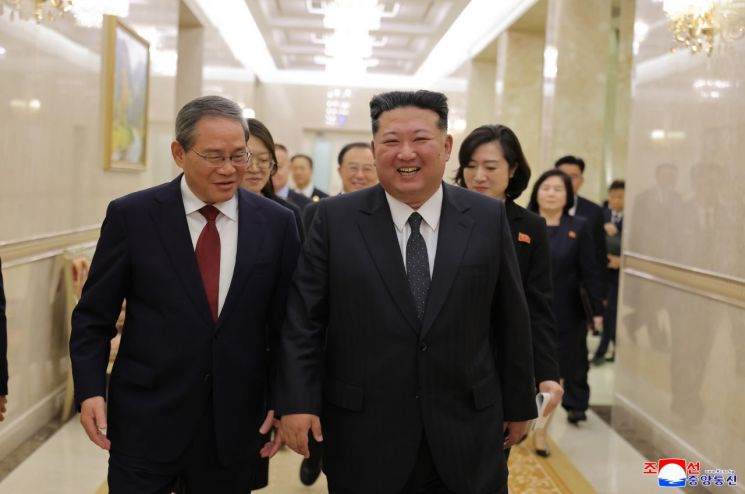 Kim Jong Un, Chairman of the State Affairs Commission, met with Li Chang, a member of the Standing Committee of the Political Bureau of the Central Committee of the Communist Party of China and Premier of the State Council of China, who is leading the Chinese Communist Party and government delegation on an official friendly visit to North Korea on the 9th, and exchanged friendly talks, reported Korean Central News Agency on the 10th. Yonhap News Agency
This move is seen as an effort to ease diplomatic isolation by restoring relations with ASEAN countries, now that North Korea's status as a nuclear-armed state has been effectively accepted as a fait accompli, and to further highlight its image as a "normal state."
According to the Ministry of Unification and foreign media reports on October 12, delegations from 11 countries visited Pyongyang for the event, including Chinese Premier Li Qiang, Russian Deputy Chairman of the Security Council Dmitry Medvedev, Vietnamese Communist Party General Secretary To Lam, and Lao President Thongloun Sisoulith.
The visits by the top leaders of Vietnam and Laos mark the first in 18 and 14 years, respectively, while the Indonesian foreign minister's visit is the first in 12 years since 2013. At the 80th anniversary military parade of the Workers' Party, North Korean State Affairs Commission Chairman Kim Jong Un was flanked by Premier Li Qiang and General Secretary To Lam, with Russian Deputy Chairman Medvedev standing beside them.
It is interpreted that, whereas Chairman Kim previously showcased the "North Korea-China-Russia trilateral alliance" at China's Victory Day parade, this time in Pyongyang he orchestrated a scene of multilateral diplomacy centered around himself.
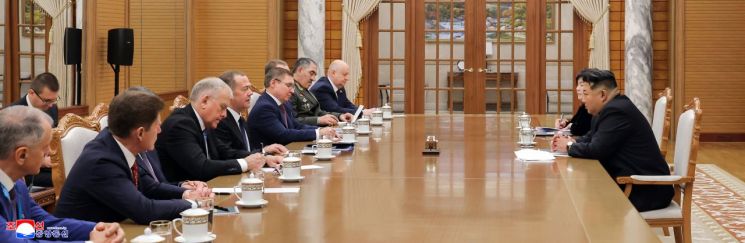 Kim Jong Un, Chairman of the State Affairs Commission, met with Dmitry Medvedev, Chairman of the United Russia Party, who is visiting North Korea to mark the 80th anniversary of the founding of the Workers' Party, the Korean Central News Agency reported on the 11th. Yonhap News Agency
North Korea held a series of meetings with these visiting dignitaries, restoring bilateral exchanges and signing cooperation documents in areas such as the economy, defense, and health. The Korean Central News Agency reported that Foreign Minister Choe Son Hui and Defense Minister No Kwang Chol exchanged cooperation agreements with Vietnamese Defense Minister Phan Van Giang and Acting Foreign Minister Le Hoai Trung. However, the specific details were not disclosed, and some have raised concerns that these agreements could potentially violate United Nations sanctions resolutions.
In his speech at the pre-event celebration, Chairman Kim stated, "The international prestige of our republic is growing stronger day by day," expressing confidence. In his speech at the military parade, he emphasized his commitment to solidarity with non-Western countries such as China and Russia by declaring, "We will defend justice and peace with our powerful revolutionary forces."
Experts believe that North Korea is seeking to restore relations with socialist and non-Western countries by taking advantage of the multipolar international order amid U.S.-China tensions.
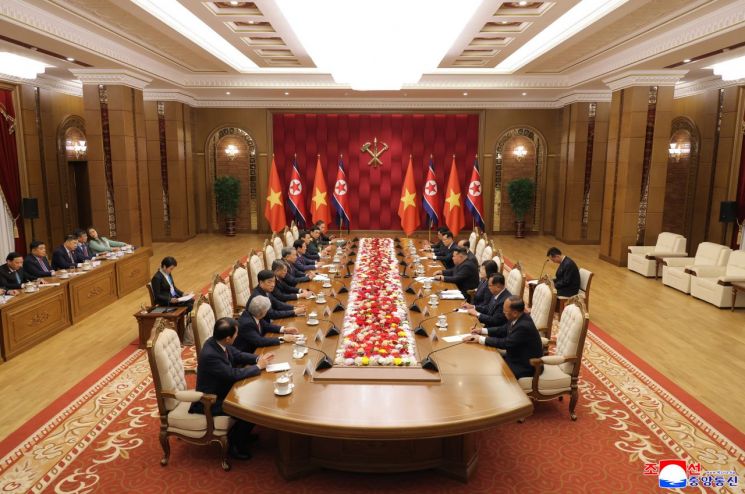 North Korean State Affairs Commission Chairman Kim Jong Un held talks with Vietnam Communist Party Central Committee General Secretary To Lam on the 9th and hosted a welcoming banquet, according to Korean Central News Agency on the 10th. Yonhap News Agency
Lim Eulchul, a professor at Kyungnam University's Institute for Far Eastern Studies, analyzed, "The visits by ASEAN countries reflect the perception that the effectiveness of sanctions against North Korea has weakened," adding, "There is a growing atmosphere in which North Korea's expanding influence is not being checked."
Meanwhile, at this parade, North Korea unveiled its new Hwasong-20 intercontinental ballistic missile (ICBM), simultaneously sending a military message targeting the United States. The ruling United Russia Party of Russia explicitly stated in a joint statement with the Workers' Party of Korea that it "supports North Korea's measures to strengthen its national defense," effectively condoning North Korea's nuclear development.
Through this event, North Korea appears to be seeking to solidify its image as a "nuclear-armed normal state" by broadening its diplomatic spectrum not only with China and Russia but also with ASEAN countries. However, it remains uncertain whether these moves will lead to future negotiations with the United States or changes in the situation on the Korean Peninsula.
© The Asia Business Daily(www.asiae.co.kr). All rights reserved.
!["The Woman Who Threw Herself into the Water Clutching a Stolen Dior Bag"...A Grotesque Success Story That Shakes the Korean Psyche [Slate]](https://cwcontent.asiae.co.kr/asiaresize/183/2026021902243444107_1771435474.jpg)


















