Jeonnam Forest Research Institute, Collection Since 2020
Exhibiting Over 60 Species Under the Theme "Namdo Wildflower Collection Diary"
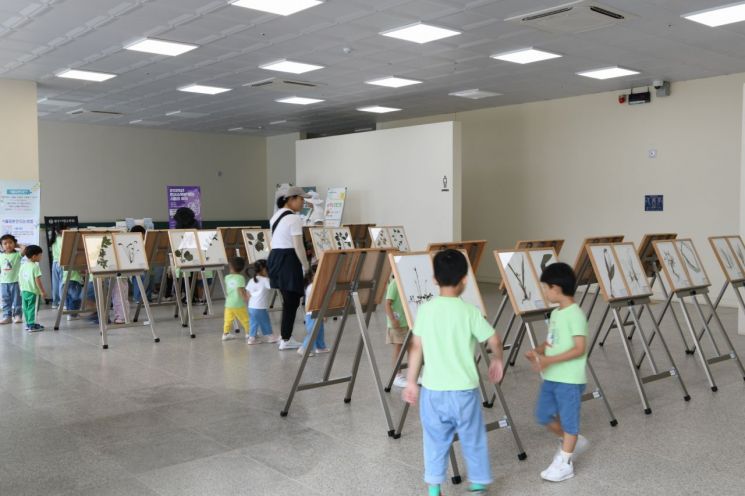 The Jeonnam Forest Research Institute is holding an exhibition titled "Namdo Wildflower Collection Diary" at the Gwangju Municipal Arboretum until the 31st. Provided by Jeonnam Province
The Jeonnam Forest Research Institute is exhibiting 60 rare and endemic plant specimens collected over five years of forest resource exploration since 2020, under the theme "Namdo Wildflower Collection Diary," at the Gwangju Municipal Arboretum until the 31st.
This exhibition is a jointly planned plant specimen exhibition by the Jeonnam Forest Research Institute and the Gwangju Municipal Arboretum, aimed at promoting accurate knowledge about the wildflowers of the Namdo region.
Since 2020, the Jeonnam Forest Research Institute has collected plant specimens from various locations, starting with Mount Illimsan in Boseong County, followed by Gamagol in Damyang County, Mount Baegunsan in Gwangyang City, Bulhoesa Temple in Naju City, Mount Chukryeongsan in Jangseong County, and Mount Sangwangsan in Wando County.
Through these efforts, the institute is gathering data on the natural habitats of Jeonnam's forest resources and using it as foundational material for discovering valuable forest resources.
In particular, the plants on display include 25 species of rare plants designated by the Korea Forest Service, such as the Korean fir and Magnolia sieboldii, as well as 35 species of endemic plants, including the Hallasan monkshood and Clematis brachyura.
According to the assessment and criteria for endangered plants presented by the International Union for Conservation of Nature (IUCN) in 2008, there are 571 species of rare plants native to Korea.
Endemic plants are unique species that grow only in specific regions, and the Korea Forest Service has designated 360 such species. Of these, 60 species collected from six regions, including Boseong, have been selected for this exhibition.
Oh Deuksil, Director of the Forest Research Institute, stated, "With this exhibition of rare and endemic plants as an opportunity, Jeonnam Province and Gwangju City will take the lead in actively cooperating on forest resource research."
The Jeonnam Forest Research Institute is also taking the lead in proactively responding to the Nagoya Protocol by exploring native habitats in major forests within the province, discovering valuable forest resources, and developing food, medicine, and fragrance products linked to the bioindustry.
The Nagoya Protocol is an international agreement that stipulates the fair sharing of benefits with resource-providing countries when using biological resources such as plants.
Additionally, through forest resource exploration, the institute discovered a yellow-fruited raspberry variant, registered it as a new variety called "Goldmoon" with the National Forest Variety Management Center, and is preparing for its second cultivation review next year (2026).
The results of the forest surveys are being systematically advanced through academic presentations and published papers, and the collected photographic materials are being compiled into plant field guides for Jeonnam (Mount Illimsan in Boseong County, Gamagol in Damyang County), which are distributed to city and county forest departments and forest research institutions, while also actively promoting the beautiful forest resources of Jeonnam Province.
© The Asia Business Daily(www.asiae.co.kr). All rights reserved.
![Clutching a Stolen Dior Bag, Saying "I Hate Being Poor but Real"... The Grotesque Con of a "Human Knockoff" [Slate]](https://cwcontent.asiae.co.kr/asiaresize/183/2026021902243444107_1771435474.jpg)
















