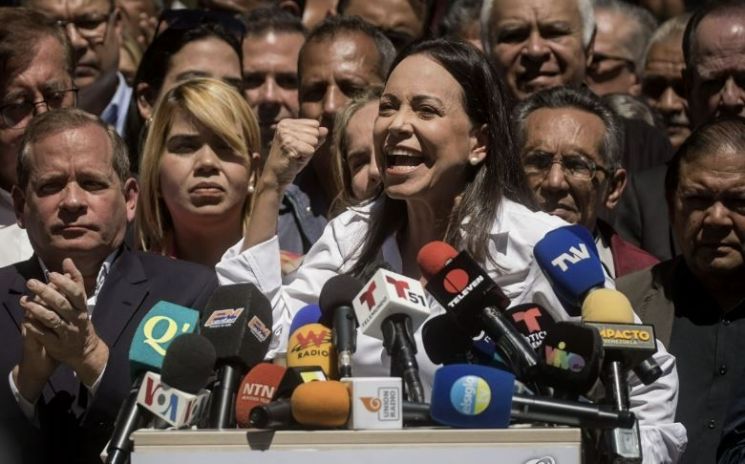
This year's Nobel Peace Prize has been awarded to Maria Corina Machado, a female opposition leader from Venezuela.
On October 10 (local time), the Norwegian Nobel Committee announced that Machado was selected as this year's Peace Prize laureate, recognizing her contribution to achieving a just and peaceful transition from a dictatorship to democracy.
The Nobel Peace Prize has been awarded a total of 106 times since its establishment in 1901. However, there were 19 occasions when no award was given, due to events such as World War I and World War II. These years include 1914-1916, 1918, 1923, 1924, 1928, 1932, 1939-1943, 1948, 1955-1956, 1966-1967, and 1972.
As of this year, there have been a total of 143 Nobel Peace Prize laureates: 112 individuals and 31 organizations. Among these, the prize was awarded solely to a single individual or organization 72 times, while 31 prizes were shared by two individuals or organizations. There have been three instances where three individuals or organizations shared the prize: in 1994 (Yitzhak Rabin, Shimon Peres, and Yasser Arafat), in 2011 (Ellen Johnson Sirleaf, Leymah Gbowee, and Tawakkol Karman), and in 2022 (Ales Bialiatski, Russian human rights organization Memorial, and Ukrainian civil society organization Center for Civil Liberties).
Among organizations, the International Committee of the Red Cross (ICRC) holds the record for the most awards, having received the prize three times-in 1917, 1944, and 1963. The United Nations High Commissioner for Refugees (UNHCR) received the prize twice, in 1954 and 1981. Henri Dunant, the founder of the ICRC, was also the first recipient of the Peace Prize.
Additionally, both the United Nations and the European Union (EU) have each been awarded the Peace Prize once.
No individual has received the Peace Prize more than once. However, American physical chemist Linus Pauling won the Nobel Prize in Chemistry in 1954 for his research on chemical bonds and the Nobel Peace Prize in 1962 for his anti-nuclear weapons activism, making him a laureate in two different fields.
With Machado's award this year, the number of female laureates has increased to 20. The first female recipient was Austrian author Bertha von Suttner, who advocated for peace and wrote the novel "Lay Down Your Arms" in 1905. The most recent female laureate before Machado was Iranian women's rights activist Narges Mohammadi in 2023.
The youngest laureate to date is Malala Yousafzai, a Pakistani human rights activist who survived a Taliban attack and received the prize in 2014 at the age of 17. The oldest recipient was Joseph Rotblat, a Polish-born British nuclear physicist who was awarded the Peace Prize in 1955 at the age of 87.
So far, only one person has ever declined the Nobel Peace Prize. In 1973, Le Duc Tho of North Vietnam was selected as a joint laureate with then-U.S. National Security Advisor Henry Kissinger for their role in leading the Paris Peace Accords, but he refused the prize, stating that "true peace had not yet been achieved in his homeland."
There have been five cases where laureates were imprisoned at the time of the award: German pacifist Carl von Ossietzky (1935), Myanmar politician Aung San Suu Kyi (1991), Chinese human rights activist Liu Xiaobo (2010), Belarusian activist Ales Bialiatski (2022), and Iranian activist Narges Mohammadi (2023).
Among Koreans, the only laureate is the late former President Kim Dae-jung. He received the Peace Prize in 2000 for leading reconciliation between North and South Korea and for his contributions to the advancement of democracy and human rights in Korea and East Asia.
© The Asia Business Daily(www.asiae.co.kr). All rights reserved.
![Clutching a Stolen Dior Bag, Saying "I Hate Being Poor but Real"... The Grotesque Con of a "Human Knockoff" [Slate]](https://cwcontent.asiae.co.kr/asiaresize/183/2026021902243444107_1771435474.jpg)











