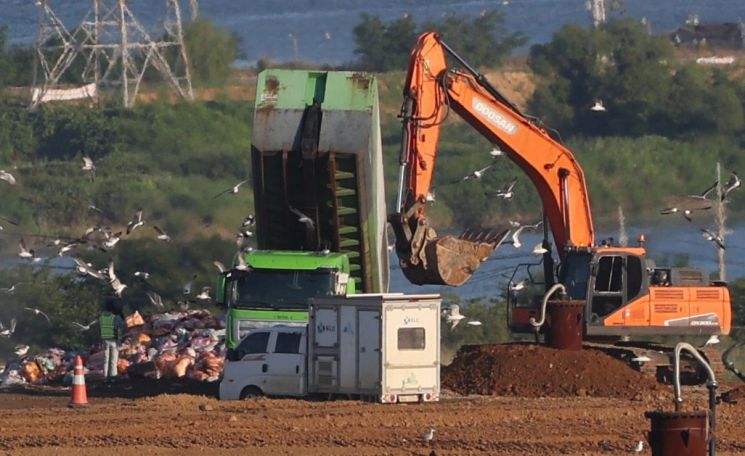
The fourth public call for applications to find a new landfill site to replace the metropolitan landfill in Seo District, Incheon, has finally secured applicants after four attempts.
The Ministry of Climate, Energy and Environment, Incheon City, Seoul City, and Gyeonggi Province announced that two private entities applied for the "Fourth Public Call for a Metropolitan Landfill Replacement Site," which was open until October 10. For the first time, this call lowered the entry barrier, allowing not only basic local governments but also individuals, corporations, organizations, and villages to participate.
However, specific details about the proposed sites and applicants have not been disclosed, as neither has reached an agreement with the relevant local governments.
Although this is the first time a candidate site has emerged in the fourth call, it is still expected to be difficult to finalize a new landfill location. With local elections scheduled for June next year, analysts say it is highly unlikely that heads of local governments will agree to establish a landfill in their jurisdictions.
The reason a new landfill must be found is that Incheon City wants to stop using the current Section 3-1 of the metropolitan landfill by the end of this year, which is when it is expected to reach its design capacity. In 2015, Incheon City, Seoul City, Gyeonggi Province, and the Ministry of Environment agreed to use the landfill only up to Section 3-1.
In the first and second calls in 2021 and the third call last year, there were no applicants at all. As a result, the requirements were significantly relaxed for the fourth call.
First, the minimum site area was set at 500,000 square meters (400,000 for landfill facilities and 100,000 for auxiliary facilities), which is about 55% of the previous requirement. In addition, even if the site area does not meet the standard, applications were allowed if the landfill capacity is at least 6.15 million cubic meters.
The requirement for "consent from more than 50% of household heads within a 2-kilometer radius of the candidate site" was removed. The installation of auxiliary facilities such as "waste-to-energy facilities" was also excluded from the mandatory requirements and will instead be determined through later consultations.
The local government hosting the landfill will receive at least 300 billion won in incentives. Additional incentives will be provided depending on the type and scale of auxiliary facilities. The government is also considering supporting key local projects at the national level.
Even if a new landfill is not finalized, the likelihood of an immediate waste crisis in the metropolitan area is low. This is because the four parties previously agreed that "if securing a replacement landfill is not possible, up to 15% (about 1.06 million square meters) of the remaining area of the metropolitan landfill can be used additionally."
Due to the implementation of the volume-based waste fee system in 1995, the ban on direct landfilling of food waste in 2005, and the ban on direct landfilling of large construction waste in 2022, the amount of waste brought to the landfill has been steadily decreasing.
Last year, about 1,072,000 tons of waste were brought to the metropolitan landfill, which is one-eighth of the 9,178,000 tons in 1995. This year, about 776,684 tons were brought in as of September.
The "ban on direct landfilling of municipal solid waste," which requires only residues after incineration or recycling to be landfilled, is also considered a variable. If this system is implemented, some analysts believe the operational period of Section 3-1 could be extended by several decades. Typically, when waste is incinerated and only ash is buried, the amount of landfill waste is reduced to 15-17% of the original volume.
According to the initial plan, direct landfilling of municipal solid waste in the metropolitan area was to be banned starting next year. However, due to insufficient incineration facilities, discussions are ongoing regarding the implementation timeline. Seoul and Gyeonggi Province are requesting a two-year grace period, while Incheon insists on implementing the ban as scheduled.
The Ministry of Climate, Energy and Environment plans to review the suitability of the sites submitted in the fourth call through a four-party consultative body, select "candidate areas," and prepare negotiation terms covering the types and scale of landfill and auxiliary facilities, the amount of special support funds, and support for key local projects, in order to persuade local governments.
Meanwhile, President Lee Jaemyung pledged during his presidential campaign to "convert the metropolitan landfill site into a space preparing for Incheon's future after its closure." However, the termination of the metropolitan landfill's use was not included among the 123 national policy tasks, leading to backlash from the local community.
© The Asia Business Daily(www.asiae.co.kr). All rights reserved.

















