Kim Byungki: "Witness Lists May Be Adjusted Even in Committees Where Selection Is Complete"
The Democratic Party of Korea has set forth three main principles regarding the selection of witnesses for the upcoming parliamentary audit, which is scheduled to begin on October 13. One of the key principles is to minimize the number of business leaders called as witnesses.
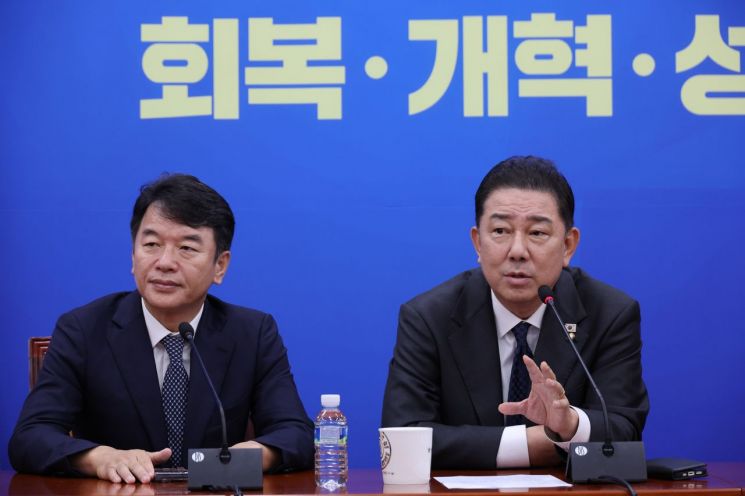
At a meeting on witness selection for the parliamentary audit held at the National Assembly in Yeouido on October 10, Floor Leader Kim Byungki outlined the three principles: minimizing business community witnesses, avoiding duplicate appearances as much as possible, and concentrating questioning within designated time slots.
Kim stated, "We plan to minimize calling business owners and CEOs as witnesses. There are cases where witnesses are summoned by multiple standing committees, but in such cases, the committee most relevant to the issue will focus its questioning."
He added, "Instead of having witnesses sit all day and only ask one or two questions, we intend to set specific questioning times, such as from 2 p.m. to 4 p.m., to eliminate the practice of making witnesses wait indefinitely as much as possible."
Even for standing committees where the witness selection process has already been completed, adjustments remain possible. Kim explained, "When we compiled the witness lists, we found a lot of overlap. There is no need to summon witnesses just to fill seats, especially business owners who are not essential to the issue at hand. We aim to make as many adjustments as possible."
Kim further clarified, "If there is a case where a business owner absolutely must attend as a witness, then they will certainly be required to appear. However, if the issue does not warrant it and other executives or staff can provide sufficient answers, we will not require owners or CEOs to attend."
Previously, both the ruling and opposition parties had requested business leaders such as SK Group Chairman Chey Tae-won, MBK Partners Chairman Kim Byungjoo, and KT CEO Kim Youngseob to appear as witnesses at the audit. In particular, criticism arose when the scheduled appearance of Chairman Chey, who is also chairing the APEC CEO Summit, at the National Policy Committee's audit on October 28 coincided with the opening day of the summit. The committee plans to question Chey regarding alleged unfair support among affiliates. When asked by reporters whether the three principles would apply to Chairman Chey's case, Kim replied, "Yes, they cover all such cases."
Meanwhile, the Democratic Party is planning to convene a plenary session during the audit period to process more than 60 non-contentious bills related to people's livelihoods. Kim noted, "The bill I regret the most is the 'emergency room transfer bill.' It really should have passed. At the very least, for bills agreed upon by both parties, we need to hold a plenary session in October to pass them."
He added, "Usually, plenary sessions are not held during the audit period, but that's because necessary bills are processed before the audit begins. If the bills have not been processed before the audit, then holding a plenary session is only natural."
© The Asia Business Daily(www.asiae.co.kr). All rights reserved.
![Clutching a Stolen Dior Bag, Saying "I Hate Being Poor but Real"... The Grotesque Con of a "Human Knockoff" [Slate]](https://cwcontent.asiae.co.kr/asiaresize/183/2026021902243444107_1771435474.jpg)











