Government Audit Scheduled for October 13-14
The National Assembly's Strategy and Finance Committee will conduct a government audit of the Ministry of Economy and Finance on October 13 and 14. This year, key agenda items include resolving the Korea Discount, the separate taxation of dividend income, government organizational restructuring, and tariff negotiations with the United States.
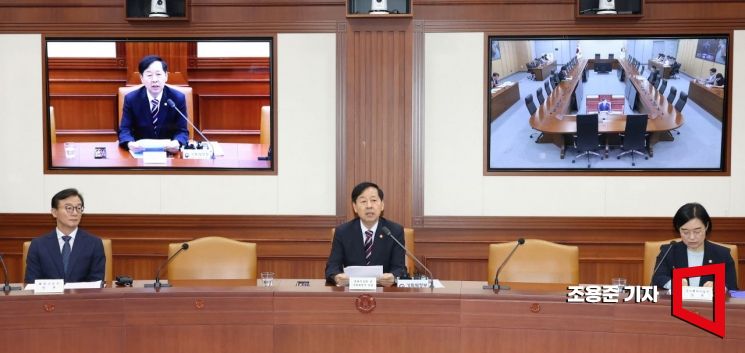 On October 2, Deputy Prime Minister and Minister of Economy and Finance Koo Yoon-chul attended the Economic Ministers' Meeting held at the Government Seoul Office in Jongno-gu, Seoul, where he spoke about consumer price trends and the Korea Sale Festa. Photo by Jo Yongjun
On the first day (October 13), the audit of economic and fiscal policy will focus on measures to address the "Korea Discount." The committee has selected Lotte Holdings President Koh Jungwook as a witness. Lotte Holdings is a leading holding company in Korea, but its price-to-book ratio (PBR) was only 0.36 as of June, making it a symbol of undervaluation. During the audit, questions are expected to focus on the reasons for the low PBR and the background behind the company's large holdings of treasury shares.
On the second day (October 14), the audit of tax policy will center on the separate taxation system for dividend income. In July, the government proposed applying a separate tax rate of up to 35% for companies with a dividend payout ratio of 40% or higher, or those with a payout ratio of 25% or higher and an increase in dividends of more than 5% compared to the three-year average. However, both the ruling and opposition parties criticized the plan for its lack of effectiveness and introduced their own bills. Lee Soyoung, a lawmaker from the Democratic Party, proposed an alternative to lower the top tax rate to 25%, arguing, "If we encourage companies to increase dividends, tax revenue could actually rise even with a lower tax rate." She has requested Lee Changhwan, CEO of Align Partners Asset Management, as a reference witness. Lee Changhwan has publicly emphasized that "the tax rate should be lowered further."
Questions are also expected to focus on the future of economic policy coordination and the direction of response. With the Ministry of Economy and Finance losing its authority over budget formulation and the failure to integrate financial functions, there are concerns that its role as the "economic control tower" at the vice prime minister level will be weakened. While the Ministry has stated, "We will consider ways to strengthen the overall economic policy function," skepticism is spreading internally that "coordination is impossible without policy tools." Tariff negotiations are also a major issue. While the Ministry of Trade, Industry and Energy and the U.S. Department of Commerce are leading the negotiations, the Korea-U.S. currency swap, considered a key variable in reaching an agreement, falls under the jurisdiction of the Ministry of Economy and Finance. Other major topics expected to be addressed include the sustainability of public finances, inheritance tax, and the accuracy of tax revenue estimates.
© The Asia Business Daily(www.asiae.co.kr). All rights reserved.

















