Only Pyongyang Standard Language Permitted
South Korean Accent Labeled as Servile and Disgusting
On October 9, Yonhap News reported that there has been a renewed emphasis within North Korea on strictly adhering to the use of 'Pyongyang Standard Language.' North Korea appears to be intensifying language control, expressing concern over the spread of South Korean expressions and foreign linguistic influences instead of its established standard language.
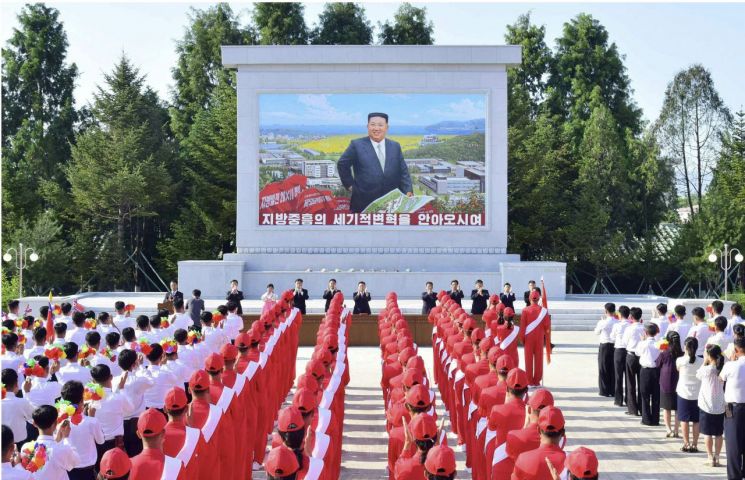 North Korea held mass rallies in each province to adopt 'Letters of Loyalty' addressed to Chairman Kim Jong Un on the occasion of the 80th anniversary of the founding of the Workers' Party (photo is for illustrative purposes and unrelated to the article content). Photo by Yonhap News.
According to Yonhap News, the latest issue of the linguistics journal 'Joseon Language and Literature,' published by North Korea's Science Encyclopedia Publishing House, features a paper by Associate Professor Kim Youngyun of the Department of Linguistics at Kim Il Sung University. The paper, titled "The Legitimacy of the Idea to Eliminate Exotic Elements in Language Life as Clarified by Respected Comrade Kim Jong Un," supports General Secretary Kim Jong Un's language-related directives.
Associate Professor Kim emphasized, "Every member of society must thoroughly reject exotic elements in both speech and writing, and must use Pyongyang Standard Language as the basis for communication." He pointed out that the use of unconventional expressions undermines the morality and cultural standards of North Korean society.
He particularly highlighted the value of Pyongyang Standard Language, stating, "Pyongyang Standard Language is a precious ideological and spiritual asset of our nation, thoroughly embodying subjectivity and national character." He further criticized, "Uncultured and exotic language expressions that violate our unique etiquette not only diminish the dignity of the speaker but also negatively impact the establishment of a refined and civilized language culture."
He also emphasized the excellence of the North Korean language, stating, "There is no language as fluent in sound and as capable of expressing complex ideas, delicate emotions, and subtle differences in phenomena as our language." He argued, "If we do not actively utilize this outstanding Pyongyang Standard Language and instead use non-native and exotic elements, we will not be able to maintain and enhance the excellence of our national language."
Professor Kim stressed that the issue of linguistic purity is not simply a matter of words, but a core element in protecting ideology and the system. He added, "Upholding the purity of Pyongyang Standard Language is not only about preserving the national character and purity of our language, but is also directly connected to safeguarding our ideology, culture, and system."
North Korea had already enacted the 'Pyongyang Standard Language Protection Law' in 2023, which defines South Korean expressions as 'puppet language remnants' and criminalizes their use. Under this law, even the use of the term 'oppa,' popularized by South Korean dramas, is prohibited. North Korea has also strongly criticized the South Korean accent, describing it as 'servile, affected, and unpleasant, with unnaturally prolonged and rising intonation.'
Experts interpret these measures as an attempt to block the influence of external content, which is spreading especially among the younger generation. There is analysis that the regime perceives the infiltration of South Korean speech patterns into everyday language through videos and smartphones as a threat to the system.
© The Asia Business Daily(www.asiae.co.kr). All rights reserved.

![Clutching a Stolen Dior Bag, Saying "I Hate Being Poor but Real"... The Grotesque Con of a "Human Knockoff" [Slate]](https://cwcontent.asiae.co.kr/asiaresize/183/2026021902243444107_1771435474.jpg)















