"Aimed at Preventing Circumvention of Export Controls"
China has introduced new measures to further strengthen export controls on rare earths, which are considered strategic minerals, as well as related technologies.
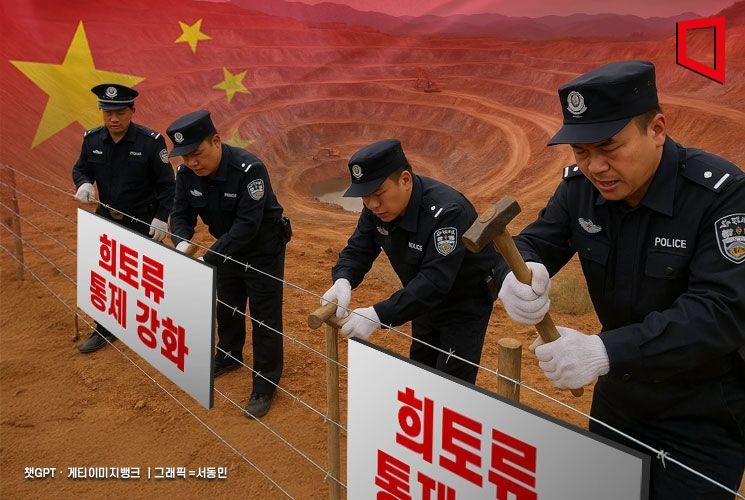
On October 9, the Chinese Ministry of Commerce announced its "Decision on Export Controls of Offshore (Overseas) Rare Earth Materials," adding samarium, dysprosium, gadolinium, terbium, lutetium, scandium, and yttrium metals, as well as samarium-cobalt alloys, terbium-iron alloys, dysprosium-iron alloys, terbium-dysprosium-iron alloys, dysprosium oxide, and terbium oxide to the list of controlled export items.
Going forward, the export of these materials will require a dual-use export license-covering both military and civilian applications-issued by the Chinese Ministry of Commerce.
Materials containing, combining, or mixing these substances, such as rare earth permanent magnet materials and rare earth target materials manufactured overseas, have also been included in the export control list. The Chinese government stated that if these materials are produced overseas using rare earths mined, refined, separated, processed, or recycled with technologies originating from China, their export will also be controlled.
Furthermore, the Chinese government made it clear that, in principle, it will not approve export applications for rare earths to overseas military companies or to companies and end-users (including subsidiaries or branches with more than 50% ownership) that are on the export control "watch list."
Even outside the military sector, export applications for rare earths intended for use in system semiconductors (logic chips) of 14nm or below, memory semiconductors with 256 layers or more, manufacturing and testing equipment for these semiconductors, or for artificial intelligence (AI) research and development with potential military applications, will be subject to individual review.
China also emphasized the obligation of Chinese businesses to comply with these export controls. Amid the ongoing US-China tariff dispute, China has previously cracked down on the illegal overseas smuggling of strategic minerals.
The Chinese government explained that this announcement is an enhancement of previous export control measures to prevent circumvention. A spokesperson for the Ministry of Commerce stated on its website, "Rare earth-related items have dual-use properties for both military and civilian purposes, and the implementation of export controls is an internationally accepted practice. In April of this year, China implemented export controls on rare earth materials for Chinese organizations and individuals, and rare earth technologies were already included in the export control technology list as early as 2001."
The spokesperson added, "For some time, certain overseas organizations and individuals have provided controlled Chinese rare earth materials to related organizations and individuals, which has directly or indirectly been used in sensitive areas such as the military, causing significant harm and potential threats to China's national security and interests. We have also discovered cases where overseas organizations and individuals illegally acquired Chinese rare earth technologies to produce rare earth materials and supplied or used them for users in military and other sensitive areas."
He continued, "China is willing to strengthen communication and cooperation with other countries through multilateral and bilateral export control dialogue mechanisms, promote legitimate trade, and ensure the safety and stability of global industrial and supply chains."
© The Asia Business Daily(www.asiae.co.kr). All rights reserved.
![Clutching a Stolen Dior Bag, Saying "I Hate Being Poor but Real"... The Grotesque Con of a "Human Knockoff" [Slate]](https://cwcontent.asiae.co.kr/asiaresize/183/2026021902243444107_1771435474.jpg)
















