Porous Material 'MOF' Created by Combining Metal Ions and Organic Molecules
Jointly Awarded to Susumu Kitagawa (Japan), Richard Robson (Australia), and Omar Yaghi (United States)
The 2025 Nobel Prize in Chemistry has been awarded to three scientists who designed space at the molecular level, opening up an entirely new world of materials.
On October 8 (local time), the Nobel Committee of the Royal Swedish Academy of Sciences announced that this year’s Nobel Prize in Chemistry would go to Professor Susumu Kitagawa of Kyoto University in Japan, Professor Richard Robson of the University of Melbourne in Australia, and Professor Omar M. Yaghi of the University of California, Berkeley in the United States.
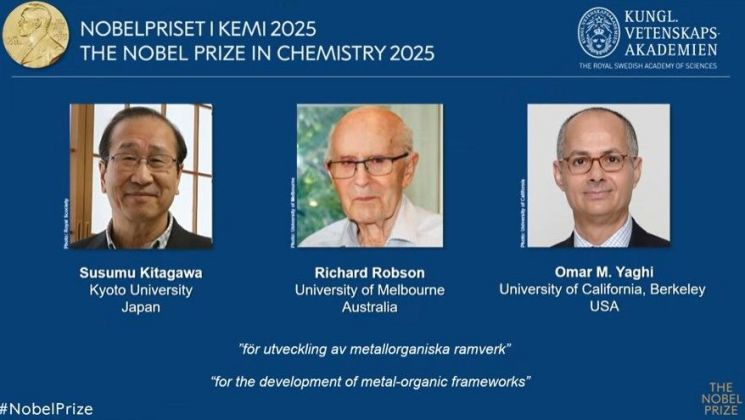 This year's Nobel Prize in Chemistry was awarded to three individuals: Professor Susumu Kitagawa of Kyoto University, Japan (from the left), Professor Richard Robson of the University of Melbourne, Australia, and Professor Omar M. Yaghi of the University of California, Berkeley, USA, for their development of metal-organic frameworks. Photo by Yonhap News
Olaf Str?m, Chair of the Nobel Committee, stated, "This year’s award is ‘a story full of holes,’ but those holes are filled with the imagination of humanity," adding, "The discoveries of these three laureates have expanded the boundaries of chemistry by utilizing empty spaces."
The 'Metal-Organic Frameworks (MOFs)' developed by these scientists are a new type of porous material created by combining metal ions and organic molecules.
The Nobel Committee explained, "Their research demonstrated that chemistry can create new dimensions of space," and described MOFs as "intricate three-dimensional crystal structures formed by using metal ions as the corners and organic molecules as the connectors of the structure."
The key feature of this structure is the 'empty space.' Regularly arranged pores, just a few nanometers in size, are formed inside, allowing gas molecules or ions to enter or remain within. Thanks to this, MOFs are applied in a wide range of fields, including carbon dioxide capture, hydrogen storage, moisture adsorption, drug delivery, and environmental purification.
The committee noted, "This material can collect water from desert air to provide drinking water, selectively remove carbon dioxide from industrial emissions, and safely store toxic substances," adding, "Their discoveries have opened up new possibilities in chemistry."
Empty Yet Robust Crystals: The Birth of Metal-Organic Frameworks
In the late 1980s, Professor Richard Robson was the first to propose the concept that metal ions and organic molecules could be systematically connected to create infinitely extending network structures. His approach, known as 'net-based' design, later became the theoretical foundation for MOF structural design.
Professor Susumu Kitagawa was the first to demonstrate in 1997 that such structures possess porosity capable of adsorbing and releasing gases. He synthesized stable MOFs that did not collapse even after water molecules were removed, establishing the new material concept of "empty yet robust crystals."
Professor Omar M. Yaghi surpassed the structural limitations of MOFs by developing 'MOF-5,' which dramatically improved both stability and surface area. Just one gram of MOF-5 has a surface area equivalent to an entire soccer field. He also established the concept of 'Reticular Chemistry,' presenting a system in which molecular building blocks can be assembled like Lego bricks to design materials with desired structures and functions.
The Nobel Committee stated, "Since their research, chemists around the world have synthesized tens of thousands of MOFs, some of which are already being used in carbon capture, water purification, and clean energy applications."
Korean Researchers: 'MOFs, a Discovery That Expanded the Boundaries of Chemistry'
The Korean chemistry community also praised this year’s award as "a discovery that expanded the boundaries of chemistry."
Joo Sanghoon, Professor of Chemistry at Seoul National University, said, "MOFs are porous materials with an enormous specific surface area, capable of selectively capturing greenhouse gases such as carbon dioxide," adding, "Their potential applications are limitless, and the three laureates are pioneers who unlocked these possibilities."
Kim Jaheon, Professor at Soongsil University, who previously worked with Professor Omar M. Yaghi, said, "Professor Yaghi’s award was an expected result," and explained, "His greatest contribution was establishing the design principle at the molecular level, or ‘reticular synthesis,’ which opened up the possibility for new porous materials that could replace zeolites."
Professor Kim also pointed out, "MOFs have exposed benzene ring structures inside, which maximizes intermolecular attractive forces, resulting in excellent gas adsorption capabilities. However, they have high manufacturing costs and require significant energy for processing." He added, "Nevertheless, MOFs have already been commercialized in fields dealing with relatively mild reaction conditions, such as pharmaceuticals and catalysis, and are being actively utilized in research institutes in Japan and Europe."
Choi Kyungmin, Professor at Sookmyung Women’s University and a former postdoctoral researcher under Professor Omar M. Yaghi at UC Berkeley, commented, "MOFs are like apartments designed at the molecular level, where the size of the pores and the internal structure can be freely adjusted," adding, "It is a field where design, synthesis, and application are closely interconnected."
Professor Choi added, "Commercialization of MOFs is also underway in Korea. MOF materials have been applied to LG Electronics’ air purification filters, greatly improving the removal of odors and harmful gases. I understand that the scope of application will be expanded next year." She further noted, "MOFs have a low regeneration temperature of 60 to 100 degrees Celsius, resulting in low energy consumption and significant carbon reduction effects. This Nobel Prize is expected to accelerate the industrialization of MOFs."
Professor Kim Jaheon remarked, "Professor Yaghi introduced the concept of 'Covalent Organic Frameworks (COFs),' which enables the design of high-performance frameworks using only covalent bonds without metals, and he is a researcher who bridged the boundaries between chemistry and materials science." Professor Joo Sanghoon also commented, "This award is an example of basic chemistry converging with environmental engineering to help solve social problems," and expressed his expectation that "MOF research will grow into a core technology in the era of carbon neutrality."
With this award, Japan has now produced both a Nobel laureate in Physiology or Medicine (Professor Simon Sakaguchi of Osaka University) and a Nobel laureate in Chemistry this year.
The award ceremony will be held this December in Stockholm, Sweden, and the laureates will share a prize of 11 million Swedish kronor (approximately 1.65 billion Korean won).
© The Asia Business Daily(www.asiae.co.kr). All rights reserved.


















