Professor Susumu Kitagawa Wins This Year’s Nobel Prize in Chemistry
Japan Produced a Nobel Laureate in Physiology or Medicine Just Six Days Ago
A Japanese scientist has been awarded the 2025 Nobel Prize in Chemistry, following the country's win in the Nobel Prize in Physiology or Medicine earlier this year. With this, Japan has produced a total of 31 Nobel laureates, including both individuals and organizations.
On October 8 (local time), NHK reported in a breaking news segment that one of this year's three Nobel Chemistry Prize winners is Sumu Kitagawa, a distinguished professor at Kyoto University, calling it "joyful news."
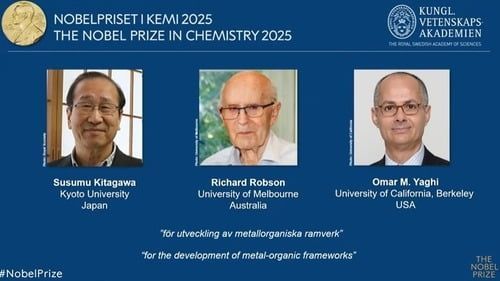 2025 Nobel Chemistry Prize Winners. From left, Professor Sumu Kitagawa, Professor Richard Robson, Professor Omar M. Yaghi. Nobel Prize Committee
Last year, the Japanese organization Nihon Hidankyo (Japan Confederation of A- and H-Bomb Sufferers Organizations) received the Nobel Peace Prize. Just two days ago, Simon Sakaguchi, a specially appointed professor at Osaka University, was awarded the Nobel Prize in Physiology or Medicine. NHK noted that this is the first time in six years that a Japanese scholar has won the Nobel Prize in Chemistry, following Dr. Akira Yoshino of Asahi Kasei in 2019, making Kitagawa the ninth Japanese recipient in this category.
Leading local dailies such as Yomiuri Shimbun, Asahi Shimbun, and Nihon Keizai Shimbun (Nikkei) featured articles about Professor Kitagawa's Nobel Chemistry Prize at the top of their homepages. Yomiuri explained that Kitagawa was honored for his work on "metal-organic frameworks," also known as MOFs, noting their potential applications in various fields such as natural gas storage and greenhouse gas separation.
This marks the 30th time a Japanese individual has received a Nobel Prize. Including organizations, Japan has now received 31 Nobel Prizes in total. By category, there have been 12 laureates in Physics, 9 in Chemistry, 6 in Physiology or Medicine, 2 in Literature, and 1 individual and 1 organization in Peace. Notably, from 2000 to 2002, Japanese scholars won the Nobel Prize in Chemistry three years in a row, and in 2002, Japan produced laureates in both Chemistry and Physics.
Meanwhile, South Korea has produced two Nobel laureates to date. Former President Kim Dae-jung received the Nobel Peace Prize in 2000, and last year, novelist Han Kang became the first Asian woman to win the Nobel Prize in Literature.
© The Asia Business Daily(www.asiae.co.kr). All rights reserved.

















