Observation of Quantum Tunneling in Superconducting Circuits
"Opened the Roots of Quantum Computing"
This year's Nobel Prize in Physics was jointly awarded to three scientists-John Clark, Michel Devoret, and John Martinis-who proved that quantum mechanics operates in macroscopic systems much larger than atoms.
The Nobel Committee of the Royal Swedish Academy of Sciences announced on October 7 (local time) that the 2025 Nobel Prize in Physics would be awarded to them in recognition of their "discovery of macroscopic quantum tunneling and energy quantization in electrical circuits."
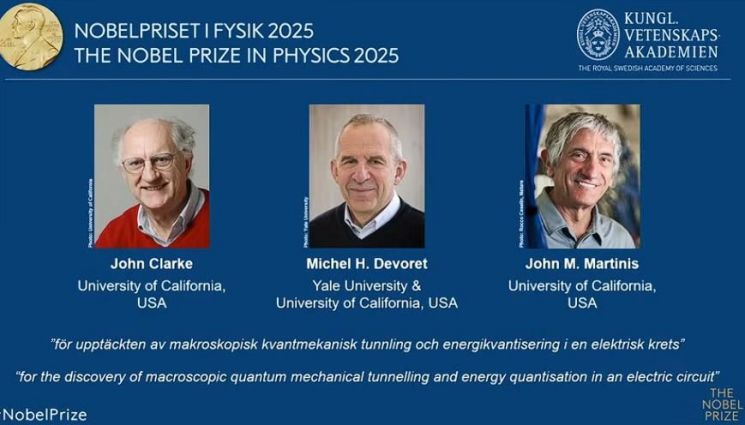 The 2025 Nobel Prize in Physics was awarded to John Clark, Michelle Devoret, and John Martinis for their contributions to "studying quantum mechanics at new scales." Photo by Yonhap News Agency
The committee explained, "Their research demonstrated that quantum mechanics does not remain confined to the microscopic world," adding, "Quantum effects were observed even in circuits that can be held in one's hand."
This research experimentally confirmed 'quantum tunneling,' in which electrons pass through barriers, and 'energy quantization,' where energy changes only in discrete quantum units, in Josephson junctions-superconducting electronic circuits-during 1984 and 1985. Its significance lies in showing for the first time that an entire circuit, entangling hundreds of billions of electrons, can behave as a single, giant quantum particle.
This experiment later became the foundation for superconducting quantum bit (qubit) technology and is regarded as the starting point for the development of quantum computer hardware. The committee stated, "Their discoveries laid the groundwork for the advancement of next-generation technologies such as quantum computers, quantum cryptography, and quantum sensors."
Olle Eriksson, Chair of the Nobel Committee for Physics, commented, "A hundred years after its inception, quantum mechanics still brings new surprises," adding, "This research has redefined the boundary between the quantum world and the classical world."
All three laureates are currently based at universities in the United States. Clark, originally from Cambridge, United Kingdom, is a Professor Emeritus at UC Berkeley and a pioneer in superconducting quantum circuit research. Devoret, from Paris, France, is a Professor Emeritus at Yale University and currently serves as Chief Scientist at Google Quantum AI. Martinis, formerly a professor at UC Santa Barbara, joined Google in 2014 to lead its quantum computing project and is now the co-founder and Chief Technology Officer (CTO) of the startup Qolab.
Professor Clark of UC Berkeley remarked, "It was the most astonishing moment of my life," and added, "In some sense, our discovery forms the basis of quantum computing. While we cannot yet precisely determine its place, one of the reasons your mobile phone works is because these things are actually correct."
Professor Jung Yeonuk of Sungkyunkwan University's Department of Physics explained, "The research began with the question, 'Can electrons really cross a barrier?' These three individuals were the ones who confirmed that." He added, "They experimentally demonstrated that quantum phenomena persist even at macroscopic scales, and this circuit structure was later directly applied to the design of quantum chips by global companies such as Google and IBM."
Recently, the Nobel Prize in Physics has shown a marked tendency to focus on the experimental verification of quantum physics. Following the award for entanglement experiments in 2022 and research observing electron motion with ultrashort pulse lasers in 2023, this year 'macroscopic quantum tunneling' was selected. Experts have analyzed, "This award signals the opening of the Second Century of Quantum Mechanics," and "It marks a discovery that opens the door to a new industrial revolution, including quantum computers, quantum communications, and quantum sensors."
The laureates will equally share a prize of 11 million Swedish kronor (approximately 1.64 billion Korean won). The Nobel Committee announced the recipients of the Physiology or Medicine Prize (for the discovery of immune tolerance) the previous day, and will announce the Chemistry Prize on October 8, the Literature Prize on October 9, the Peace Prize on October 10, and the Economics Prize on October 13.
© The Asia Business Daily(www.asiae.co.kr). All rights reserved.

















