This year's Nobel Prize in Physics has been awarded to three scientists-John Clarke (83), Michel H. Devoret (72), and John M. Martinis (67)-for experimentally demonstrating quantum mechanical tunneling and quantization of energy levels in electronic circuits.
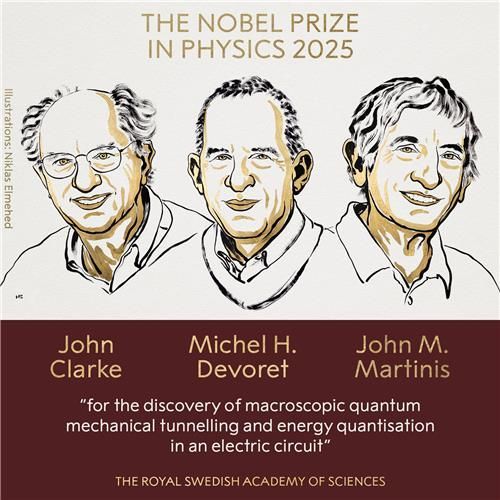 Illustration of the three recipients of this year's Nobel Prize in Physics for 'Quantum Mechanics Research.' Nobel Committee
The Nobel Committee of the Royal Swedish Academy of Sciences announced on October 7 (local time) that these three have been selected as this year's Nobel Prize in Physics recipients.
Clarke, originally from Cambridge, United Kingdom, is a professor at the University of California, Berkeley. Devoret, from Paris, France, is a professor at both Yale University and the University of California, Santa Barbara. Martinis is a professor at the University of California, Santa Barbara.
In 1984 and 1985, they used electronic circuits made from superconductors (Josephson junctions) to prove that quantum mechanical properties can manifest even in macroscopic systems.
Olle Eriksson, Chair of the Nobel Committee for Physics, stated, "I am pleased that we can celebrate the fact that quantum mechanics, even after 100 years, continues to bring new surprises. Quantum mechanics forms the foundation of all modern digital technology, and this discovery will contribute to the advancement of next-generation quantum technologies such as quantum computers, quantum cryptography, and quantum sensors."
The total prize money for this year's Nobel Prize in Physics is 11 million Swedish kronor (approximately 1.64 billion Korean won), which will be divided equally among the three laureates.
© The Asia Business Daily(www.asiae.co.kr). All rights reserved.

















