Rising Freshman Competition Rates and Consecutive Achievements in National Competitions
Impact of Innovation Districts and Departmental Restructuring by the Office of Education Becomes Evident
Vocational high schools, once overlooked, are now creating a new wave in Gwangju. Policy changes by the Metropolitan Office of Education, such as the designation of Gwangju-style Meister High Schools and the operation of innovation districts, are leading to increased freshman enrollment and achievements in national competitions.
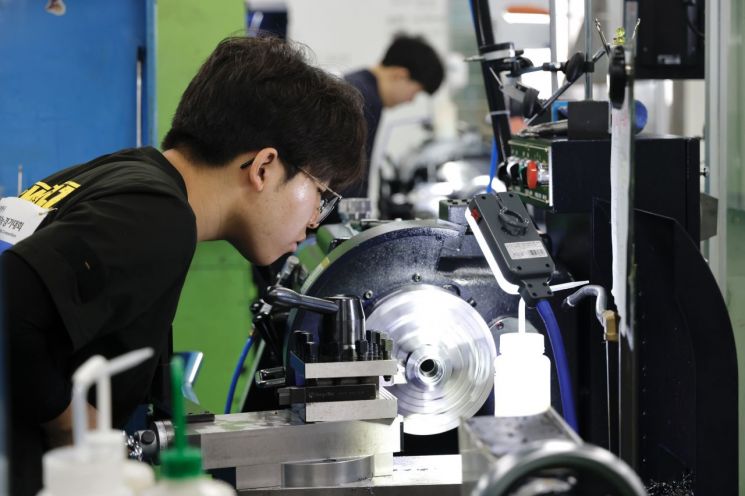 A vocational high school student specializing in operating lathe machines and focusing on metalworking tasks. Provided by Gwangju Metropolitan Office of Education
According to the Gwangju Metropolitan Office of Education on October 7, Gwangju Technical High School recruited new students for the first time this year after being designated as a Gwangju-style Meister High School. With 166 applicants for 144 available spots, the school recorded a competition rate of 1.15 to 1, a clear contrast to last year’s under-enrollment.
Gwangju Automation Equipment Meister High School (2.26 to 1) and Gwangju Software Meister High School (1.7 to 1) also saw high competition rates. Nine other specialized high schools, including Gwangju Girls’ Commercial High School and Gwangju Natural Science High School, also exceeded their enrollment quotas.
The driving force behind this shift is the policy changes of the city’s Office of Education. To strengthen the competitiveness of vocational high schools, the office has promoted initiatives such as operating vocational education innovation districts, restructuring academic departments, and designating Meister High Schools.
The “Bitgoeul Vocational Education Innovation District,” selected by the Ministry of Education in 2022, aims to create a virtuous cycle model of education, employment, and settlement. Students can learn technologies in five areas: future transportation equipment, the energy industry, medical and healthcare, AI convergence, and the cultural industry. This approach is gaining popularity among students who prefer competitive employment over university admission.
Additionally, a variety of experiential opportunities are being provided through programs such as mutual credit recognition courses with universities, university tours, and collaborations with organizations like the Energy Valley Corporate Development Institute and the Gwangju Employers Federation.
The results are evident in the numbers. At the 13th National Commercial Skills Competition held in Gyeongju last September, the Gwangju team won awards for 25 students, including the Minister of Education Award. At the 60th National Skills Competition held in Gwangju in the same month, vocational high school students earned a total of 19 medals-5 gold, 8 silver, and 6 bronze-accounting for 90% of all medals won by the Gwangju delegation.
Gwangju Software Meister High School ranked fourth overall among 216 institutions at the national competition, receiving the “Bronze Pagoda” award for outstanding institutions. This marks two consecutive years of top-tier results, following last year’s “Silver Pagoda” (third place) award.
This year, Gwangju Technical High School was designated as a Gwangju-style Meister High School, and next year, Songwon Girls’ Commercial High School will be renamed Songwon Future Talent High School and will launch new departments, including Railroad Electrical Engineering.
© The Asia Business Daily(www.asiae.co.kr). All rights reserved.

















