Selected as Co-Recipient of the Nobel Prize in Physiology or Medicine
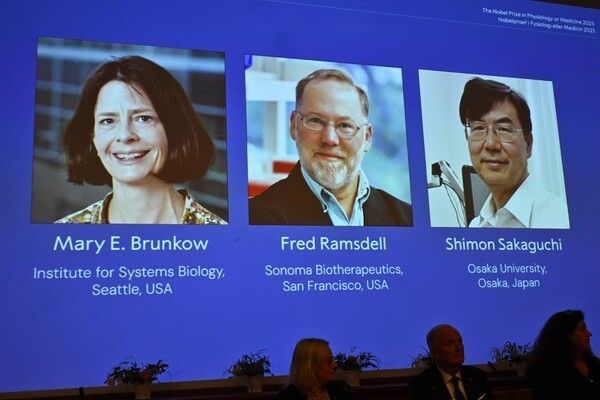 The Nobel Committee announced on the 6th (local time) that this year's Nobel Prize in Physiology or Medicine was awarded to Mary E. Brunkow, Fred Ramsdell, and Shimon Sakaguchi for their discoveries related to peripheral immune tolerance, contributing to research on human immunity. The far right is Shimon Sakaguchi, Professor Emeritus at Osaka University, Japan. Photo by Yonhap News
With Shimon Sakaguchi, Professor Emeritus at Osaka University in Japan, being selected as a co-recipient of the 2025 Nobel Prize in Physiology or Medicine on October 6 (local time), the number of Nobel laureates from Japan has reached 29 individuals and 1 organization.
According to NHK on October 6, this marks the 30th time a Japanese national or organization has received a Nobel Prize, beginning with Dr. Hideki Yukawa, who won the Nobel Prize in Physics in 1949.
By category, there have been 12 laureates in Physics, 8 in Chemistry, 5 in Physiology or Medicine, and 2 in Literature from Japan so far.
With Professor Sakaguchi being selected as a co-recipient alongside American biologists Mary Brunkow and Fred Ramsdell, the number of Japanese Nobel laureates in Physiology or Medicine has increased to 6. Japan has now achieved the honor of winning the prize for two consecutive years, following Nihon Hidankyo last year.
This is the first time in four years that a Japanese national has won a Nobel Prize in the natural sciences-Physics, Chemistry, or Physiology or Medicine-since Dr. Syukuro Manabe, who had changed his nationality to the United States, received the Nobel Prize in Physics in 2021.
The accumulation of scientific research over 81 years, since Japan began fully embracing Western science following the Meiji Restoration in 1868, has laid the foundation for these achievements.
By era, the number of Japanese Nobel laureates surged after 2000, as investments in basic science bore fruit amid repeated periods of rapid economic growth.
From 2000 to 2002, Japanese scientists won the Nobel Prize in Chemistry for three consecutive years. In 2002, for the first time, two Japanese nationals were listed as Nobel laureates in the same year, with simultaneous wins in Chemistry and Physics.
In 2008, including simultaneous recipients of the Physics Prize, a total of four Japanese nationals became Nobel laureates in a single year.
© The Asia Business Daily(www.asiae.co.kr). All rights reserved.

















