Mary Bruncko and Fred Ramsdell of the US, Simon Sakaguchi of Japan Share the Prize
"Research Spanning 30 Years, the Foundation of Human Immunology"
This year, the Nobel Prize in Physiology or Medicine was awarded to scientists who elucidated the mechanism that acts as a brake in the human immune system.
On October 6 (local time), the Nobel Committee at Sweden's Karolinska Institute announced that American scientists Mary Bruncko and Fred Ramsdell, along with Japanese scientist Simon Sakaguchi, were selected as joint recipients for their work in uncovering the principles of "peripheral immune tolerance."
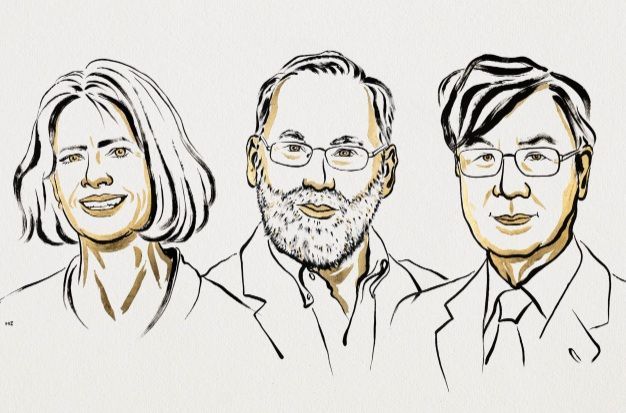
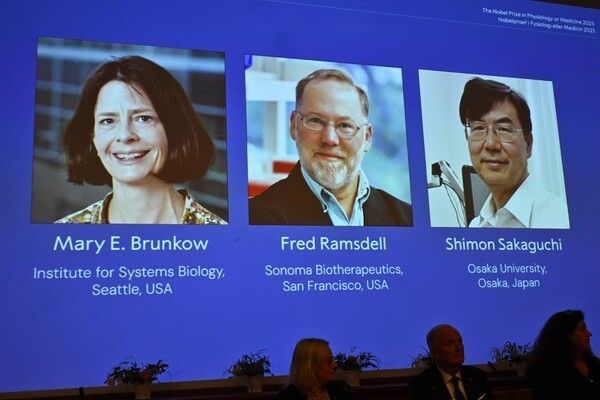 American biologists Mary Bruncko (left) and Fred Ramsdell (center), and Japanese biologist Simon Sakaguchi, recipients of the 2025 Nobel Prize in Physiology or Medicine. Photo by Yonhap News
The committee stated, "Their discoveries identified a key mechanism that prevents the human body from attacking its own tissues," and praised their achievements as "a redefinition of the fundamental principles of immunology."
Simon Sakaguchi, a distinguished professor at Osaka University in Japan, was the first to propose the existence of regulatory T cells (Treg) that suppress autoimmune responses within the immune system in the early 1990s. Through experiments, he demonstrated that specific T cells control excessive immune reactions and maintain immune balance.
Subsequently, the two American researchers completed the puzzle. Dr. Mary Bruncko, a biochemist, led research on immune disorders at the genetic level at the University of Washington and the biotechnology company Immuo at the time. In 2001, she identified the 'Forkhead box P3 (Foxp3)' gene mutation (scurfy mutation) that causes autoimmune disease in a mouse model. Foxp3 is a crucial transcription factor that determines the formation and function of regulatory T cells, playing a vital role in maintaining immune tolerance. Currently, she is participating in immune-related gene-based drug development projects at the research headquarters of the Seattle-based biotech company Insight.
Co-recipient Dr. Fred Ramsdell is an immunologist and biotechnology innovator who, while at Immuo, collaborated with Bruncko to identify the immune regulatory function of Foxp3. He revealed that defects in Foxp3 cause IPEX syndrome (Immune dysregulation, Polyendocrinopathy, Enteropathy, X-linked syndrome), which leads to autoimmune diseases, and established Foxp3 as the 'master regulator' gene of regulatory T cells. Ramsdell is now working with Cytolic Therapeutics in San Francisco, focusing on the development of new drugs to suppress autoimmunity and restore immune balance platforms.
Research Recognized After 30 Years
Their research developed along separate paths from the early 1990s, but in 2001, when Bruncko and Ramsdell identified the molecular nature of the Foxp3 gene and Sakaguchi linked it to regulatory T cells, it was established as a complete theory of immune tolerance.
Committee Chair Ole Kampe commented, "Their discoveries played a decisive role in understanding how the immune system works and why not everyone suffers from severe autoimmune diseases."
The Korean immunology community also welcomed the Nobel Committee's decision. Kim Sungsoo, an emeritus professor at Kyung Hee University School of Medicine who has spent his career studying the microenvironment of tumors, muscles, and immunity and demonstrated that metabolic regulation can act as a switch for tolerance and immune activation, described their findings as "the essence of basic science" and expressed his satisfaction that "research that has fundamentally changed humanity's understanding of immunity over decades has finally received proper recognition."
Professor Kim added, "Recently, research in applied medicine, such as obesity treatments like Wegovy or new diabetes drugs, has attracted attention, so it is both surprising and welcome that the Nobel Committee has returned its focus to basic science."
He further stated, "The relationship between regulatory T cells and Foxp3 is not merely about cell biology; it demonstrates the philosophical system of the human body that prevents self-attack," adding, "This decision reminds us of the true essence of immunology as a discipline."
Experts view this year's award as "a philosophical choice by the Nobel Committee to prioritize fundamentals over applications." The concepts of autoimmune suppression and immune balance continue to serve as starting points in diverse fields, including cancer immunotherapy and vaccine development.
"A Nobel Prize Returning to Basics, Welcomed"
In particular, the regulatory network of the Foxp3 gene is expected to lead to the development of next-generation immunomodulators, cell therapies, and strategies to minimize immunosuppression in organ transplantation, with clinical applications likely to expand in the future.
Professor Kim stated, "This award will serve as an opportunity for humanity to reframe the immune system as one of 'balance' rather than simply 'attack.'"
Immunology has traditionally focused on aggressive immune responses to fight disease, but the trend is now shifting toward "the science of suppression" that protects the body's own cells. Professor Kim noted, "The research of Bruncko, Ramsdell, and Sakaguchi was the starting point of this transformation."
Meanwhile, the laureates will equally share the prize money of 11 million Swedish kronor (approximately 1.64 billion Korean won). The Nobel Committee will continue to announce the recipients of the Physics Prize on October 7, the Chemistry Prize on October 8, the Literature Prize on October 9, the Peace Prize on October 10, and the Economics Prize on October 13.
© The Asia Business Daily(www.asiae.co.kr). All rights reserved.


















