Same Model as Contractor-Type Projects Among Existing Private Participation Public Housing
"Need to Consider Transitioning to a Model Where Private Operators Also Manage Operations"
The Ministry of Land, Infrastructure and Transport has proposed supplying housing in future public housing sites through direct implementation by Korea Land and Housing Corporation (LH). However, there have been calls to further encourage private sector participation in order to revitalize these projects.
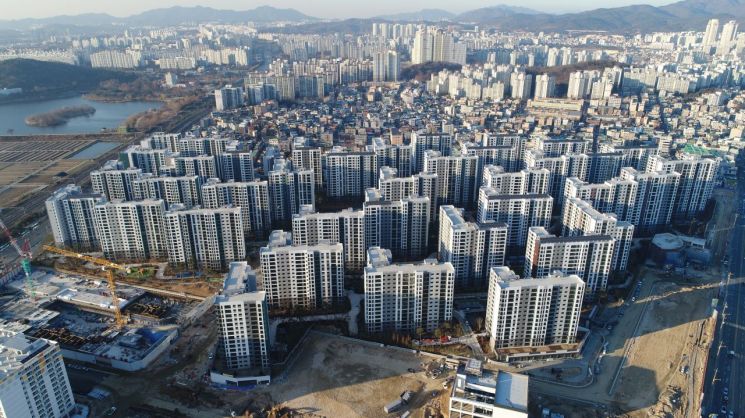 Korea Land and Housing Corporation (LH) and Daewoo Engineering & Construction consortium signed a private participation project agreement and are carrying out public housing within the Suwon High School Residential Environment Project District.
 [Image source=Prugio Homepage]
On October 8, the Construction Industry Institute stated in its "Construction Trends Briefing: Comparison of Overseas Cases and Implications for Contractor-Type Private Participation Projects in Public Housing Sites" that "to activate contractor-type private participation projects, it is worth considering a transition to the DBFM (Design-Build-Finance-Maintenance) model, where private operators take charge not only of construction but also of operation."
In its September 7 measures, the Ministry of Land, Infrastructure and Transport proposed the contractor-type private participation model as a method for supplying public housing in the future. Under this model, LH provides the land, while the private sector is responsible for financing, design, and construction. Previously, LH's private participation public housing construction projects were primarily based on a profit-sharing model, but depending on the agreement, public offering, or company choice, they have also been carried out as contractor-type projects.
At the "LH Private Cooperation Governance Forum" held on September 25, it was mentioned that the detailed direction for contractor-type private participation projects is the same as the contractor-type projects among existing private participation public housing construction projects. In addition, directions for financial support systems to incentivize private sector participation were presented, and measures will be taken to enable low-interest project financing through payment guarantees by the Housing and Urban Guarantee Corporation (HUG). Four districts have been designated for contractor-type private participation projects in the second half of this year, with construction scheduled to begin in June next year. The estimated private sector investment is about 1.2 trillion won.
Looking at overseas cases of contractor-type private participation projects, unlike in Korea, administrative support such as permits and subsidies, cross-subsidy measures, and long-term payment agreements (installment repayment of construction funds) are provided. The cross-subsidy measure compensates for limited private profits through alternative revenue models, thereby reducing the burden on construction companies. When the government has limited financial resources, long-term payment agreements are also utilized.
There are also suggestions that if the volume of contractor-type private participation projects increases, it is necessary to consider transitioning to the DBFM model, where the private sector also manages rental housing operations, since the financial burden is deferred until after project completion. While increasing the volume of contractor-type private participation projects can ease LH's short-term financing pressure, it leaves the burden of having to purchase the housing in four to five years.
Kim Sunghwan, a research fellow at the Construction Industry Institute, explained, "If the private sector is responsible for operations as well, operational know-how can be applied during construction, and it is possible to improve maintenance quality and standardize fiscal burdens through lifecycle cost management and performance-linked payments. However, if the DBFM model is adopted, LH will face the burden of an initial risk premium, and participating companies may have their funds tied up for the long term, so efforts to find common ground are necessary."
Additionally, there are concerns that the recently discussed introduction of a bond auction system requires a cautious approach. While this system allows a portion of the profit from pre-sale buyers to be returned to the public and can help alleviate the financial difficulties of the housing fund, it also presents several issues, such as the potential for higher pre-sale prices.
Research fellow Kim added, "When the bond auction system was introduced in the past, several problems were pointed out, including de facto increases in pre-sale prices and greater cost volatility. If combined with current consumer finance regulations such as DSR and LTV, there are growing concerns about higher total acquisition costs and reduced purchasing power, so a cautious approach is necessary."
© The Asia Business Daily(www.asiae.co.kr). All rights reserved.

















