China Led Negotiations by Restricting Rare Earth Exports
Now Wields Soybean Import Controls Against the U.S.
Likely to Demand U.S. Opposition to Taiwan Independence Beyond Trade Talks
There is an interpretation that China's strategy has proven effective, as President Donald Trump of the United States has identified soybeans as a key agenda item in negotiations with China.
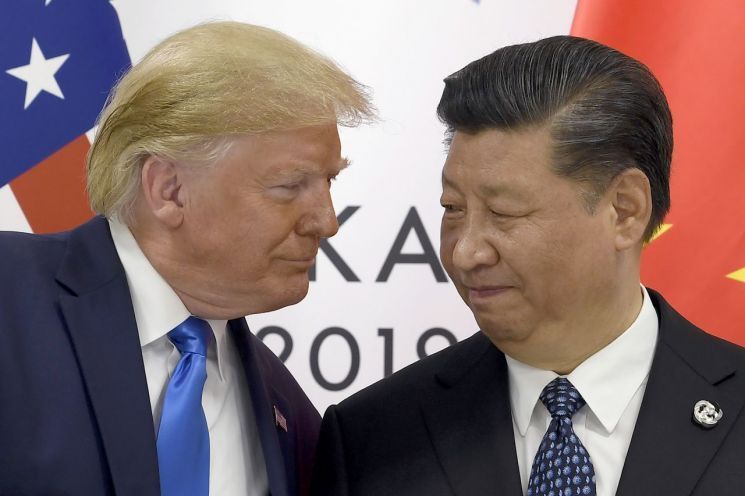 Donald Trump, President of the United States (left), and Xi Jinping, President of China. Photo by AP Yonhap News
On October 4, Singapore's Chinese-language media outlet Lianhe Zaobao reported that, amid this year's U.S.-China trade tensions, China, which previously played the rare earth card with a "not selling" strategy, has now succeeded with a "not buying" strategy by using soybeans as leverage.
Previously, in April, China restricted exports to the United States of 7 out of 17 types of rare earth elements. As a result, the Trump administration granted approval for the export of Nvidia's H20 chips for artificial intelligence (AI) to China.
This time, soybeans, a major source of protein in China, have emerged as a bargaining chip. Although China has not achieved full self-sufficiency in soybeans, it has secured alternative import sources to put pressure on the United States. China has significantly increased its imports of soybeans from South American countries such as Brazil and Argentina instead of the United States, dealing a direct blow to American soybean farmers. This also demonstrates once again the effectiveness of China's strategy to strengthen ties with Global South countries (referring mainly to emerging and developing nations in the Southern Hemisphere).
Lianhe Zaobao explained, "It appears that the re-elected Trump administration, lacking comprehensive consideration, believed it could break through China's defenses by igniting a tariff war and applying extreme pressure, but underestimated China's resilience. The tariff war initiated by President Trump has ultimately harmed American farmers, and with the midterm congressional elections approaching next year, China has accurately identified that the soybean dispute will become a domestic political issue in the United States."
Ultimately, what China wants is not simply to gain an upper hand in trade negotiations, but for the United States to express opposition to 'Taiwan independence.' On September 21, Japan's Yomiuri Shimbun, citing sources familiar with the inner workings of Xi Jinping's administration, reported that China is seeking an official U.S. government statement declaring that it does not support 'Taiwan independence.' This would go beyond the existing position of not recognizing Taiwan as a country.
Meanwhile, the leaders of the United States and China are scheduled to meet at the Asia-Pacific Economic Cooperation (APEC) summit to be held in Gyeongju at the end of this month. Regarding this, President Trump posted on his social media platform Truth Social, stating, "I will meet with President Xi Jinping in four weeks, and soybeans will be one of the main topics of discussion," adding, "Let's make soybeans and other crops great again."
© The Asia Business Daily(www.asiae.co.kr). All rights reserved.
![Clutching a Stolen Dior Bag, Saying "I Hate Being Poor but Real"... The Grotesque Con of a "Human Knockoff" [Slate]](https://cwcontent.asiae.co.kr/asiaresize/183/2026021902243444107_1771435474.jpg)
















