Reviewing Whether to Request an Arrest Warrant
The police have detained former Chairwoman of the Korea Communications Commission, Lee Jinsook, in the holding cell again after completing a second round of questioning. Lee is scheduled to appear at a court hearing on the legality of her arrest on the afternoon of October 4.
The Yeongdeungpo Police Station in Seoul conducted its second investigation of Lee from 10 a.m. to 5 p.m. on October 3. After the questioning, she was returned to the police holding cell. She will spend another night in detention before attending the arrest validity review at the Seoul Southern District Court at 3 p.m. on October 4.
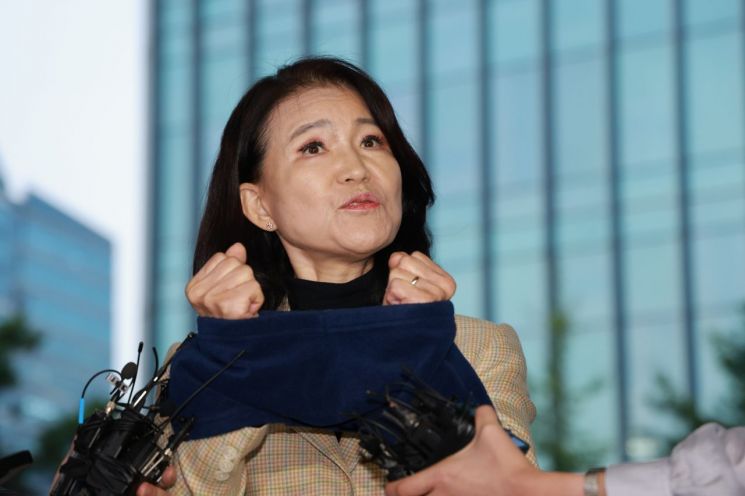 Former Chairwoman of the Korea Communications Commission Jin-Sook Lee, who was arrested on charges including violation of the National Public Officials Act and the Public Official Election Act, is being escorted to the Yeongdeungpo Police Station in Seoul on the 2nd and is speaking to the press. Photo by Yonhap News
Lee faces charges of violating the Public Official Election Act and the National Public Officials Act, based on allegations that she made politically biased remarks and engaged in preliminary election campaigning through conservative YouTube channels and her own Facebook account between September and October of last year and again from March to April this year. During the investigation, Lee acknowledged the facts of the case but denied the charges, arguing that her actions do not constitute a crime. The police plan to analyze her statements before deciding whether to request an arrest warrant.
Since the arrest validity review is scheduled, it is possible that a decision on the arrest warrant will be made after the hearing. The court’s arrest validity review determines whether the arrest was lawful and whether continued detention is necessary. Such reviews are also available for cases of detention. However, it is relatively rare for suspects to request a validity review at the arrest stage. This indicates a strong confrontation between the police and Lee’s legal team from the early stages of the investigation.
The police arrested Lee near her residence at around 4 p.m. the previous day, executing an arrest warrant issued by the court after she failed to comply with six summonses. A suspect who is arrested must either have an arrest warrant requested or be released within 48 hours. The period between the court’s receipt of investigative documents and evidence for review and the return of those materials after a decision is made is not included in the 48-hour deadline for requesting an arrest warrant after the execution of the arrest warrant.
Meanwhile, regarding the arrest, Lee’s attorney, Im Mooyoung, told reporters after the second round of questioning, “The actual investigation time over the two days was less than six hours, excluding meals and breaks,” and argued, “It was an abuse of authority by the police to forcibly detain her for an investigation that lasted less than six hours.” He reiterated that there was only one formal summons, not six, and raised suspicions that the police may have obtained the arrest warrant based on a false investigation report exaggerating the possibility of non-appearance.
© The Asia Business Daily(www.asiae.co.kr). All rights reserved.

















