The survival mechanisms of stem cells in acute myeloid leukemia and chronic myeloid leukemia, both intractable blood cancers, have been identified.
On October 3, the National Research Foundation of Korea announced that the research team led by Professor Hyukyoung Kwon at Soonchunhyang University has identified the key molecular pathway of the 'DEPTOR' protein, which enables tumor stem cells to survive even in amino acid-deficient environments.

DEPTOR is a protein that plays a crucial role in cell growth and metabolic regulation. In this study, the research team newly identified its functions in stabilizing KIF11 and regulating metabolic adaptation, thereby proposing a new strategy for treating intractable blood cancers. KIF11 is a protein that forms the spindle apparatus essential for cell division and is stabilized by DEPTOR.
Acute myeloid leukemia arises from abnormal differentiation of hematopoietic progenitor cells (immature cells at a stage before differentiating into specific cell types), and even with chemotherapy or hematopoietic stem cell transplantation, the five-year survival rate of patients remains at only 24%.
Recent studies have shown that, unlike normal cells, leukemia cells exhibit metabolic vulnerabilities by relying on amino acid metabolism. It has been revealed that targeting these vulnerabilities can suppress cancer cells.
However, the adaptive mechanisms by which leukemia stem cells survive in amino acid-deficient environments had not been clearly identified, which has limited the development of new therapeutic strategies aimed at suppressing cancer cell activity by targeting metabolic vulnerabilities.
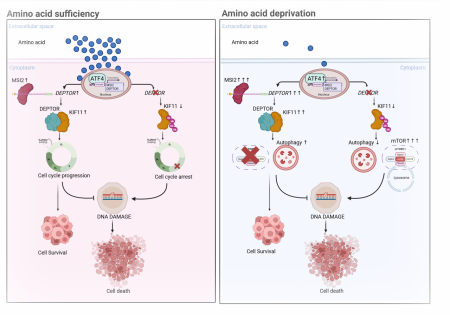
In this context, the research team identified that the interactions among four proteins involved in amino acid metabolism in intractable blood cancers-ATF4 (a transcription factor induced in response to intracellular stress and amino acid deficiency), MSI2 (an RNA-binding protein related to cell proliferation, differentiation, and stem cell maintenance), DEPTOR, and KIF11-are the key mechanism enabling leukemia stem cells to survive under metabolic stress conditions.
The team also found that inhibiting these proteins can selectively block tumor cells.
Through molecular biology techniques, patient cells, and animal model studies, the team demonstrated that in amino acid-deficient environments, DEPTOR stabilizes KIF11, enabling the regulation of mTOR (a protein kinase complex responsible for cell growth, proliferation, survival, metabolism, and autophagy) and metabolic adaptation. This mechanism allows leukemia cells to evade DNA damage and cell death, presenting a new principle.
In actual experiments, hematopoietic stem cells deficient in DEPTOR showed significantly increased DNA damage and cell death under amino acid deprivation. In both patient cells and animal models, DEPTOR inhibition was found to suppress leukemia progression.
In contrast, normal hematopoietic stem cells were minimally affected, proving that DEPTOR is a selective therapeutic target. Most notably, analysis of patient data confirmed that higher DEPTOR expression correlates with lower survival rates, supporting its clinical significance.
Professor Kwon stated, "This study is expected to serve as a foundation for developing next-generation cancer therapies, not only for leukemia but also for other cancer types."
© The Asia Business Daily(www.asiae.co.kr). All rights reserved.
![Clutching a Stolen Dior Bag, Saying "I Hate Being Poor but Real"... The Grotesque Con of a "Human Knockoff" [Slate]](https://cwcontent.asiae.co.kr/asiaresize/183/2026021902243444107_1771435474.jpg)

















