Driverless Vehicle Caught in the U.S.
No Fine Can Be Imposed
In the United States, a self-driving vehicle was caught by police for making an illegal U-turn, but because there was no driver, even a traffic fine could not be issued. As robots now drive themselves, the law and regulatory systems are failing to keep pace with technological advancements, causing ongoing confusion on the ground.
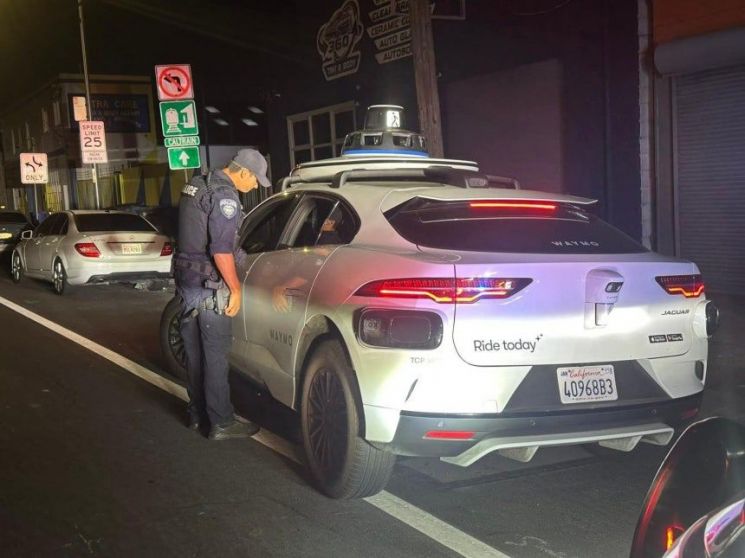 San Bruno police cracked down on illegal U-turns by Waymo, the self-driving robot taxi operated by Alphabet, Google's parent company, but could not issue a traffic violation ticket because there was no driver. San Bruno police Facebook
On October 1 (local time), the New York Times reported that in San Bruno, California, a driverless autonomous taxi operated by Alphabet, Google's parent company, was caught by police for making an illegal U-turn. However, in reality, no legal action could be taken.
The police officer involved stated, "We stopped the vehicle, but since there was no driver, we could not issue a fine," and added, "There is no category for 'robot' in our penalty system." For the police, it was a situation where they witnessed a clear violation but had no responsible party to hold accountable.
Waymo explained, "Our system is designed to comply with traffic rules, and we are continuously improving driving safety through ongoing learning."
Under current California law, there are insufficient legal mechanisms to issue tickets for violations committed by autonomous vehicles. As a result, in 2023, the California state government prepared legislation allowing for a "notice of non-compliance" to be issued when an autonomous vehicle violates traffic rules, with the law set to take effect in July 2026. However, this law does not include specific penalty provisions regarding what sanctions will follow after such a notice is issued.
Police Say "You Can't Fine a Computer"... Institutional Limitations
In contrast, in Arizona, traffic tickets can be issued to autonomous vehicles in the same way as regular vehicles. However, a police official from Phoenix, the capital of Arizona, stated, "I have never heard of an actual case where a fine was issued to a self-driving vehicle."
Last year, police in downtown Phoenix stopped a self-driving Waymo vehicle that was driving in the wrong direction, but no substantial action was taken. At the time, the vehicle was completely empty, with no passengers inside. Waymo is designed to stop when it detects emergency vehicles or sirens, so it was able to comply with police orders.
Bodycam footage from the police officer who stopped the Waymo at the time shows the officer, surprised by the lack of a driver, radioing for assistance. Waymo explained, "A construction sign caused confusion, leading the vehicle to drive in the wrong lane for about 30 seconds."The police stated, "Since we could not fine a computer, the incident ended without further action."
Experts point out, "Technology is already out on the roads, but the relevant laws are still parked in the garage," emphasizing the urgent need for regulatory reform.
© The Asia Business Daily(www.asiae.co.kr). All rights reserved.
![Clutching a Stolen Dior Bag, Saying "I Hate Being Poor but Real"... The Grotesque Con of a "Human Knockoff" [Slate]](https://cwcontent.asiae.co.kr/asiaresize/183/2026021902243444107_1771435474.jpg)
















