Requisitioned as a British Hospital Ship During World War I
Sank in 1916 After Striking a German Mine
For the first time, artifacts have been recovered from the British hospital ship that sank in the Aegean Sea during World War I in 1916.
On October 2 (local time), AP News and the French daily Le Monde reported that Greek divers and archaeologists recently succeeded in retrieving artifacts from the wreck of the Britannic, which lies at a depth of 120 meters off the coast of Kea Island in the Aegean Sea.
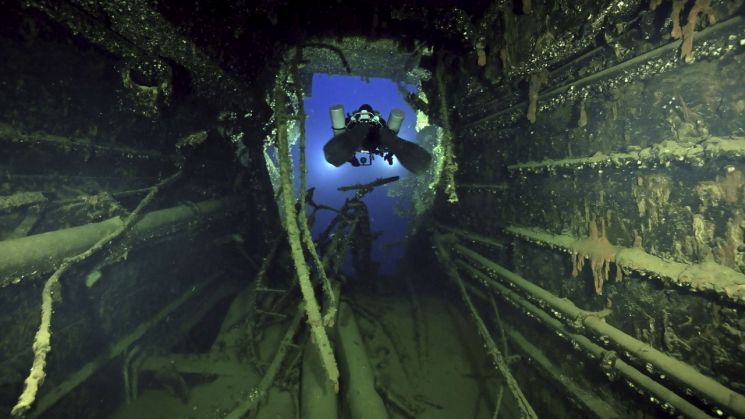 A diver is inspecting the interior of the Britannic. Greek Ministry of Culture. Photo by AP Yonhap News.
Bell, Lamp, Ceramic Tiles, Binoculars, and More Discovered
The Underwater Archaeology Department of the Greek Ministry of Culture announced that, together with a multinational diving team, they conducted a week-long deep-sea exploration and recovered several artifacts. The items discovered include the ship’s bell, a navigation signal lamp, silver-plated trays for first-class passengers, ceramic tiles used to decorate a Turkish-style bath, observation binoculars, and a ceramic washbasin.
The Britannic was a sister ship to the luxurious Titanic, which sank in April 1912, and was built as an improved version by the same British shipbuilder, Harland & Wolff. Originally, the Britannic was one of three passenger liners, along with the Titanic and the Olympic. However, during World War I in 1915, the ship was requisitioned by the British Navy and used as a hospital ship. On November 21, 1916, while transporting and treating thousands of British soldiers wounded on the Balkan and Middle Eastern fronts, the Britannic struck a German mine and sank near Kea Island in Greece. Of the 1,000 people on board at the time, 30 lost their lives.
For decades, the exact location of the wreck remained unknown until 1975, when French ocean explorer Jacques Cousteau identified its position. However, due to the depth and high cost of operations, salvage and excavation efforts were repeatedly delayed. It was not until a British historian who acquired the exploration rights to the Britannic in the 1990s pushed forward that the first official exploration took place in May of this year.
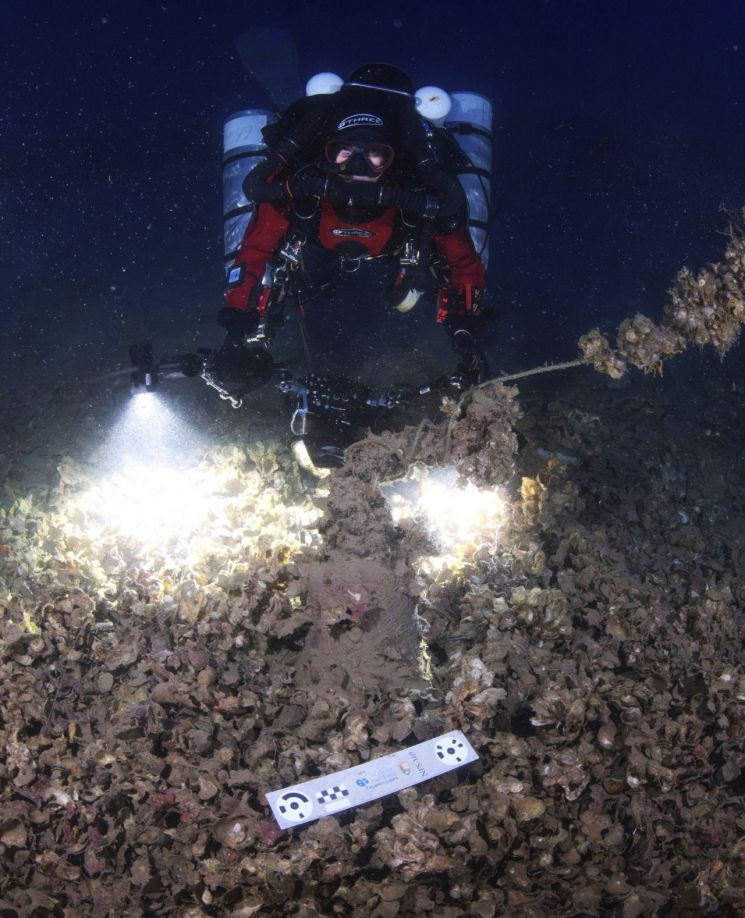
Dimitris Kourkoumelis, head of underwater archaeology at the Greek Ministry of Culture, stated, "These artifacts are extremely valuable as they reflect the life aboard an early 20th-century passenger ship," adding, "It is rare to discover so many artifacts in the Aegean Sea." Le Monde described this recovery as an important event that goes beyond a simple discovery, offering a glimpse into world history in the early 20th century.
Authorities plan to dispatch additional exploration teams to continue the recovery of artifacts, and the recovered items will be transported to Athens for preservation work before being exhibited at the Piraeus Underwater Archaeology Museum.
© The Asia Business Daily(www.asiae.co.kr). All rights reserved.


















