AI Factories Driving Manufacturing Innovation... Aiming for Global No.1 by 2030
Government Launches Manufacturing AI Factories... "Expanding to 500 Leading Projects"
Deployment of Humanoids and Virtual Factories
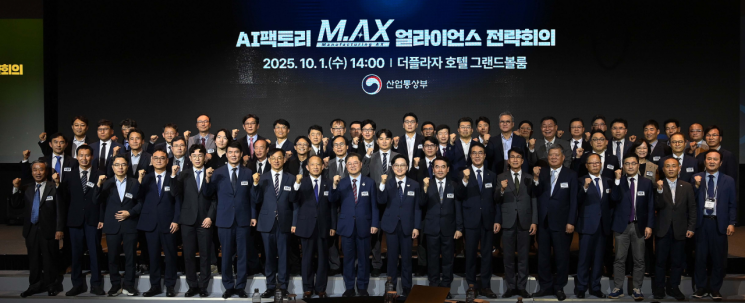 On the afternoon of the 1st, at The Plaza Hotel in Jung-gu, Seoul, a commemorative photo was taken at the AI Factory M.AX Alliance Strategy Meeting, featuring Kim Jungkwan, Minister of Trade, Industry and Energy (center front row), along with representatives from Samsung Electronics, Hyundai Motor Company, LG Energy Solution, Samsung Heavy Industries, and other companies and institutions. (Photo by Ministry of Trade, Industry and Energy)
The government has officially launched the "AI Factory M.AX (Manufacturing.AX Alliance) Alliance" with the goal of becoming the world's leading manufacturing artificial intelligence (AI) powerhouse by 2030. Major domestic manufacturing companies, including Samsung Electronics, Hyundai Motor Company, LG Energy Solution, and HD Hyundai Heavy Industries, have gathered to share strategies and expand leading projects.
On October 1, the Ministry of Trade, Industry and Energy held the "AI Factory M.AX Alliance Strategy Meeting" at The Plaza Hotel in Seoul, announcing achievements in manufacturing innovation and outlining future strategies.
To date, 102 AI Factory leading projects have been launched, and this number will be expanded to more than 500 by 2030. Samsung Electronics plans to introduce AI into its high-bandwidth memory (HBM) inspection process, raising inspection accuracy to over 99% and reducing inspection time by more than 25%. Hyundai Motor Company will develop AI-powered multifunctional robotic arms suitable for flexible production, improving productivity by over 30%. HD Hyundai Heavy Industries will deploy maintenance robots for naval vessels, while Nongshim will implement an AI autonomous maintenance system in its ramen production process, each aiming to enhance efficiency and safety.
Starting this year, humanoid robots will be fully deployed in manufacturing sites. Rainbow Robotics will collaborate with Samsung Display and CJ Logistics, while Arobot will work with HD Hyundai Mipo and Samsung Heavy Industries. Robros and Holiday Robotics will partner with LG Electronics and SK Energy, respectively. These robots will perform a variety of tasks, including parts replacement, logistics sorting, welding, home appliance assembly, and petrochemical valve operation. The government plans to accumulate data through more than 100 pilot projects by 2027 and establish mass production systems starting in 2028.
The AI Factory M.AX Alliance will also develop industry-specific manufacturing AI models. Twenty-three experts, including Professor Yoon Byungdong from Seoul National University, Professor Ko Youngmyung from Pohang University of Science and Technology (POSTECH), and Professor Choi Jaesik from KAIST, will participate, along with leading international scholars in the field of large-scale AI. Based on collected manufacturing data, a general-purpose model will be completed by 2028 and provided to companies. This is expected to reduce development costs by 50% and development time by 40%.
From next year, the Ministry of Trade, Industry and Energy will expand the AI Factory project to evolve into fully autonomous AI factories, covering factory design, supply chain management, logistics, and after-sales service. During this process, "Virtual Factories" will be implemented to simulate equipment failures, material replacements, and supply chain fluctuations in advance, and will also be used for real-time monitoring and remote control. The government aims to secure "dark factory" technology based on this foundation and become an exporter of manufacturing AI plants by 2030.
Kim Jungkwan, Minister of Trade, Industry and Energy, emphasized, "The AI era is a race against time. We will focus our policies and resources to ensure that the AI Factory ship can smoothly sail toward its destination as the global leader."
© The Asia Business Daily(www.asiae.co.kr). All rights reserved.
![Clutching a Stolen Dior Bag, Saying "I Hate Being Poor but Real"... The Grotesque Con of a "Human Knockoff" [Slate]](https://cwcontent.asiae.co.kr/asiaresize/183/2026021902243444107_1771435474.jpg)
















