Both Republican and Democratic Temporary Budget Bills Fail
Shutdown Expected from 12:01 a.m. on October 1
Concerns Over Wage Losses and Widespread Economic Slowdown
The prospect of a federal government shutdown (temporary suspension of operations) has become a reality as the U.S. Senate failed to pass a stopgap spending bill. In this case, an average of about 750,000 federal employees are expected to be placed on unpaid leave each day, with the resulting losses estimated at approximately $400 million (about 544 billion won) per day. Considering that the 34-day shutdown during the first Trump administration caused a decline in gross domestic product (GDP), there are concerns that a prolonged situation this time could also have significant economic repercussions.
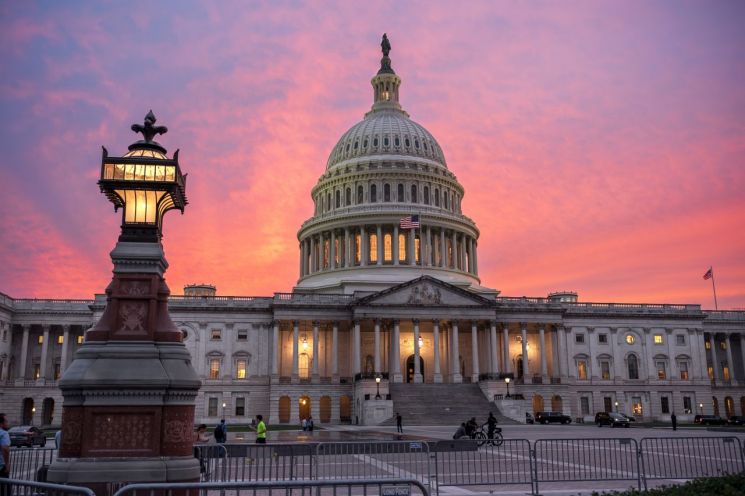
According to a report by the Associated Press on September 30 (local time), the U.S. Senate put the Republican Party's seven-week continuing resolution (CR) to a vote on the final day of negotiations to avoid a shutdown, but it was rejected by a vote of 55 against 45. The Republican stopgap bill was intended to keep the government operating until November 21, while Congress discusses the 2026 fiscal year budget after the end of the 2025 fiscal year (September 30). The Democratic Party's own stopgap bill was also put to a vote but failed, making it likely that the federal government will enter a shutdown starting at 12:01 a.m. on October 1 (U.S. time; 1:01 p.m. Korean time on October 1). This federal government shutdown will be the first in about seven years since the previous shutdown (December 22, 2018, to January 25, 2019).
The Congressional Budget Office (CBO) estimated that, in the event of a shutdown, about 750,000 federal employees would be placed on furlough, resulting in daily wage losses of approximately $400 million (about 544 billion won). If the shutdown is prolonged, such losses are expected to snowball. When the shutdown becomes a reality, hundreds of thousands of federal employees will not receive their pay on time. As a result, household disposable income will decrease, consumer sentiment will weaken, and the overall private sector, including retail and service industries, is expected to face increased burdens.
There are also concerns that the financial pressure of medical expenses on low-income households will intensify. The Washington Post reported that if the Affordable Care Act (ACA) tax credits expire, about 4 million people could lose their insurance starting next year, and an additional 20 million people could see their premiums increase.
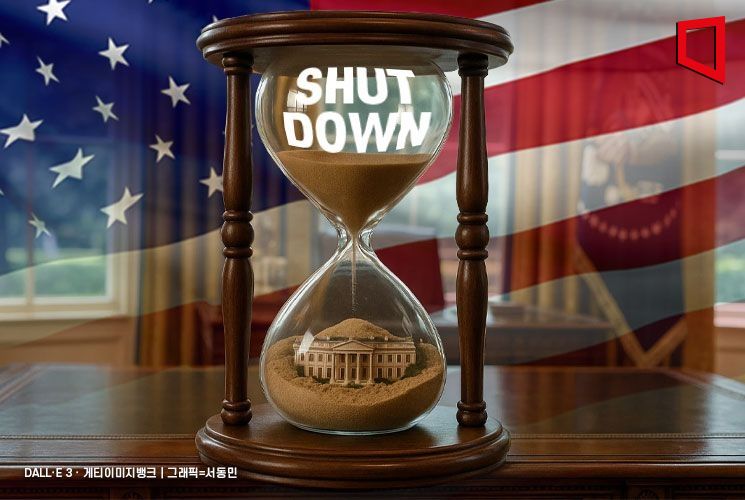
There have been a total of 14 federal government shutdowns in the United States since the 1980s. The longest of these was during the first Trump administration from 2018 to 2019, when the federal government was shut down for a record 34 days. The CBO estimated the economic loss from that shutdown at a minimum of $1.1 billion, of which about $300 million was considered a permanently unrecoverable loss. In addition, due to delays in federal spending and the suspension of federal services resulting from the partial government closure, the real GDP growth forecast for the first quarter of 2019 was lowered by 0.2 percentage points.
Traditionally, shutdowns have resulted only in the temporary unpaid leave of federal employees, but this time, the possibility of layoffs is also being discussed, raising concerns about job security. President Trump warned, "Thanks to the shutdown, we can take action in various areas, including healthcare, and reduce benefits. We can cut a lot of people."
This contradicts the internal guidance already shared by some federal agencies stating that "there will be no permanent layoffs." In fact, the Office of Management and Budget (OMB) is reported to have sent a memo to federal agencies instructing them to prepare for "mass layoffs" in the event of a shutdown. As a result, there are concerns that President Trump's threat of layoffs may not be just a warning.
In response to this ultimatum, federal employee unions immediately pushed back. Major unions such as the American Federation of Government Employees (AFGE) filed lawsuits against the administration, arguing that "using the shutdown as a pretext for mass layoffs is illegal," according to Bloomberg News.
© The Asia Business Daily(www.asiae.co.kr). All rights reserved.
![A Woman with 50 Million Won Debt Clutches a Stolen Dior Bag and Jumps... A Monster Is Born [Slate]](https://cwcontent.asiae.co.kr/asiaresize/183/2026021902243444107_1771435474.jpg)

















