Korea Aerospace Administration and Australian Space Agency
Sign SOI at "IAC 2025"
South Korea and Australia are joining forces to establish a surveillance network to respond to space hazards. The Korea Aerospace Administration has signed a Statement of Intent (SOI) for cooperation with the Australian Space Agency on the occasion of the International Astronautical Congress (IAC 2025), and will officially launch the 'BRAHE Project' to build a medium- and high-orbit optical surveillance system together with major Australian universities.
The Korea Aerospace Administration announced on September 30 that it had signed the SOI for cooperation on the BRAHE Project with the Australian Space Agency (ASA) during IAC 2025, held in Sydney, Australia.
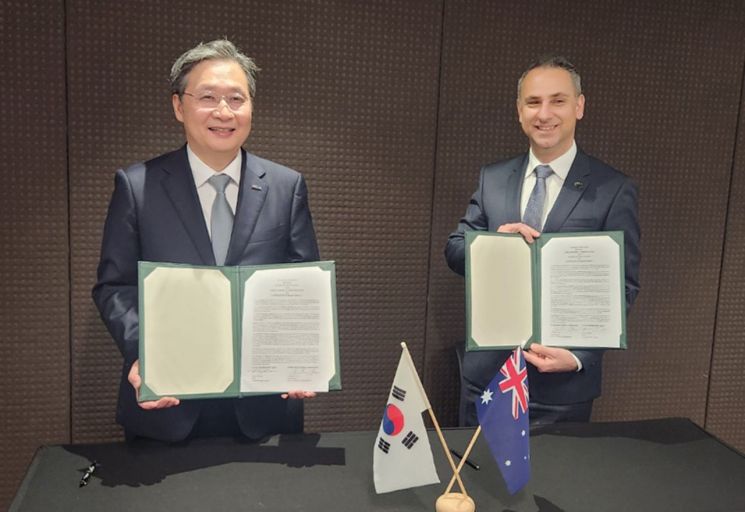 Yoon Youngbin, Administrator of the Space Agency (left), and Enrico Palermo, Administrator of the Australian Space Agency, signed a letter of intent for cooperation to establish a medium- and high-orbit optical surveillance system on the 30th of last month in Sydney, Australia, and are taking a commemorative photo. Provided by the Space Agency.
This project aims to ensure public safety and protect key space assets by detecting the risk of satellite and space debris reentry and collisions in Earth's orbit at an early stage. From 2024 to 2027, the government will invest 14 billion KRW (approximately 10 million USD) to install two 80cm-class optical telescopes at suitable observatories in Australia.
The signing of the SOI was carried out to strengthen surveillance capabilities in the medium- and high-orbit regions of the Korean Peninsula's longitude band and to contribute to international Space Situational Awareness (SSA) cooperation. With the heads of both space agencies signing the agreement in person, the strategic partnership in the field of space hazard response has become even stronger.
On September 29 and October 1, the Korea Aerospace Administration also held cooperation meetings at Siding Spring Observatory (managed by the Australian National University) and Zadko Observatory (managed by the University of Western Australia), which are the planned installation sites. The Korean delegation included Kwon Hyunjun, Director General of the Space Policy Bureau, and Park Janghyun, President of the Korea Astronomy and Space Science Institute. The Australian side was represented by Anna-Marie Moore, Director of the Australian National University, Eduardo Trifoni, Director, and Danail Obreschkow, Director at the University of Western Australia. They discussed support for installation and operation as well as expanding joint research.
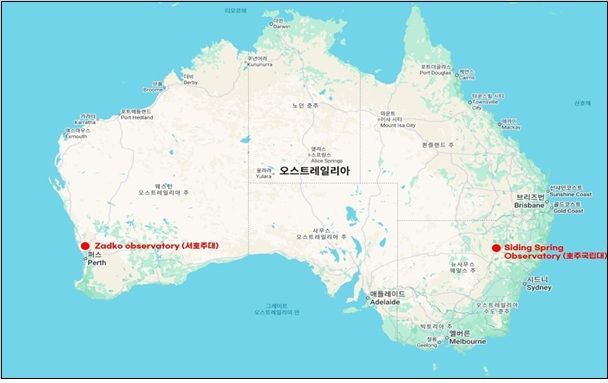 Map of Australia showing the locations of two 80cm-class optical telescopes installed in Australia. Provided by the Space Agency
Siding Spring Observatory is a leading professional observatory in the Southern Hemisphere, known for its active international research collaborations. Zadko Observatory is equipped with a 1-meter-class telescope used for asteroid and comet monitoring and space debris tracking research.
The optical telescopes to be installed in Australia will be linked with Korea's 'Optical Wide-field patroL Network (OWL-Net)'. OWL-Net is Korea's first dedicated automated optical telescope system for space surveillance, used for low-orbit satellite monitoring at five locations: Mongolia, Morocco, Israel, the United States, and Korea. Once the Australian system is connected, simultaneous observations covering both the Northern and Southern Hemispheres will be possible, improving orbital determination accuracy and expanding the surveillance range to medium and high orbits.
Kwon Hyunjun, Director General of the Space Policy Bureau, emphasized, "With the signing of the SOI and the cooperation meetings, preparations for installation and operation in Australia are now in full swing. We will complete the project without delay by 2027, enabling both countries to jointly respond to space hazards and contribute to international SSA cooperation."
© The Asia Business Daily(www.asiae.co.kr). All rights reserved.


















