Direct Mention of Restoring Wartime Operational Control in Armed Forces Day Address
"Self-Reliant National Defense Is Inevitable Amid Rapidly Changing Security Environment"
Proposes Smart, Elite Military, Fostering Defense Industry, and Improvin
President Lee Jaemyung announced his intention to restore wartime operational control on the occasion of the 77th Armed Forces Day. He emphasized that self-reliant national defense is essential to respond to rapidly changing security environments, meaning that the authority to command and control the military during emergencies must rest with the Korean government. President Lee also pledged to turn the dream of a "strong and independent national defense" into reality by reorganizing the military into a "smart, elite, and powerful force" and by actively fostering the defense industry to simultaneously strengthen national defense and achieve economic development. He further promised significant improvements to the welfare of military personnel.
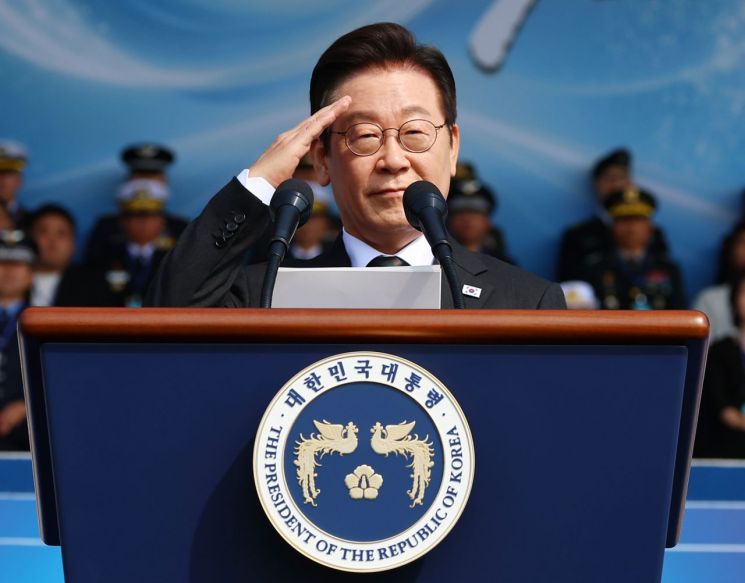
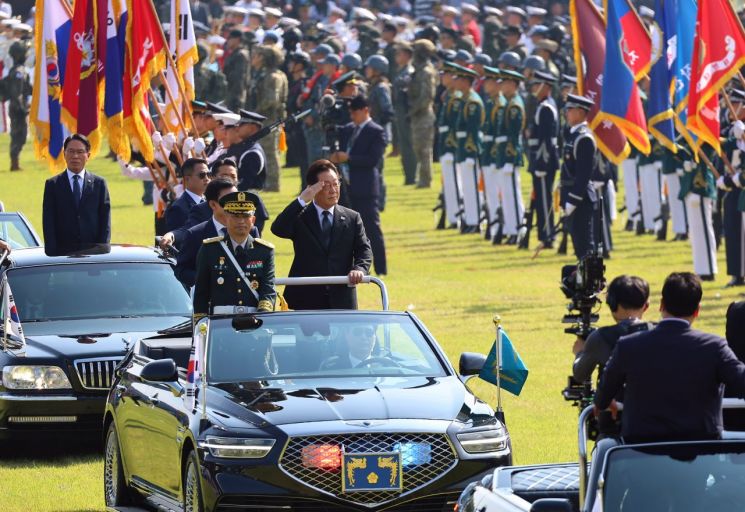
On October 1, at Gyeryongdae in South Chungcheong Province, President Lee attended the Armed Forces Day ceremony under the theme "An Advanced and Strong Military with the People." He stated, "Based on a robust South Korea-U.S. alliance, we will restore wartime operational control and take the lead in the combined defense posture of South Korea and the United States," adding, "A firm combined defense capability and posture will contribute not only to peace and stability on the Korean Peninsula but also to regional stability and shared prosperity."
Wartime operational control refers to the authority to command troops within a limited time and space for specific operations. In South Korea, the Chairman of the Joint Chiefs of Staff (a four-star general) holds this authority during peacetime, but in wartime, it is exercised by the Commander of the South Korea-U.S. Combined Forces Command, who is an American general. This is the first time President Lee has directly declared his intention to reclaim wartime operational control, rather than through campaign pledges or the National Policy Planning Committee.
President Lee's remarks were made in the context of explaining the necessity of self-reliant national defense and the measures to achieve it. He stated, "We must move toward a strong, independent national defense based on our high pride in and unwavering confidence in our military capabilities," and emphasized, "Self-reliant defense is inevitable if we are to respond proactively to rapidly changing security environments." As society moves into what he described as an era of "every man for himself," President Lee believes, "We must further strengthen our own capabilities."
On September 21, just before departing for the United States to attend the United Nations General Assembly in New York, President Lee had also criticized on social media, "It is a submissive mindset to think that self-reliant national defense is impossible without foreign troops, despite our military strength and national power." The opposition party raised concerns that "foreign troops" referred to the U.S. Forces Korea.
However, President Lee explained that South Korea's national defense is stronger than ever. He said, "South Korea is a military powerhouse with the world's fifth-largest military strength, spending 1.4 times North Korea's gross domestic product (GDP) on defense, and is a strong nation whose integrated national power, including economic and cultural strength, is second to none." He also noted, "We have a solid South Korea-U.S. alliance and a firm nuclear deterrence based on it." President Lee pointed out, "There is no reason for a country like South Korea to doubt its defense capabilities, and even less reason to be anxious."
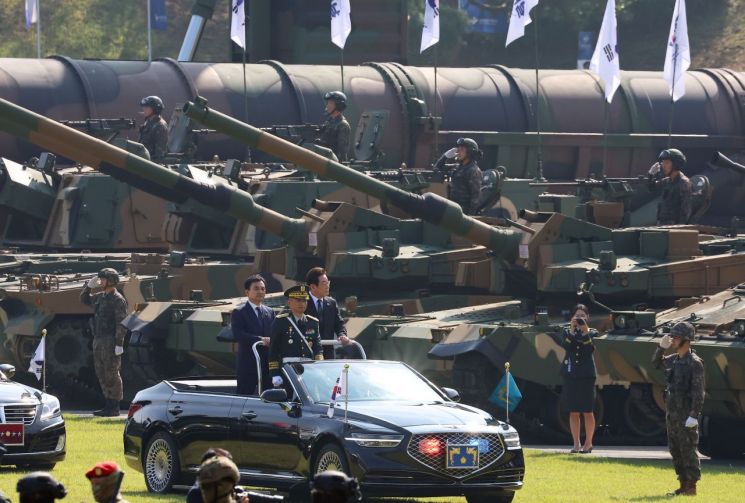
As measures for self-reliant national defense, President Lee cited: ▲ building a smart, elite, and powerful military ▲ fostering the defense industry ▲ improving the welfare of military personnel. He stated, "Advanced innovative technologies are completely transforming the paradigm of the battlefield," and proposed that "the solution lies in units equipped with unmanned and manned integrated advanced weapon systems, such as artificial intelligence (AI) combat robots, autonomous drones, and ultra-precise high-performance missiles."
He pledged to actively foster the defense industry to achieve both stronger national defense and economic development. To this end, he plans bold investments in defense technology development and to create a robust ecosystem. For military personnel, he promised to improve the treatment of junior officers and enhance job security for mid-level officers. He also vowed to strengthen support and recognition for injured soldiers, promising that "the self-deprecating lament that 'when called, you are the nation's child, but when injured, you are abandoned' will no longer be tolerated."
Meanwhile, President Lee remarked, "On December 3 last year, some military commanders, forgetting their core duties, sided with the highest authority and turned their guns on the people," but added, "Fortunately, thanks to the courage of the majority of military personnel who, as uniformed citizens, resisted unlawful orders, we were able to prevent greater tragedy and misfortune."
He continued, "The military, whose duty is to protect the people, must never again turn its guns on the people," and added, "As commander-in-chief and as the president responsible for the people of South Korea, I will thoroughly eliminate the remnants of illegal martial law and further strengthen democratic and institutional foundations to rebuild the military as a force that protects the Constitution and the people."
© The Asia Business Daily(www.asiae.co.kr). All rights reserved.
![Clutching a Stolen Dior Bag, Saying "I Hate Being Poor but Real"... The Grotesque Con of a "Human Knockoff" [Slate]](https://cwcontent.asiae.co.kr/asiaresize/183/2026021902243444107_1771435474.jpg)


















