Promoting Crop Growth by Utilizing Atmospheric CO2
Enabling Low-Concentration Capture Instead of Industrial CO2
Compact Equipment Design Offers Advantages
Key Challenges Remain: Economic Feasibility and Scalability
EcoPro HN, in collaboration with the Korea Advanced Institute of Science and Technology (KAIST) and the Korea Research Institute of Chemical Technology, has developed a Direct Air Capture (DAC) technology that directly captures carbon dioxide (CO₂) from the atmosphere. The company is currently validating a small-scale facility with the goal of commercialization by 2026, and is initially applying the technology to smart farm agriculture to assess its growth impact.
On October 1, EcoPro HN announced that it had jointly developed a small-scale DAC facility based on KAIST’s dry carbon dioxide adsorbent and the Korea Research Institute of Chemical Technology’s equipment design and manufacturing technology. Crops grown in smart farms and greenhouses exhibit rapid growth in environments with high concentrations of carbon dioxide. Traditionally, carbon dioxide was artificially injected from industrial sources. However, the newly developed small-scale DAC captures low-concentration atmospheric carbon dioxide (around 400 ppm) and concentrates it to levels suitable for crop growth (800-1000 ppm).
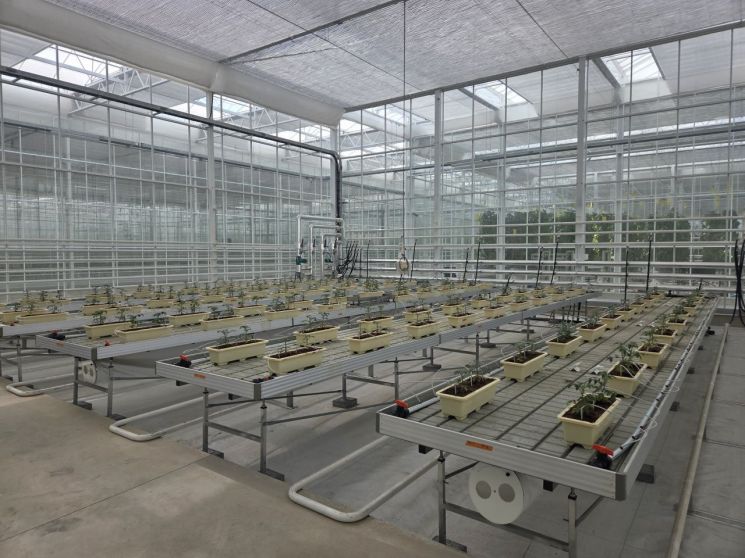 A pilot demonstration of a small DAC facility is being conducted in the EcoPro HN greenhouse located within the Smart Farm Innovation Valley in Sangju, Gyeongsangbuk-do. EcoPro
This technology is distinguished by its ability to enhance photosynthetic efficiency and promote crop growth. Additionally, by using a dry adsorbent, it addresses the drawbacks of conventional wet capture methods, such as wastewater generation and equipment corrosion. The compact size of the equipment also allows for installation in a wide range of locations, not limited to specific emission sources.
Currently, EcoPro HN is conducting tomato cultivation experiments using the first-generation DAC facility at the Sangju Smart Farm Innovation Valley in Gyeongsangbuk-do. The facility has raised the carbon dioxide concentration inside the smart farm to 600-700 ppm, and the company aims to achieve the target concentration of 800-1000 ppm. Following successful validation, there are plans to expand the technology to other crop sectors, including microalgae.
Until now, carbon capture, utilization, and storage (CCUS) technology has primarily targeted high-concentration emissions from power plants and steel mills, which limited its scope of application. In contrast, small-scale DAC can utilize low-concentration atmospheric carbon dioxide, greatly expanding potential installation sites and industrial applications.
EcoPro HN views this technology as an initiative that can go beyond “carbon neutrality” and achieve actual carbon reduction (carbon negativity). Whether the technology can address both industrial applicability and cost challenges will be a key factor in the future commercialization of DAC technology.
© The Asia Business Daily(www.asiae.co.kr). All rights reserved.

















