Ministry of Trade, Industry and Energy Releases September 2025 Export and Import Trends
Record-Breaking Total Exports in Three and a Half Years
Driven by Increased Number of Working Days
September exports reached an all-time high, driven by an increase in the number of working days. However, the average daily export value, adjusted for the number of working days, fell by more than 6%, and exports to the United States continued to decline.
According to the "September Export and Import Trends" announced by the Ministry of Trade, Industry and Energy on October 1, exports rose 12.7% year-on-year to $65.95 billion.
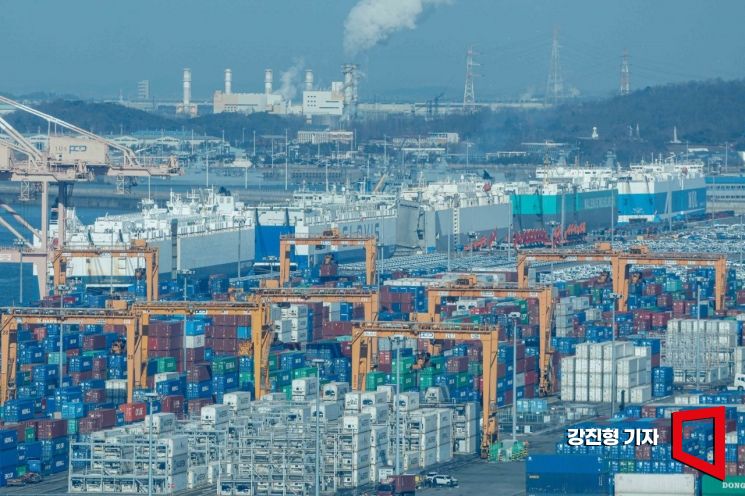 Export vehicles and containers are waiting to be loaded at Pyeongtaek Port, Gyeonggi Province. Photo by Kang Jinhyung
An official from the Ministry of Trade, Industry and Energy stated, "September exports reached $65.95 billion, marking the highest figure in three years and six months since March 2022 and achieving four consecutive months of growth. Third-quarter exports also surpassed $180 billion (with a monthly average of $60 billion), reaching $185.03 billion, the highest quarterly record ever."
The increase in exports last month was largely due to the greater number of working days. Unlike last year, this year’s Chuseok holiday began in October. As a result, there were 24 working days in September 2025, four more than the 20 days in the previous year. Taking this into account, the average daily export value was $2.75 billion, a decrease of 6.1%.
In September, exports increased for 10 out of the 15 main export items. Semiconductor exports rose 22.0% to a record $16.61 billion, the highest ever for any period, driven by strong demand for high-value-added memory such as high-bandwidth memory (HBM) and double data rate (DDR)5, particularly for artificial intelligence (AI) servers, as well as stable fixed prices for memory chips. This marked a new all-time high for the second consecutive month following August.
Automobile exports rose 16.8% to $6.4 billion, the highest ever for September, as both eco-friendly vehicles such as pure electric vehicles (EVs) and hybrids, as well as internal combustion engine vehicles, saw increases. Used car exports also performed well at $1.04 billion. This marked four consecutive months of growth. Auto parts exports also turned positive, reaching $1.92 billion, an increase of 6.0%.
By region, exports to China increased by 0.5% to $11.68 billion, ending a four-month streak of declines and turning positive. Exports to the United States, however, fell by 1.4% to $10.27 billion amid challenging conditions such as tariff policies.
September imports increased by 8.2% to $56.4 billion. While energy imports ($9.4 billion) decreased by 8.8%, non-energy imports ($47 billion) rose by 12.5%.
The trade surplus in September increased by $3.12 billion, reaching $9.56 billion, the largest surplus in seven years since September 2018 ($9.62 billion). The cumulative surplus from January to September also grew by $13.85 billion to reach $50.47 billion.
Minister of Trade, Industry and Energy Kim Jeonggwan said, "There is still a high level of uncertainty surrounding our exports, including ongoing U.S. tariff negotiations, so we must remain vigilant and respond swiftly. The government will strengthen policy support to help our companies maintain export competitiveness."
© The Asia Business Daily(www.asiae.co.kr). All rights reserved.
![Clutching a Stolen Dior Bag, Saying "I Hate Being Poor but Real"... The Grotesque Con of a "Human Knockoff" [Slate]](https://cwcontent.asiae.co.kr/asiaresize/183/2026021902243444107_1771435474.jpg)











