44 Masterpieces from the National Museum of Modern and Contemporary Art Unveiled
A Century of Art Between Monet and Ai Weiwei
Includes 16 Pieces from the Lee Kun-hee Collection
Four Works Revealed for the First Time, Including Payment-in-Kind Artworks
From masterpieces by leading Impressionist painters of the 19th and 20th centuries such as Claude Monet, Pierre-Auguste Renoir, and Camille Pissarro, to works by contemporary artists including Barbara Kruger, Anselm Kiefer, and Ai Weiwei, the exhibition brings together works by artists spanning 100 years of art history. The exhibition "Water Lilies and Chandelier," which opened at the Gwacheon branch of the National Museum of Modern and Contemporary Art, features 44 pieces from the collections of 33 international masters. For the first time, four works are being unveiled, including two pieces from the "Portrait" (2007) series by Chinese artist Zeng Fanzhi, the first artworks donated through the art payment-in-kind system in Korea. Sixteen pieces from the Lee Kun-hee Collection are also on display.
 Barbara Kruger, an American conceptual artist, created the work "Insult, Condemn" (2010). It expresses the threats and violence that media and visual images impose on individuals. Courtesy of the National Museum of Modern and Contemporary Art
The exhibition title, "Water Lilies and Chandelier," is drawn from the iconic "Water Lily Pond" (1917-1920) by Claude Monet (1840-1926), a representative figure of 19th-century French Impressionism, and "Black Chandelier" (2017-2021) by contemporary Chinese artist Ai Weiwei (born 1958). Kim Yujin, the curator who organized the exhibition, explained, "We designed the exhibition to allow visitors to explore a century of scenes between Monet and Ai Weiwei."
The exhibition arranges 44 works in a large circular hall. Visitors are first greeted by "Insult, Accuse" (2010) by American conceptual artist Barbara Kruger (age 80). The work features an image capturing the moment a sharp needle is about to pierce an eye, overlaid with the phrase "Insult, Accuse." This piece vividly reveals the threats and violence that media and visual images inflict on individuals, effectively showcasing the artist's signature style of combining image and text to deliver satirical messages.
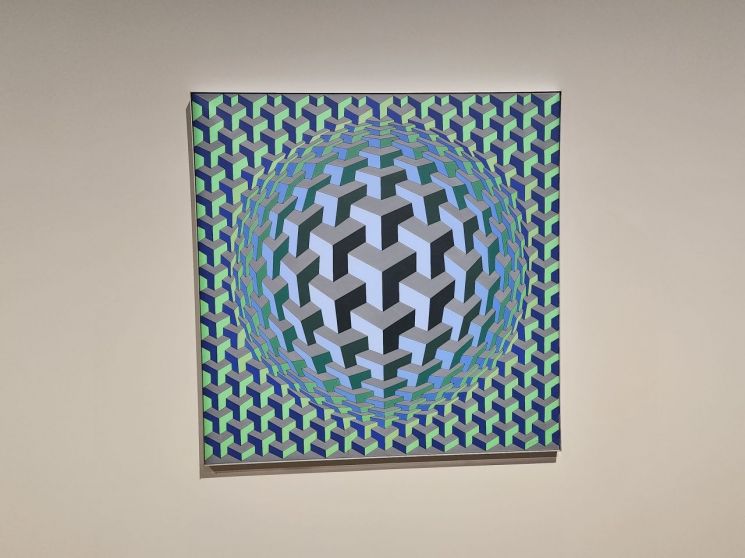
The works of Victor Vasarely (1906-1997) are marked by striking optical illusions. Despite being flat, they present a vivid sense of three-dimensionality when viewed head-on. The intense optical effects created through geometric forms, colors, and patterns are characteristic of Vasarely's work. He is regarded as a leading figure in Optical Art, an abstract art movement that creates a sense of movement and three-dimensionality on a flat surface.
Also on view is "Water Lily Pond" (1917-1920), a representative work by Claude Monet (1840-1926), a leading figure of 19th-century French Impressionism. The impression of water lilies floating on the pond and the sky and clouds reflected on the surface is captured with free and expressive brushstrokes. As one of approximately 250 pieces in Monet's "Water Lilies" series, in which he explored how objects change under different lighting, the work beautifully and vividly captures the fleeting moments of changing light and color.
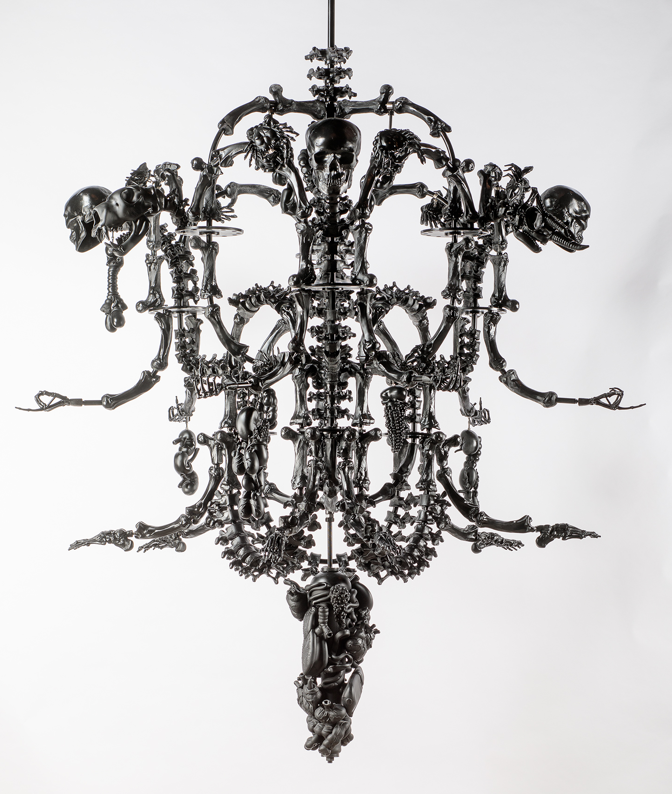 Ai Weiwei's "Black Chandelier" (2017?2021). Courtesy of the National Museum of Modern and Contemporary Art
Suspended from the exhibition hall ceiling, Ai Weiwei's "Black Chandelier" (2017-2021) commands attention with its monumental presence. Born in China, Ai Weiwei studied at the Beijing Film Academy before moving to New York, where he was influenced by artists such as Marcel Duchamp and Andy Warhol and began creating conceptual art using objects. His works are imbued with concerns about human rights, freedom of expression, and refugee issues. "Black Chandelier" embodies death within darkness, in stark contrast to the original purpose of a chandelier as a source of light. The black glass fragments form shapes reminiscent of spines, organs, and the skulls of humans and animals. Crab motifs can also be found throughout the work, serving as a critique of the Chinese government's censorship practices. In Chinese, the word for crab (pangxie) is phonetically similar to the word for censorship (hexie), making the crab an internet slang term for censorship in China. Curator Kim explained, "This work expresses humanity's uncertain future, with the crab symbolizing censorship."
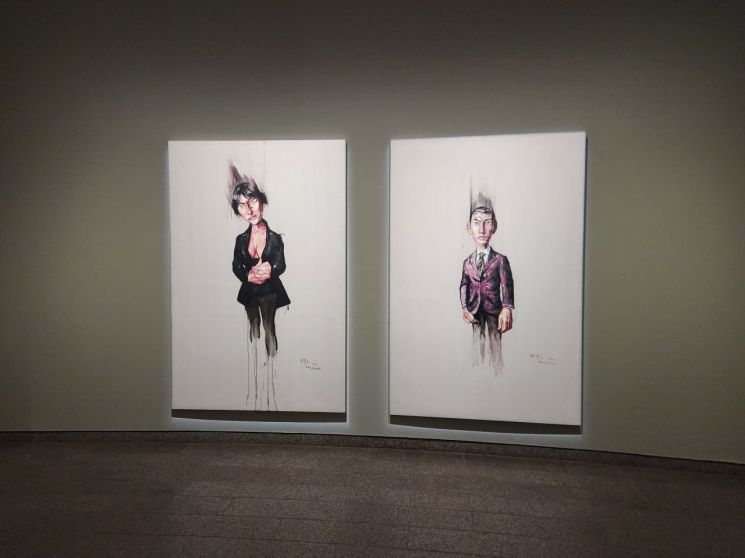
Among the artworks donated through the art payment-in-kind system, Zeng Fanzhi's "Portrait" (2007) is being unveiled. In the two works titled "Portrait," parts of the bodies of a man and a woman are blurred and erased. The artist's signature large, vacant eyes reveal the anxious inner world of alienated individuals. Following his "Mask" series, in which faces were hidden, the "Portrait" series exposes the face, depicting the unstable inner psyche of the vanishing human form.
Director Kim Sunghee commented, "This exhibition is a carefully curated selection of international masterpieces from the National Museum of Modern and Contemporary Art's collection. We planned it so that the stories of the works transcend time and boundaries," adding, "We hope it will be a gift-like exhibition for the Chuseok holiday."
Currently, a permanent exhibition examining the history of Korean art is being held at the Gwacheon branch of the National Museum of Modern and Contemporary Art. With the addition of this exhibition exploring a century of international art history, visitors now have a valuable opportunity to gain a comprehensive view of both Korean and global art. The exhibition runs until January 3, 2027.
© The Asia Business Daily(www.asiae.co.kr). All rights reserved.
![Clutching a Stolen Dior Bag, Saying "I Hate Being Poor but Real"... The Grotesque Con of a "Human Knockoff" [Slate]](https://cwcontent.asiae.co.kr/asiaresize/183/2026021902243444107_1771435474.jpg)


















