Seoul National University is accelerating the development of future medical technologies by breaking down the boundaries between engineering and medicine. By sharing joint research achievements and promoting exchanges between the College of Engineering and the College of Medicine, the university has also successfully concluded an AI medical imaging competition with undergraduate student participation. The university is being recognized for leading an innovative ecosystem in the medical field through interdisciplinary convergence research.
Seoul National University College of Engineering and College of Medicine Hold Interdisciplinary Convergence Research Project Selection and Presentation Ceremony
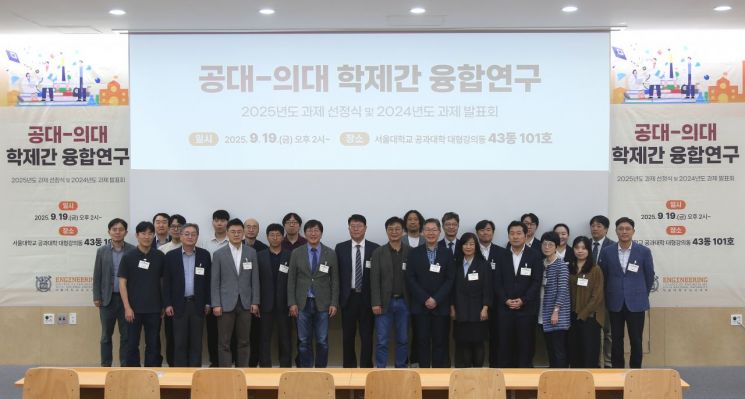
The College of Engineering at Seoul National University (hereafter referred to as Seoul Engineering) held the "Interdisciplinary Convergence Research Project Selection Ceremony for 2025 and 2024 Project Presentation" together with the College of Medicine on September 19.
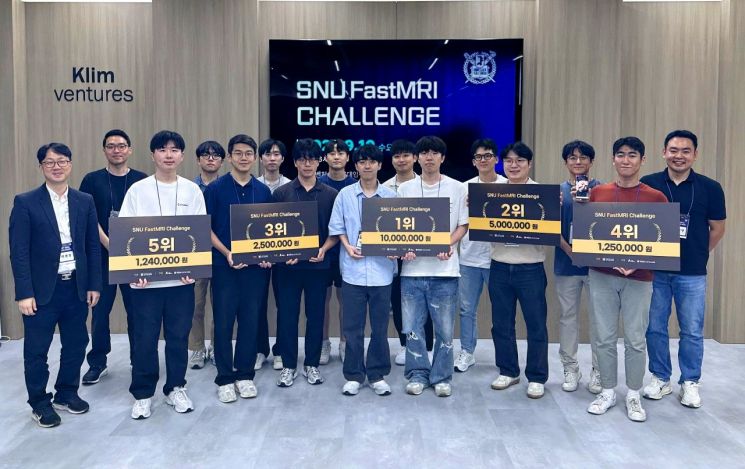
 The 5th SNU FastMRI Challenge hosted by the laboratory of Professor Kim Joungho from the Department of Electrical and Electronic Engineering at Seoul National University. From the left: Professor Kim Joungho, Nam Honggyu, CEO of Kkeullim Ventures, the award-winning team, and Lee Jingu, CEO of Airs Medical. College of Engineering, Seoul National University.
This event served as a platform to revitalize convergence research between the College of Engineering and the College of Medicine and to promote active exchanges between the two colleges. The aim was to generate synergies in the development of innovative future medical technologies through interdisciplinary collaboration and to achieve groundbreaking results that would not have been possible through independent research alone.
During the event, new research projects for 2025 were announced. The newly selected projects include: ▲Functional study of biomolecular phase separation in antibiotic-resistant hospital pathogens ▲Evaluation of the effectiveness of wearable hip robot assistance and personalized support strategies for improving gait function in Parkinson's disease patients ▲Development of an early prediction model for pulmonary arterial hypertension in premature infants using machine learning ▲Development of a portable biosensor for early prediction and rapid diagnosis of neonatal necrotizing enterocolitis for application in neonatal intensive care units ▲Development of a minimally invasive, self-deploying brain surface device and machine learning-based signal processing algorithms for high-frequency signal restoration for diagnosis and treatment of brain disorders ▲Development of an immunotherapy drug for refractory solid tumors based on complement activation and immunogenic cell death induced by CD59×HER2 asymmetric bispecific antibodies.
There were also presentations and mutual discussions on the results of six projects conducted last year. The 2024 research projects included: ▲Basic research on AI digital biomarker tracking technology using mask-type wearable devices ▲Development of an air flow control system for ambulance stretchers and evaluation of its effectiveness in infection control ▲Convergence research on dementia treatment paradigms in simulated microgravity environments, among others.
Kim Youngoh, Dean of Seoul Engineering, stated, "I hope that the convergence of engineering and medicine will establish a world-class research hub and create new research domains." Kim Jeongeun, Dean of the College of Medicine, added, "As the engineering-medicine convergence research project celebrates its 19th anniversary this year and has become a model case for future convergence research by driving new medical discoveries and engineering innovations, I hope the newly selected projects will lead to meaningful results through challenging attempts. We will also promote convergence education at the undergraduate level to contribute to the creation of future growth engines."
The 5th 'SNU FastMRI Challenge' Successfully Concludes...A Step Forward for Commercialization of AI Medical Imaging Technology
Seoul Engineering, under the direction of Professor Kim Joungho's laboratory from the Department of Electrical and Electronic Engineering, hosted the "5th 2025 SNU FastMRI Challenge." This competition, held from July 1 to August 20 for 50 days, invited Seoul National University undergraduates to propose solutions that achieve high-quality MRI images with less data, based on FastMRI technology, which dramatically reduces MRI scan times while maintaining image quality.
 Interdisciplinary Convergence Research Project Selection Ceremony for 2025 and 2024 Project Presentation at the College of Engineering, Seoul National University. College of Engineering, Seoul National University.
A total of 280 undergraduate students participated in this competition, forming 180 teams. This represents an approximately 70% increase in participants compared to the inaugural event in 2021. The students tackled medical imaging challenges such as data reduction, noise removal, and resolution enhancement by utilizing deep neural network-based algorithms. The 'SNUnet' team from the Department of Computer Engineering, which won first place, was recognized for its advanced MRI image reconstruction algorithm, which is considered highly applicable to real-world medical settings.
Through this competition, participants can contribute to the commercialization of AI medical imaging technology. Outstanding teams are also likely to pursue startups or joint research with companies. Professor Kim Joungho of the Department of Electrical and Electronic Engineering at Seoul National University commented, "I hope this competition serves as an important foundation for the future development of medical AI technology."
In fact, the global medical AI market, which is expanding with the growth of the healthcare sector, is projected to grow at an average annual rate of more than 35%, reaching approximately 190 billion dollars by 2030. Among these, the imaging diagnosis AI sector, which handles high-resolution medical imaging data such as MRI and CT, is the fastest-growing market in terms of commercialization.
A representative from Seoul Engineering stated, "We plan to continue hosting competitions focused on challenging research topics such as medical AI and bio artificial intelligence, with participation from both undergraduates and researchers, in order to strengthen the virtuous cycle of technology, talent, and investment."
© The Asia Business Daily(www.asiae.co.kr). All rights reserved.


















