The government is undertaking a sweeping overhaul of criminal penalty provisions scattered across various laws. The aim is to reduce 'excessive criminal penalties' that have discouraged business management and new industry ventures, such as the crime of breach of trust, and have imposed unreasonable burdens on ordinary citizens and self-employed individuals for minor violations. Through this, the government seeks to revitalize the economy and improve livelihoods.
On September 30, the government and the ruling party held a policy coordination meeting and announced the 'First Measures for Rationalizing Economic Criminal Penalties.' This initiative follows President Lee Jaemyung's directive at the Emergency Economic Task Force meeting in July, where he called for swift measures to rationalize economic criminal penalties to prevent excessive penalties from stifling business activities.
Subsequently, the Ministry of Justice, the Ministry of Economy and Finance, the Ministry of Trade, Industry and Energy, and the Ministry of Employment and Labor formed a joint task force to review all relevant laws. As a result, they identified criminal penalty provisions in a total of 110 laws as targets for improvement. Many outdated provisions were found that imposed criminal liability for simple mistakes or minor violations, or failed to reflect the characteristics of new industries.
In revising these criminal penalty provisions, the government established five key principles: criminal penalties should be a last resort, balance and fairness must be ensured, provisions should reflect current realities and rationality, economic activities should be supported, and livelihoods must be protected. If the same effect can be achieved, administrative sanctions or civil remedies will be applied first, aiming to prevent unnecessary criminal risks for ordinary citizens and the self-employed. In particular, acts not intended to pursue illegal gains or mistakes without intent will have reduced penalties or be excluded from criminal punishment altogether.
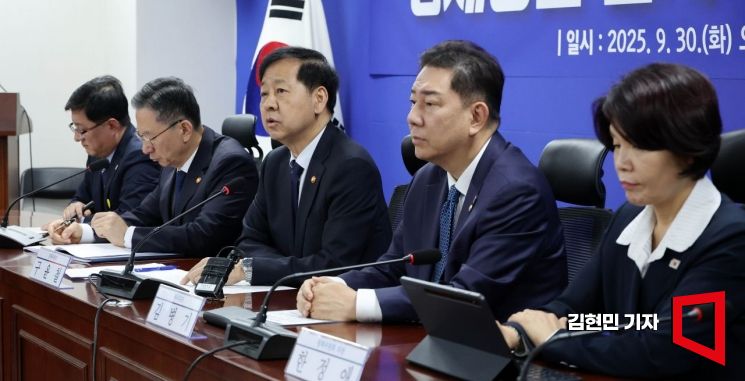 Deputy Prime Minister and Minister of Economy and Finance Koo Yoonchul is speaking at the Economic Punishment Civil Liability Rationalization Task Force ruling party-government meeting held at the National Assembly Members' Office Building on the 30th. 2025.9.30 Photo by Kim Hyunmin
Revising Breach of Trust Laws That Hinder Business Decision-Making
The first category the government is focusing on is criminal penalty provisions that discourage business management activities. The most notable example is the crime of breach of trust. Under current law, company executives can face criminal charges for breach of trust even if they did not pursue personal gain, simply because a loss occurred. The requirements for breach of trust are vague and its scope is broad, which has long been criticized for stifling normal business operations.
As a result, companies have often hesitated to make bold investments or enter new industries. In fact, there are concerns that, during research and development investment by large domestic corporations, technical failures could immediately lead to criminal liability for management. According to the government's analysis of approximately 3,300 first-instance court rulings on breach of trust from the past five years (2020-2024), the crime was most frequently applied in the business sector, but was also widely applied in public and civil areas. Breach of trust has also been applied in areas unrelated to business, such as livelihood issues, misappropriation of business opportunities, and cryptocurrency crimes.
The government plans to ease these provisions so that if there is no intent and the outcome is the result of a reasonable business decision, it will not be punishable as breach of trust. However, acts that harm the interests of the company, such as the private use of corporate funds by employees or the leakage of trade secrets, will still warrant punishment for breach of trust. A government official stated, "We will ensure maximum autonomy and predictability, while also preventing any gaps in the punishment of serious crimes."
Reducing Criminal Penalties That Burden Ordinary Citizens and the Self-Employed
The government will also improve regulations that excessively constrain economic activities affecting livelihoods. For minor violations, criminal penalties will be replaced with administrative fines to prevent the unnecessary creation of criminal records. For example, currently, modifying the size of a truck bed can result in up to one year in prison or a fine of up to 10 million won, but going forward, criminal penalties will be abolished in favor of a maximum administrative fine of 10 million won and an order to restore the original state.
Additionally, if a business such as a hair salon fails to report a change in its business name, the penalty will be revised from up to six months in prison or a fine of up to 5 million won to an administrative fine of up to 1 million won. If an employer fails to specify simple items such as the type of work in an employment contract, the penalty will change from a fine of up to 5 million won to an administrative fine of 5 million won. The government plans to actively identify additional tasks in the future, as imposing criminal penalties for violations of obligations mainly burdens small business owners and is closely tied to everyday life.
While criminal penalties will be eased, financial accountability will be strengthened. For example, under the current Mutual Insurance Association Act, if a director or similar violates the law and unfairly distributes profits to specific individuals, the penalty is up to seven years in prison or a fine of up to 70 million won. This will be changed to up to three years in prison or a fine of up to 30 million won, but liability for damages to victims (up to twice the amount of damages) will be introduced.
The government will also shift to a system of administrative action first, followed by criminal penalties. Even when criminal penalties are necessary, if the legislative purpose can be achieved through administrative sanctions such as corrective orders or orders to restore the original state, these will be prioritized. For example, if a market-dominant business operator unfairly sets product prices under the Fair Trade Act, a corrective order will be issued first, and only if this is not complied with will criminal penalties be imposed. The current provision of up to three years in prison or a fine of up to 200 million won will be maintained only for cases where the corrective order is not followed. Similarly, if a paint manufacturer operates a hazardous chemical facility (such as a storage warehouse) without regular inspections, a corrective order will be issued first, followed by criminal penalties if not complied with. The same applies to cases where large corporations acquire, start, or expand businesses designated as suitable for livelihood, such as bookstores, or lease port facilities without permission.
In addition to the 110 criminal penalty provisions targeted for improvement this time, the government aims to revise 30% of all criminal penalty-related provisions in laws under the jurisdiction of all ministries within one year. Kwon Chilsung, head of the Democratic Party of Korea's Economic Punishment Civil Liability Rationalization Task Force, stated, "The government and ruling party share the view that excessive regulation of economic activities and obstacles to creative innovation and investment decisions are excessively constraining the vitality of the real economy," adding, "We will move away from an overreliance on criminal penalties and, by strengthening civil liability, work to provide substantial protection for victims."
© The Asia Business Daily(www.asiae.co.kr). All rights reserved.

















