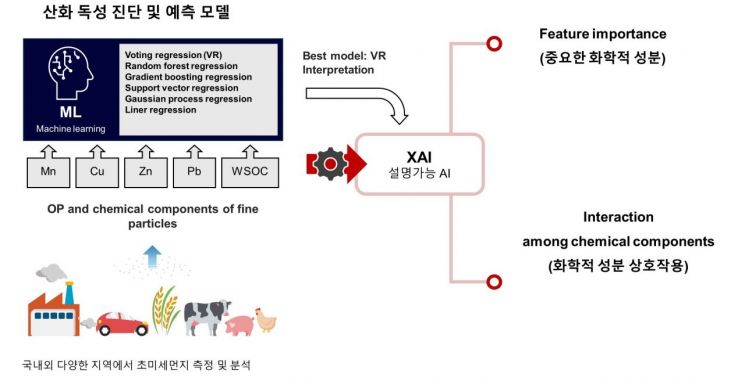
Gwangju Institute of Science and Technology (GIST) announced on September 30 that Professor Park Kihong's research team from the Department of Environmental and Energy Engineering has successfully analyzed the chemical composition and oxidative potential (OP) of fine particulate matter (PM2.5) collected in China and South Korea, and developed an artificial intelligence (AI) prediction model based on this data.
Focusing on the fact that the concentration of fine particulate matter alone is insufficient to fully explain its impact on human health, the research team utilized the oxidative potential-representing the ability of fine dust to induce oxidative stress in the body-as a new indicator of health risk.
Directly measuring the toxic components and toxicity of fine particulate matter requires significant time and cost. To address this, the research team collected data on concentration, chemical composition, and oxidative toxicity (OP) simultaneously over several years from both urban and rural areas in South Korea, China, and other countries, and used this data to train the AI model. As a result, they identified the optimal model capable of most accurately predicting oxidative toxicity using only concentration and chemical composition data.
In particular, the team applied explainable artificial intelligence (XAI) to determine which chemical components have the greatest influence on the oxidative toxicity of fine particulate matter. The results revealed that manganese (Mn), lead (Pb), copper (Cu), zinc (Zn), and water-soluble organic carbon (WSOC) are key factors. Among these, manganese (Mn) was found to have the greatest impact on oxidative toxicity, followed by lead (Pb), water-soluble organic carbon (WSOC), copper (Cu), and zinc (Zn).
Additionally, the XAI analysis revealed interaction effects among the chemical components. For example, when the concentration of copper (Cu) exceeds 0.004 μg/m³, a strong antagonistic effect (where two substances weaken each other's influence) occurs in its interaction with water-soluble organic carbon (WSOC), resulting in suppression of the increase in oxidative potential (OP). This finding demonstrates the discovery of nonlinear interactions-complex relationships that cannot be easily identified through conventional statistical analysis.
The newly developed AI model is not limited to a specific country or region; it can precisely diagnose health risks associated with fine particulate matter and predict trends in various environments. This makes it applicable for public health risk prevention and policy development. The research team expects that this technology will contribute significantly to the development of new health indicators for fine particulate matter in the future, and that it can be applied to assess the health impacts of particulate matter generated not only outdoors but also indoors.
Professor Park Kihong stated, "This study is significant in that it presents a precise health risk assessment method that considers not only the simple concentration of fine particulate matter, but also its chemical characteristics and the interactions among its components. The 'explainable AI' technique can provide scientific evidence for both air pollution management and national policy formulation."
This research, supervised by Professor Park Kihong and conducted by doctoral student Lee Seunghye and others from the Department of Environmental and Energy Engineering at GIST, was supported by the Ministry of Science and ICT and the National Research Foundation of Korea's Individual Basic Research Program (Mid-Career Researcher Program). The results were published online in the international journal Journal of Hazardous Materials on September 11.
© The Asia Business Daily(www.asiae.co.kr). All rights reserved.
!["The Woman Who Threw Herself into the Water Clutching a Stolen Dior Bag"...A Grotesque Success Story That Shakes the Korean Psyche [Slate]](https://cwcontent.asiae.co.kr/asiaresize/183/2026021902243444107_1771435474.jpg)
















