AmCham Hosts U.S. Visa Seminar on the 29th Afternoon
Comprehensive Discussion on Visa Types, Procedures, and Risk Management
Keynote Speech by Jung Manseok, Attorney at Dayang Law Firm
"Requesting Flexible Visa Operations Is Also a Short-Term Solution"
Heightened Interest Following the Georgia Case
Practical Business Strategies and Policy Directions Presented
As South Korea and the United States seek solutions to visa issues, there have been calls for the government and businesses to actively push for the swift passage of the “Partner with Korea Act” in the United States.
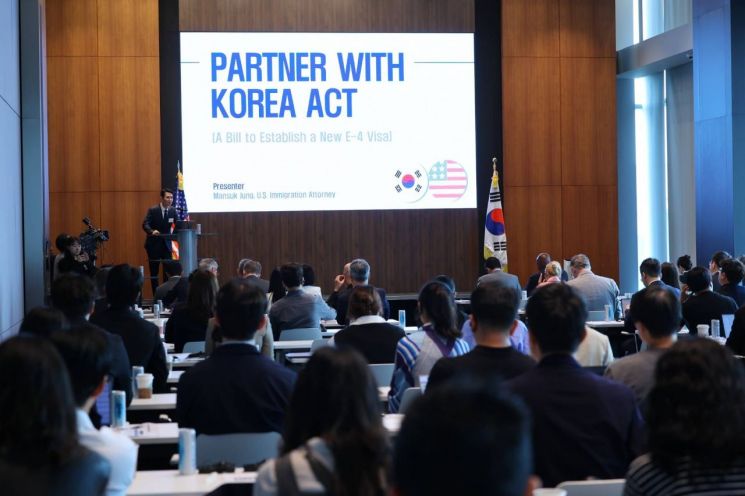 Jung Manseok, immigration attorney at Daeyang Law Firm, is delivering the keynote speech at the "AmCham Insights: U.S. Visa Seminar" hosted by the American Chamber of Commerce in Korea (AmCham) on the 29th at The Forum, IFC Yeouido. Photo by AmCham
Jung Manseok, an immigration attorney at Dayang Law Firm, delivered the keynote speech at the “AmCham Insights: U.S. Visa Seminar” hosted by the American Chamber of Commerce in Korea (AmCham) on the 29th at The Forum, IFC Yeouido, emphasizing this point.
The Partner with Korea Act centers on enabling the annual issuance of up to 15,000 professional employment visas (E-4) to skilled Korean nationals. If this bill passes Congress, Korean companies will be able to reduce the time required to dispatch skilled workers to the United States from the current “six months or one year” to “less than one month.”
Jung pointed out, “South Korea’s investment in the United States is expected to exceed 600 billion dollars,” adding, “This is a considerable amount even compared to Japan (550 billion dollars) or the European Union (600 billion dollars), and South Korea is by far number one in the world in terms of new U.S. investment relative to GDP.”
Previously, the U.S. government requested 350 billion dollars in direct investment from South Korea in exchange for lowering reciprocal tariffs from 25% to 15%. Korean companies accepted this investment plan and, in addition, pledged to invest another 150 billion dollars in the United States.
Jung noted that while there are several legitimate visas such as H-1B, H-2B, L-1, and E-2, there are significant practical constraints due to quota systems, rising costs, and ambiguous interpretations. He stated, “B-1 (business travel) visas or ESTA (Electronic System for Travel Authorization) are only temporary measures and cannot serve as strategic alternatives,” adding, “The biggest problem is the vulnerability of the current system, which is forcing companies to resort to expedient methods out of necessity.”
As a short-term solution, he suggested that the government could request more flexible visa operations from the U.S. side. Jung said, “For large-scale projects in specific industries such as semiconductors and batteries, we could propose administrative guidelines to grant more flexibility in visa screening,” and “There is also the option of expanding and clarifying the scope of activities permitted under the B-1 visa, which many companies currently use.”
At the seminar, AmCham invited domestic and international business representatives, legal professionals, and policy experts to review the overall U.S. visa system and discuss various practical challenges and strategies for Korean companies entering the U.S. market. In particular, the seminar covered visa strategies for smooth market entry, including suitable visa types by purpose, application procedures and considerations, and common mistakes and countermeasures experienced by companies.
James Kim, Chairman and CEO of AmCham, remarked, “The case in Georgia once again demonstrates that companies must thoroughly understand and strictly comply with the U.S. visa system,” adding, “If new systems such as the K-visa are introduced, Korean talent will be able to operate more freely, further strengthening the Korea-U.S. economic partnership.” He continued, “AmCham will continue to provide reliable information and practical strategies so that member companies can confidently continue their business even as regulatory environments change.”
Christopher Landau, U.S. Deputy Secretary of State, said in a video message, “Investments by Korean companies play a key role in President Trump’s vision for America’s future,” adding, “The United States deeply appreciates the scale and impact of these investments, and recognizes that such investments can only succeed if the management of Korean companies can come to the U.S. to share expertise and train local talent.”
© The Asia Business Daily(www.asiae.co.kr). All rights reserved.
![Clutching a Stolen Dior Bag, Saying "I Hate Being Poor but Real"... The Grotesque Con of a "Human Knockoff" [Slate]](https://cwcontent.asiae.co.kr/asiaresize/183/2026021902243444107_1771435474.jpg)
















