Trump Raises H-1B Visa Fee by 100 Times
Global Competition to Attract Top Professionals Intensifies
Prime Minister Carney: "We Will Propose Talent Attraction Policies"
As U.S. President Donald Trump increased the professional H-1B visa fee by a factor of 100, countries around the world are moving to attract top talent. Yonhap News reported on the 27th (local time), citing Bloomberg, that "Canadian Prime Minister Mark Carney expressed his intention to attract professionals who are unable to work in the United States to Canada."
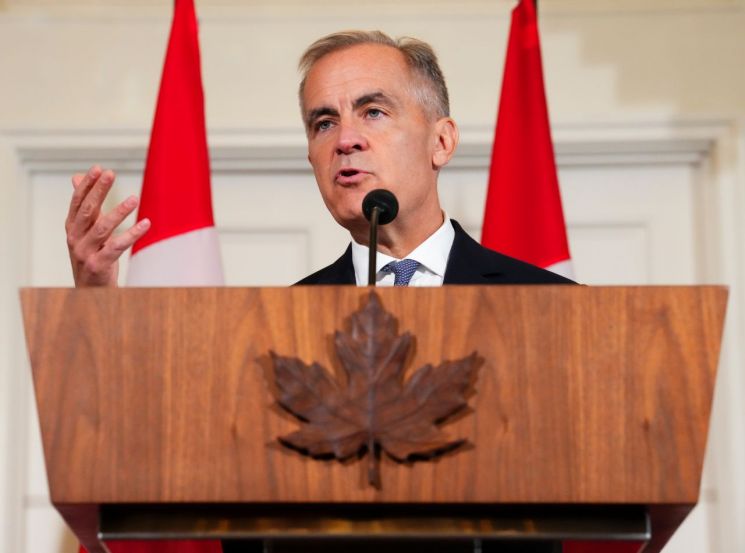
During his visit to London, Prime Minister Carney commented on the Trump administration's changes to the H-1B visa policy, stating, "What is clear is that this is an opportunity to attract people who previously received H-1B visas to Canada." He added, "Many H-1B applicants are professionals in the technology sector and are willing to migrate for work." He emphasized, "As we review our immigration policy, we are considering the absorption of this type of talent," and said, "We will make clear policy proposals on this matter."
On the 19th, President Trump announced that the H-1B visa fee would be raised from $1,000 per person per year to $100,000. The H-1B visa is applied to professional positions in the STEM (Science, Technology, Engineering, and Mathematics) fields, and has been regarded as a means for U.S. companies to hire top talent and maintain their competitiveness.
However, hardline conservatives in the United States have criticized the H-1B visa, arguing that it takes away high-paying jobs from Americans. As of last year, 71% of visa recipients were Indian nationals and 11.7% were Chinese nationals.
The Department of Homeland Security projected that, once the new system is implemented, the total wages paid to H-1B workers would increase to $502 million in fiscal year 2026, $1 billion in 2027, $1.5 billion in 2028, and $2 billion annually from 2029 to 2035. Currently, about 5,200 small and medium-sized enterprises using the H-1B visa are expected to suffer significant economic damage due to the loss of labor.
Other countries besides Canada are also seizing the opportunity to attract top talent to their own countries following the U.S. H-1B visa fee hike. The British government is considering abolishing fees for its own visa programs similar to the H-1B visa. China plans to introduce a new visa for attracting STEM professionals starting in October.
Bernhard Rohleder, head of Bitkom, a German digital industry association, stated, "The new U.S. policy could be an opportunity for Germany and Europe to attract the best talent." Kang Hoonshik, Presidential Chief of Staff, also commented, "This could be an opportunity to attract global STEM professionals to Korea," adding, "The government plans to focus next year's budget on major initiatives such as an AI-driven transformation to realize a super-innovative economy led by technology."
© The Asia Business Daily(www.asiae.co.kr). All rights reserved.

















