Identity Verification Blocked as Resident Registration Card Services Halted
Loan Reviews Also 'Stopped' as Public MyData Disrupted
Financial Firms Hold Emergency Meetings... "Prepare Paper Documents for In-Person Services"
As the government’s computer network has been virtually paralyzed due to the fire at the National Information Resources Service (NIRS), disruptions are spreading across the entire banking sector. This is not a simple system error; critical infrastructure such as resident registration card verification and electronic certificate issuance has come to a halt, making it inevitable that financial activities across the board-including non-face-to-face account openings, loan reviews, and card issuance-are facing significant inconvenience.
According to the financial industry on September 28, the fire that occurred on September 26 led to the suspension of resident registration card-based identity verification services. As a result, non-face-to-face account openings at banks are only possible for those who possess a driver's license, passport, alien registration card, or an already issued mobile ID. Customers without alternative identification methods are unable to use mobile banking or even receive a check card. Even when visiting a branch, government-issued documents cannot be provided, resulting in a vicious cycle of work delays.
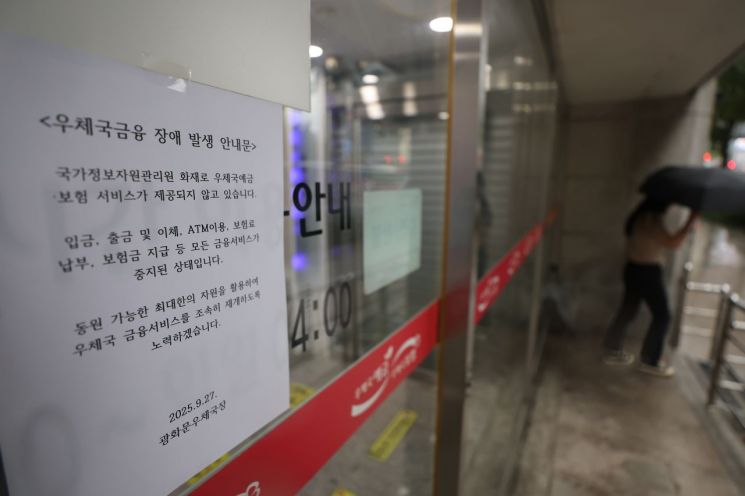 Due to a fire in the computer room of the Daejeon National Information Resources Service (NIRS), postal and financial services have been disrupted. On the 28th, a related notice was posted in front of a post office in downtown Seoul. Photo by Yonhap News
In particular, the suspension of the public MyData service has had a direct impact on the loan market. Some banks have halted reviews for credit loans and mortgage loans because they cannot electronically verify income or assets. The inconvenience of having to obtain physical documents has increased, causing significant uncertainty for those involved in real estate transactions and individuals needing funds for living expenses. Internet-only banks have been hit even harder, as they lack alternative channels. KakaoBank has implemented an emergency solution by allowing document image uploads, but K Bank and Toss Bank are unable to process applications for certain loan products.
As the confusion spreads, financial holding companies and banks have all activated crisis response systems. Major financial firms such as Shinhan Financial Group, Hana Financial Group, KB Financial Group, Woori Financial Group, and NH Nonghyup Financial Group are holding consecutive meetings led by risk management executives, and are thoroughly reviewing branch response manuals and customer notification plans across their organizations. Some banks plan to distribute company-wide notices and call center response guidelines in preparation for a return to normal operations starting on September 29.
The card and insurance industries are also working to minimize confusion by guiding customers to use alternative authentication methods such as driver's licenses. Mutual financial institutions have also begun to develop their own response measures. The financial authorities will hold another emergency meeting this afternoon, following one held the previous day, to reassess the damage situation by sector.
© The Asia Business Daily(www.asiae.co.kr). All rights reserved.












