Interview with Song Junho, CEO of Korea PIM
From Realizing Precise Robot Hand Movements to Mass Production
Supplying Components to US Humanoid Companies via Korean Conglomerates
Mass Production of Reducer Parts for Logistics Robots Expected Next Year
Global big tech companies are making massive investments to gain an early lead in the humanoid robot market. Hyundai Motor Group is rushing to pilot its humanoid robot, 'All-New Atlas,' on production lines within this year. The establishment of robotics-dedicated factories around the world is also on the horizon. In the domestic stock market, shares related to humanoid robots, such as Rainbow Robotics, Robotis, and Wonik Holdings, have surged significantly since the beginning of this year. The corporate value of Robotis and Wonik Holdings, both of which have developed 'robot hands,' has increased by five to six times.
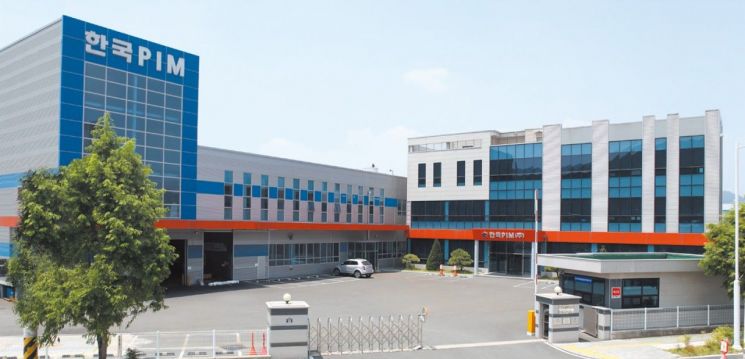
Highly sophisticated robot hands are one of the fundamental prerequisites for dominating the global humanoid market. Even Elon Musk, CEO of Tesla, which developed the humanoid 'Optimus,' has cited robot hands as the biggest challenge in the overall design of humanoids. Korea PIM, a KOSDAQ-listed company, has secured ultra-precision manufacturing technology called 'micro metal powder injection molding (MIM),' which is necessary to produce components that enable the precise movements of robot hands. The company is working to supply these parts to American humanoid companies through domestic conglomerates.
Precision Robot Fingers... Joining the Humanoid Value Chain

Song Junho, CEO of Korea PIM, said, "In humanoid robots, especially in the fingers, ultra-small reducers of generally less than 20mm are applied to realize precise movements," adding, "These small reducers consist of very tiny parts, which are mainly manufactured using turning processes."
He continued, "Turning processes are not suitable for mass production," and added, "Korea PIM has secured the technology to mass-produce small parts by applying micro MIM technology."
This is why leading global humanoid companies are seeking to partner with Korea PIM, whose market capitalization is only 100 billion won. As the company possesses essential technological capabilities for establishing a mass production system for humanoids, its role in the era of humanoids is expected to grow further.
Korea PIM, the number one MIM technology company in Korea, has accumulated expertise in MIM technology while producing automotive parts such as turbochargers and dual-clutch transmissions (DCT). Based on this, the company is now ready to enter the humanoid supply chain. CEO Song explained, "Unlike traditional robots, the core of humanoids is the realization of precise movements. For this, ultra-small reducers are essential, and Korea PIM mainly manufactures reducers smaller than Ø50 (50mm) with the goal of supplying them to humanoid robot module manufacturers."
He added, "Although we cannot disclose details due to non-disclosure agreements (NDAs) with our clients, we have completed the development of materials for humanoid parts and are currently conducting physical property tests on lightweight materials."
Before humanoid parts, the mass production of reducer parts for logistics robots is expected to proceed even more quickly. Clients are already testing the quality with the goal of completing validation within this year. Mass production is expected to be applied next year.
Maximizing Shareholder Value through New Businesses in Robotics and Defense
CEO Song has high expectations for new businesses in humanoids and robotics. He said, "If the commercialization of humanoid robots, which have significant growth potential, gets into full swing, we expect to far exceed our target sales figures," adding, "While maintaining stable growth in our existing automotive business, we will generate new revenue streams in robotics, defense, and aerospace, which are our new growth engines."
He promised, "We will expand our sales scale for advanced industries based on our unrivaled technological capabilities and thereby increase shareholder value."
Korea PIM's role in future growth industries is expected to become even more significant. In advanced industries such as aerospace, as well as robotics, miniaturization, precision, and weight reduction are essential factors. CEO Song said, "Starting domestically, we are shifting the materials applied to MIM technology to focus on titanium, and we expect to maximize the lightweight properties through this."
Korea PIM has recently entered the defense market as well. Last month, the company won its first order for next-generation firearm materials from Israel Weapon Industries (IWI), Israel's largest firearms manufacturer. By producing safety locking devices for firearms using MIM technology, the company can minimize processes compared to conventional casting methods, thereby maximizing production efficiency.
CEO Song explained, "We have received an initial order for one product and are currently developing it," and added, "After commercializing the first product, we plan to secure additional items as well."
© The Asia Business Daily(www.asiae.co.kr). All rights reserved.












