Nuclear Safety and Security Commission Delays Decision
on Accident Management Plan and Continued Operation Permit
On September 25, the Nuclear Safety and Security Commission reviewed whether to allow the continued operation of Gori Nuclear Power Plant Unit 2 in Gijang-gun, Busan. However, as some members expressed the need for further review, the commission did not reach a conclusion and decided to revisit the issue at the next meeting.
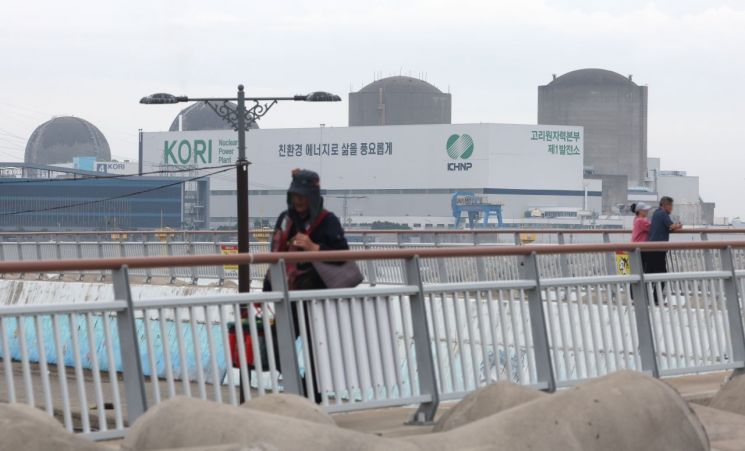 On the afternoon of the 25th, a view of Gori Unit 2 (second from the right) was seen from Wolnae, Jangan-eup, Gijang-gun, Busan. The Nuclear Safety and Security Commission held a meeting that day to review the accident management plan and the continued operation of Gori Unit 2. Photo by Yonhap News Agency
During its 222nd meeting on this day, the commission placed the approval of the accident management plan and the continued operation permit for Gori Unit 2 on the agenda for deliberation and resolution. However, to allow for more thorough discussion, it decided to resubmit the agenda items at a future meeting.
The commissioners debated the accident management plan, which was the second item on the agenda, for about three hours starting at 2 p.m. However, they raised concerns that there was insufficient explanation about the differences between Gori Unit 2-a different reactor type from the previously approved Korean standard nuclear power plant (APR1400)-and called for further discussion.
The commission also decided to revisit the continued operation permit, as some aspects of it overlap with the accident management plan, such as measures for responding to severe accidents. The next meeting is scheduled for October 23.
Gori Unit 2 began commercial operation on April 9, 1983. It is a pressurized water reactor with an electric output of 685 megawatts (MWe). The plant was shut down on April 8, 2023, after exceeding its 40-year design lifespan. Korea Hydro & Nuclear Power applied for continued operation in April 2022.
© The Asia Business Daily(www.asiae.co.kr). All rights reserved.

![Clutching a Stolen Dior Bag, Saying "I Hate Being Poor but Real"... The Grotesque Con of a "Human Knockoff" [Slate]](https://cwcontent.asiae.co.kr/asiaresize/183/2026021902243444107_1771435474.jpg)















