U.S. to Enforce 15% Tariff on EU Cars Starting in August
Japan to Receive 15% Tariff from the 16th
South Korea Alone Faces 25% Tariff Due to Disagreement Over $350 Billion U.S. Investment
The U.S. government has finalized a decision to lower tariffs on European automobiles and auto parts to 15%, in accordance with a trade agreement reached with the European Union (EU) last July. With the EU now receiving the same benefits as Japan, South Korea, which continues to face a 25% tariff on automobiles, finds itself at an even greater disadvantage compared to its competitors in the U.S. market.
On the 24th (local time), the U.S. Department of Commerce and the Office of the United States Trade Representative (USTR) released an advance notice containing these details, one day ahead of the official publication in the Federal Register on the 25th.
According to the advance notice, the U.S. will reduce tariffs on European automobiles from the current 27.5% to 15%, retroactively effective from August 1. As a result, European companies that paid tariffs exceeding 15% after August will be eligible for refunds.
Additionally, the U.S. will exempt certain European pharmaceutical ingredients and aircraft parts from tariffs, with this measure retroactively applied from September 1.
This measure is contingent on the EU eliminating tariffs on U.S. manufactured goods and enacting legislation to open certain agricultural and fisheries markets. Since the EU already introduced a draft of the relevant legislation at the end of last month, both sides have effectively begun the process of implementing the agreement.
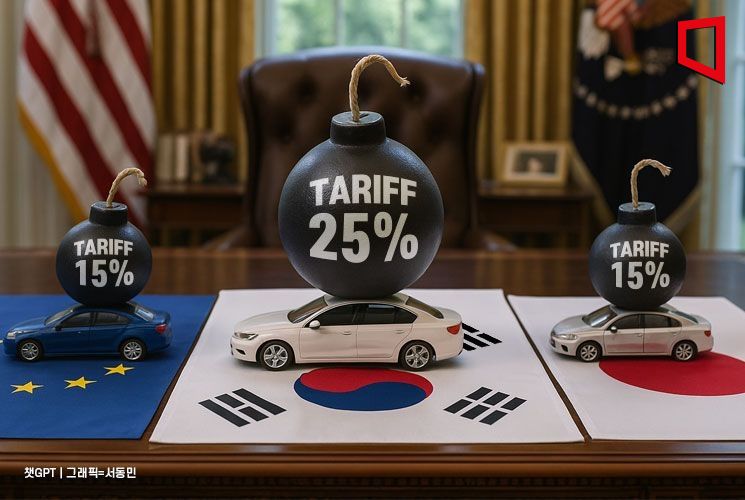
Previously, since April, the U.S. had imposed a 25% itemized tariff on all imported automobiles. Subsequently, the U.S. reached trade agreements with Japan, the EU, and South Korea, agreeing to lower automobile tariffs for these countries and regions to 15%. While the U.S. implemented this measure for Japan on August 16 and for the EU on August 1, South Korea remains the only one among them for which the 15% tariff reduction has not been applied.
This situation stems from a deadlock in follow-up negotiations on the U.S.-Korea trade agreement. At the end of July, the U.S. and South Korea agreed that South Korea would establish a $350 billion investment fund in the U.S. in exchange for mutual tariff reductions and a 15% tariff on automobiles. However, the two sides have since disagreed on how the investment should be executed. The U.S. is demanding a higher proportion of direct investment, while South Korea prefers investment through guarantees and loans, maintaining a negative stance toward the U.S. proposal. As the U.S. holds firm to its position, the South Korean side, concerned about potential shocks to the foreign exchange market, has even made a currency swap agreement a precondition, with President Lee Jaemyung personally involved, but the U.S. has not accepted this either.
As a result, the South Korean automobile industry is left with no other choice but to endure unfavorable conditions in the U.S. market until the U.S.-Korea trade agreement is finalized. Recently, Hyundai Motor Company reflected the impact of tariffs by lowering its annual consolidated operating margin target from the previous 7-8% to 6-7%, a decrease of 1 percentage point. Regarding this, Jose Munoz, President of Hyundai Motor Company, stated at an investor event in New York on the 18th that he hopes U.S. tariffs on Korean automobiles will be reduced from the current 25% to 15%, emphasizing the need for the U.S.-Korea trade agreement to be concluded as soon as possible.
© The Asia Business Daily(www.asiae.co.kr). All rights reserved.













