Export Value Reaches $795 Million from January to August, Up 12%
Driven by Japan and the United States, Expansion into Southeast Asia and Russia
Gim, often referred to as the "black semiconductor," has once again broken its own export record. The combination of growing curiosity about Korean culture and the recognition of gim as a healthy food has led to record-breaking results every year. Once considered merely a side dish, gim is now evolving into a high-value-added snack in overseas markets. Major domestic food companies are also actively strengthening their presence in the gim industry.
Exports Up 12%, Expansion Centered on Japan and the United States
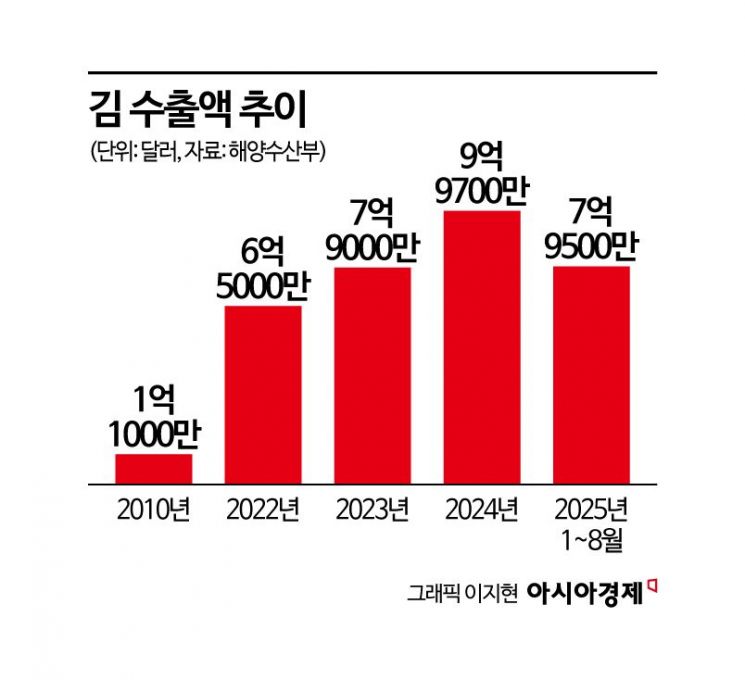
According to the Ministry of Oceans and Fisheries and the food industry on September 23, the export value of gim from January to August this year reached 794.99 million dollars (approximately 1.1 trillion won), up 12.3% from 708.1 million dollars during the same period last year. This figure has already surpassed the total export performance for 2023. During the same period, export volume also increased by 8% to 26,613 tons.
By country, the top export destinations are Japan (168.92 million dollars), the United States (162.04 million dollars), China (84.49 million dollars), Thailand (79.53 million dollars), and Russia (63.36 million dollars). The export value of gim has grown nearly ninefold, from 110 million dollars in 2010 to 997 million dollars last year.
According to the Ministry of Oceans and Fisheries' plan to strengthen the competitiveness of the gim industry, Korean gim holds a 70% share of the global market. The global trade volume of gim has grown from 440 million dollars in 2014 to 1.08 billion dollars in just ten years. Only three countries-Korea, Japan, and China-produce gim, giving Korea a dominant position. Last year, Korea produced more than 1.5 billion sheets (one bundle consists of 100 sheets) annually. The Ministry of Oceans and Fisheries expects this to increase to 1.6 billion bundles this year.
The domestic gim industry is shifting from exporting mainly raw and low-priced products to focusing on processing, branding, and localization.
Orion, in partnership with the National Federation of Fisheries Cooperatives, invested 60 billion won to establish the joint venture "Orion Suhyup." Based on dried gim, the company is targeting the global market with processed products such as gim snacks. Thailand is a representative country for gim snacks, with the local brand "Tao Kae Noi" having become a national snack. For Thai consumers, gim is considered more of a snack or appetizer than a side dish for rice.
Since launching "Yangban Gim" in 1986, Dongwon F&B has maintained a quality concept of "selecting only the best gim and roasting it twice." The company directly purchases raw materials through a system of origin inspectors and was quick to introduce applied products such as gim flakes and gim bugak. "Yangban Gim Bugak," launched in 2021, modernized the traditional gim bugak into a snack format and has been well received in the market. Recently, Dongwon F&B has collaborated with Dongwon Home Food to release "Dipping Gim Bugak," further targeting the appetizer and snack market. While Japan accounts for about 30% of its exports, the company expanded its market to Muslim countries such as Malaysia and Indonesia after obtaining halal certification in 2016.
Daesang exports to more than 30 countries based on its local factories in Indonesia and Vietnam. Sales of processed seaweed products reached 155 billion won last year, more than doubling in four years. Daesang established the first private "Seaweed Research Center," introduced a gim quality grading system, and strengthened competitiveness by offering customized raw material blends for side dishes, snacks, and ingredients. In Indonesia, the "Mama Suka" brand holds the top market share, while in Vietnam, "O'Food" gim flakes and snack gim are popular as health foods.
Gim Prices Rising, Technology Development for Production Stabilization
Gim prices have been rising sharply in recent times. This is due to unstable aquaculture environments caused by climate change, increased labor and raw material costs, and a surge in overseas demand. According to the Korea Agro-Fisheries & Food Trade Corporation (aT), the retail price for dried gim (per 10 sheets) was 1,354 won as of September 22, up 43% compared to the average year.
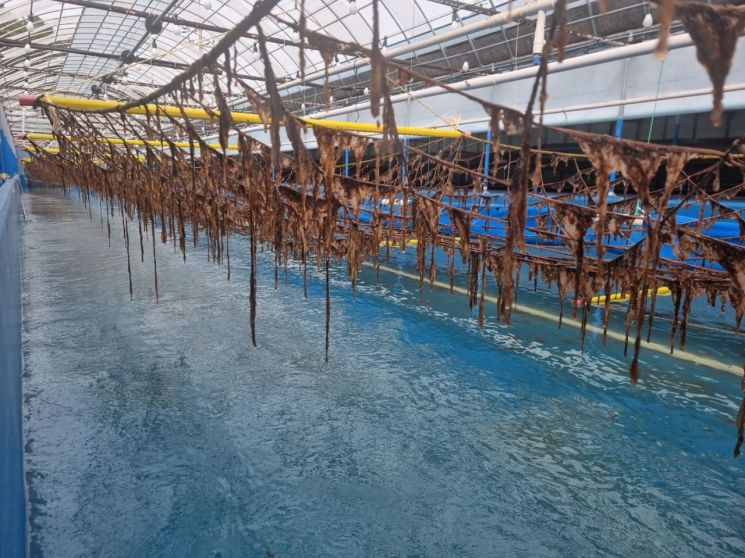
In response, food companies are focusing on "land-based aquaculture" technology to stabilize production. In 2023, Dongwon F&B signed a memorandum of understanding (MOU) for smart land-based aquaculture of gim and seaweed with the Jeju Technopark Lava Seawater Center, aiming to secure high-quality raw materials by utilizing lava seawater with stable year-round temperatures and minerals. The company is also strengthening research and development (R&D) with advice from Professor Park Eunjeong, a leading seaweed research expert at Pukyong National University.
Daesang has established a land-based aquaculture facility in Goheung, Jeollanam-do, and is conducting year-round production trials. This year, Daesang was selected as the lead institution for the Ministry of Oceans and Fisheries' national project on "sustainable high-quality gim seed and land-based aquaculture technology development," and plans to lead R&D worth 35 billion won through 2029. Pulmuone is also working with Kongju National University, Pohang University of Science and Technology, and Daesang on a project for "year-round production and quality management of gim."
CJ CheilJedang has accelerated research on land-based aquaculture technology this year by partnering with Jeollanam-do, Haenam County, Incheon City, and Incheon National University. In February, the company collaborated with Jeollanam-do and Haenam County to promote technology development and distribution in the gim industry, and in March, it signed an agreement with Incheon City and Incheon National University to advance marine and fisheries development and research on gim aquaculture.
© The Asia Business Daily(www.asiae.co.kr). All rights reserved.