Over 230 Works on Display, Many Debuting in Korea
Insured Value Reaches 1.4 Trillion Won, Collected from Nine Countries
On View at DDP Museum Until January 31 Next Year
Works by Jean-Michel Basquiat (1960-1988), a master of contemporary art who elevated graffiti into high art, have arrived in Korea in a blockbuster exhibition with an insured value of approximately 1.4 trillion won. The special exhibition, "Jean-Michel Basquiat: Iconic Symbols Connecting Past and Future," is organized into 11 sections and features over 230 pieces, including more than 70 paintings and drawings collected from nine countries, as well as 155 pages from Basquiat's notebooks. Most of these works are being introduced to Korea for the first time through this exhibition.
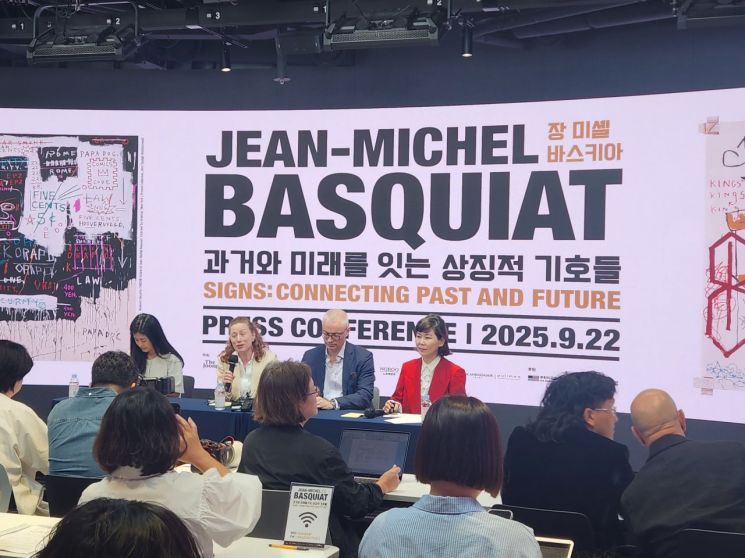 On the 22nd, a press conference for "Jean-Michel Basquiat: Iconic Symbols Connecting Past and Future" was held at the Dongdaemun Design Plaza (DDP) Seoul Hwaseong On Studio. From the far right, Lee Jiyoon, Artistic Director; Dieter Buchhart, Curator; Anna Karina Hofbauer. Photo by Seo Mideum
Jean-Michel Basquiat was born in Brooklyn, New York in 1960 to parents of Puerto Rican and Haitian descent. From the age of eight, he began expressing family conflicts and personal turmoil through art, gaining attention for his politically charged and poetic graffiti on the streets. In 1981, he debuted as a fine artist at the "New York/New Wave" exhibition, and at 22, he became the youngest artist to participate in the Whitney Biennial, making a significant mark on the art world. Although he died young at the age of 27 in 1988, his eight years of work are regarded as masterpieces that encompass symbols, history, race, identity, and language. In 2017, his 1982 painting "Untitled" was sold at Sotheby's New York auction for 150.2 billion won, and he is now considered one of the most influential contemporary artists in the world, surpassing even Andy Warhol.
This exhibition delves deeply into Basquiat's journey of embodying "symbols and iconography" as he visually explored the universal language of human communication. For the first time in Asia, it presents more than 70 paintings and drawings created over eight years, from his early life until just before his death, along with eight artist notebooks (153 pages) that he personally recorded. Lee Jiyoon, Director of the SUM Project and chief organizer of the exhibition, stated at a press conference held on the morning of the 22nd, "Jean-Michel Basquiat lived a short but intense life. During his eight years of artistic activity, he built a unique language and symbolism, embedding fundamental questions about race, identity, and power into his works."
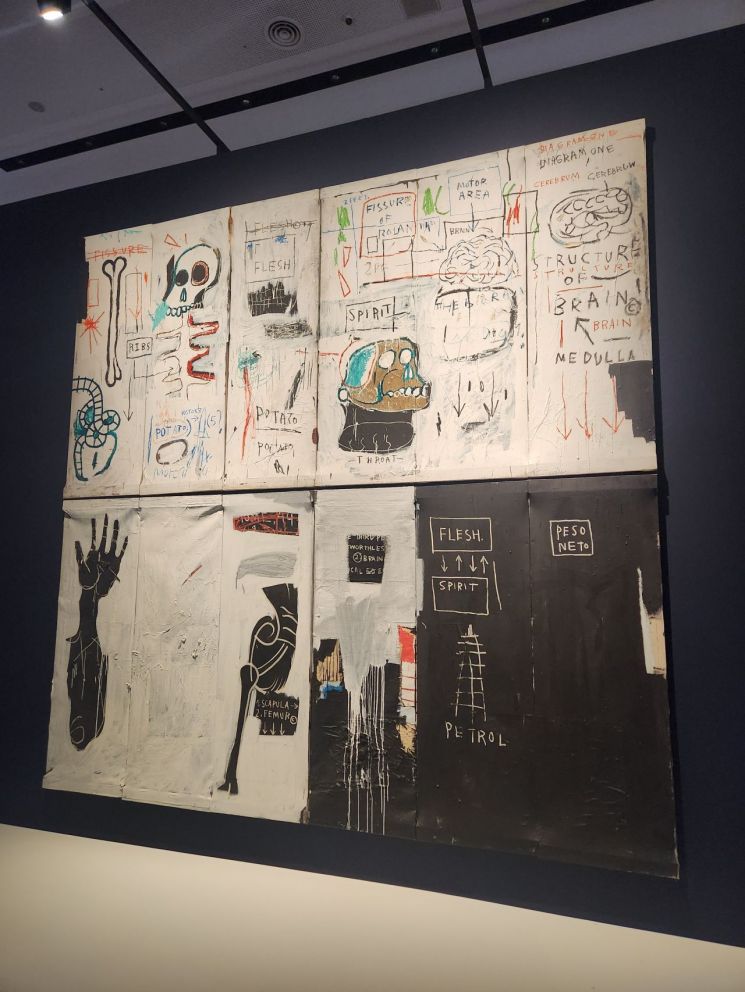
Dieter Buchhart and Anna Karina Hofbauer, the curators who co-organized this exhibition, recommended Basquiat's monumental work "Flesh and Spirit" (1982-1983) as a highlight. Composed of four large canvases and twelve panels, this piece juxtaposes anatomical imagery with African spiritual symbols centered on "flesh" and "spirit," exploring the boundaries between life and death, science and faith.
In May 1968, at the age of seven, Basquiat suffered a serious car accident that resulted in a broken arm and a ruptured spleen, requiring major surgery. His mother, Matilda, gave him a copy of "Gray's Anatomy," a book that had a profound impact on his artistic world. Anatomical explanations, words, and drawings frequently appear in Basquiat's works, leading to explorations of identity, death, and vulnerability.
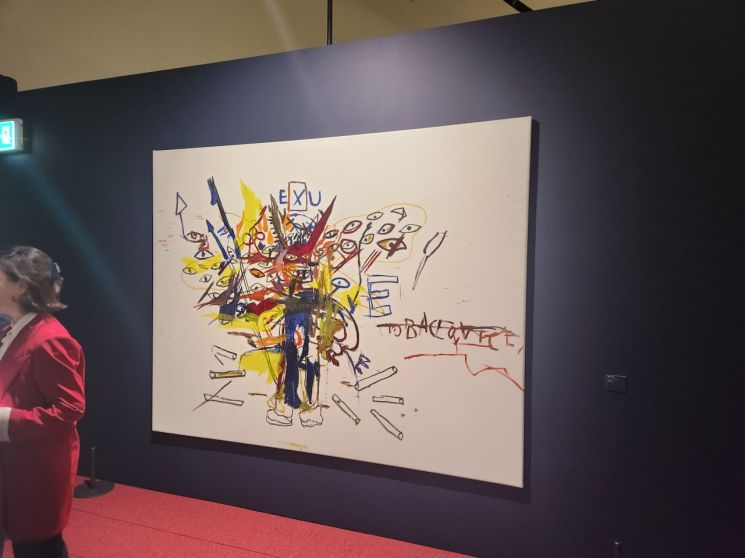
"Exu" (1988), a spiritual self-portrait, is the last work Basquiat completed in his lifetime. Through "Exu," the Yoruba deity of boundaries, he simultaneously reveals his intuition about death and questions of identity. The cigarette placed on the floor serves both as an offering to the deity and as a reference to the exploitation of slaves on tobacco plantations, while the words "TOBACCO VICE" written on the right highlight the immorality of such exploitation.
The exhibition also features Korean cultural artifacts such as the Bangudae Petroglyphs of Daegok-ri, Uljoo, the Hunminjeongeum Haeryebon, late calligraphy by Kim Jeonghee (Chusa), and video art by Nam June Paik. Director Lee Jiyoon explained, "By discovering the universal language and symbolism that Basquiat sought within Korean culture, we aimed to create a new interpretive space where Eastern and Western aesthetics intersect." The exhibition runs until January 31 next year.
© The Asia Business Daily(www.asiae.co.kr). All rights reserved.














