Rising Share of Experienced Freshmen
Rolling Recruitment Nears 80 Percent
Average Starting Salary Reaches 46.71 Million Won
It has become increasingly evident that major domestic conglomerates are showing a stronger preference for candidates with prior work experience, even in entry-level recruitment. Companies are favoring so-called "experienced new hires" with short-term experience, as a way to reduce the costs and time associated with recruitment and talent development.
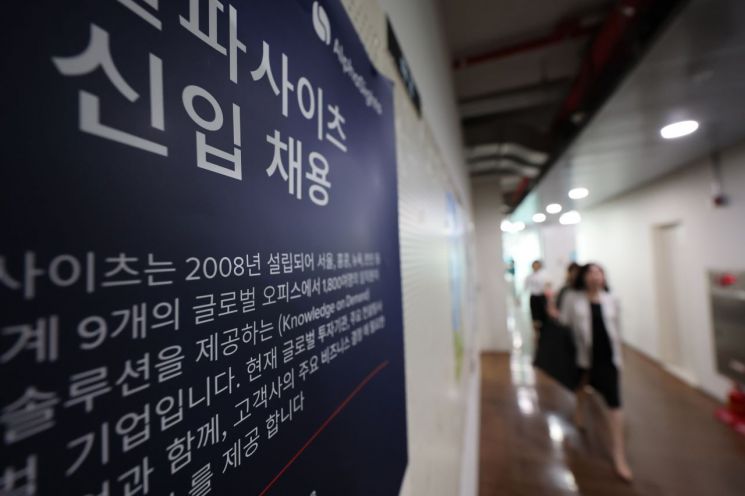 A graduate is walking past the employment bulletin board with a public recruitment notice posted at Ewha Womans University in Seodaemun-gu, Seoul, where the 2024 academic year second semester graduation ceremony is being held. Photo by Yonhap News
According to a survey titled "2025 Second Half University Graduate Recruitment Plans" released by the Korea Economic Research Institute on the 21st, 28.1% of new university graduate hires last year joined with some level of prior work experience. This figure represents an increase of 2.3 percentage points from the previous year (25.8%).
The survey targeted 121 companies among the top 500 firms by revenue. Among these companies, the most preferred length of prior experience for experienced new hires was "1 to 2 years," accounting for 46.5%. This was followed by "6 months to 1 year" (38.6%), "2 to 3 years" (7.9%), and "more than 3 years" (5.3%).
Notably, the preference for experienced candidates varied by company size. The top 100 companies by revenue tended to favor candidates with short-term experience, whereas companies ranked 300th to 500th showed a stronger preference for those with "2 to 3 years" or more of experience.
In the same survey, experienced hires accounted for an average of 26.9% of new university graduate recruitment in the second half of this year. The proportion of companies planning to hire "more than half experienced candidates" reached 15.7%, while only 22.3% of companies reported having no plans to hire experienced candidates at all.
Changes are also being observed in recruitment methods for the second half of the year. A total of 48.8% of all respondent companies indicated plans to conduct "rolling recruitment," suggesting a rapid transition from the traditional public recruitment system with fixed schedules to hiring as needs arise.
The proportion of rolling recruitment was overwhelmingly higher than that of public recruitment. Among the 59 companies that have adopted rolling recruitment, the share of rolling recruitment was 79.5%, about four times higher than public recruitment (20.5%).
However, even among large corporations, the top 100 companies had a relatively low adoption rate of rolling recruitment at 30%. This is attributed to the fact that some major companies, such as Samsung, still maintain a regular public recruitment system.
The average starting salary for new hires at large corporations was 46.71 million won. By company size, the top 100 companies offered an average of 52.5 million won, companies ranked 101st to 200th offered 50 million won, and companies ranked below 300th offered around 43.05 million won.
An industry official commented, "Recently, companies are increasingly favoring candidates with immediate work readiness, considering cost efficiency and productivity. Now, only Korea and Japan maintain a public recruitment system. It is highly likely that the domestic recruitment culture will also shift toward rolling and experienced-based hiring."
Meanwhile, when asked about the major expected changes in the recruitment market for the second half of the year, the most cited was "increase in rolling recruitment" (22.0%), followed by "expansion of experienced hiring" (19.5%), "stronger preference for experienced new hires" (16.2%), and "strengthened assessment of organizational fit" (16.2%).
© The Asia Business Daily(www.asiae.co.kr). All rights reserved.
![Clutching a Stolen Dior Bag, Saying "I Hate Being Poor but Real"... The Grotesque Con of a "Human Knockoff" [Slate]](https://cwcontent.asiae.co.kr/asiaresize/183/2026021902243444107_1771435474.jpg)
















