Scheduled to Open in Two Locations in Gwangsan and Seo Districts, Gwangju
Consumers: "Able to Compare at Affordable Prices"
Pharmaceutical Association: "Concerns Over Misuse and Threats to the Ecosystem"
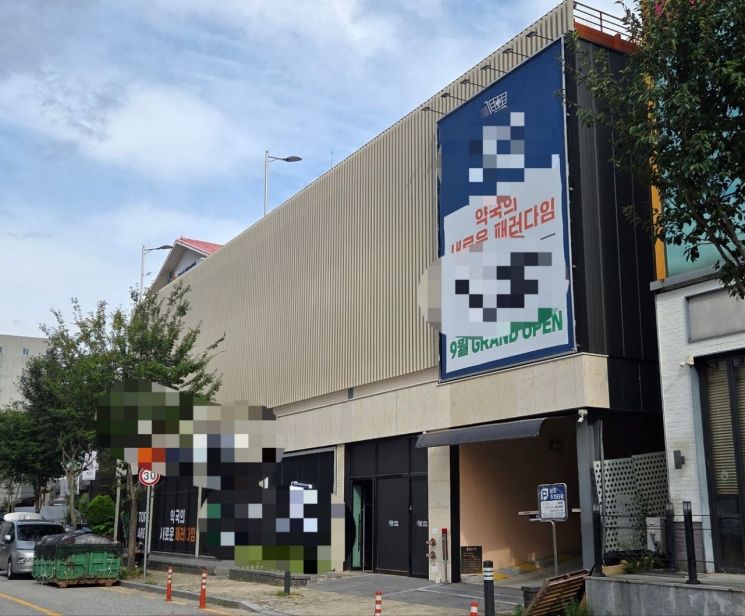 On the 19th, a banner reading "A New Paradigm for Pharmacies, Opening in September" is hung on the exterior wall of a warehouse-style pharmacy preparing to open in Gwangsan District, Gwangju. Photo by Min Chanki
A warehouse-style pharmacy that promotes "bulk and low-cost sales" is set to open in Gwangju, drawing significant attention from the local community. While consumers welcome the ability to compare and choose from a wide range of medications at low prices, pharmacists are strongly opposed, citing concerns about drug misuse and threats to the local pharmacy ecosystem.
According to Gwangsan District and the Gwangju Pharmaceutical Association on September 19, a warehouse-style pharmacy with a floor area of approximately 760 square meters (230 pyeong) is currently undergoing the establishment process in Suwan District, Gwangsan, with the goal of opening either at the end of this month or early next month.
A banner reading "A New Paradigm of Pharmacies, Opening in September" is hung at the entrance of the building where the warehouse-style pharmacy, currently undergoing interior remodeling, will be located.
This pharmacy initially applied for registration last month but voluntarily withdrew the application due to facility deficiencies under the Pharmaceutical Affairs Act. The building is currently designated as a sports facility, but the plan is to change its use to a retail store, fulfill all requirements, and then reapply for registration.
Additionally, in Ssangchon-dong, Seo District, a pharmacy with a floor area of 262 square meters (76 pyeong) has completed its registration process and is preparing to open. As the first warehouse-style pharmacies are about to open in Gwangju, responses from consumers and pharmacists in the local community are divided.
Inside the warehouse-style pharmacy, customers will push shopping carts and directly select over-the-counter drugs and health supplements themselves. By purchasing in bulk and reducing distribution margins, prices are expected to be 20 to 30 percent lower than those at neighborhood pharmacies. The size of the new pharmacy is also over 100 pyeong larger than the first warehouse-style pharmacy in Korea, which opened in Seongnam, Gyeonggi Province in June.
Mr. Kim (41), a resident of Suwan District, said, "I am looking forward to being able to compare and choose various types of health supplements at a glance," adding, "I plan to purchase in advance the nutritional supplements my family needs, in the quantities we require."
On the other hand, the Gwangju Pharmaceutical Association opposes the move, citing concerns about drug misuse and threats to the existing neighborhood pharmacy ecosystem. In Korea, the establishment of pharmacies is based on a registration system, not a licensing system. Only those with pharmacist or oriental pharmacist qualifications can open a pharmacy under the relevant laws, and operating a warehouse-style pharmacy is not illegal.
For this reason, the Gwangju Pharmaceutical Association insists that systems to prevent drug safety accidents must be strengthened.
The Gwangju Pharmaceutical Association recently submitted a proposal to the city of Gwangju to make it mandatory for warehouse-style pharmacies to submit safety management plans, and held a press conference the previous day urging the suspension of administrative procedures.
The association stated, "Medicines are not simple industrial products to be purchased just because they are cheap; they are bioactive substances. Thorough management and guidance by pharmacists are necessary," adding, "There are currently no regulations on warehouse-style pharmacies in the Pharmaceutical Affairs Act. The law needs to be revised to reflect changing times."
Regarding this, an official from Gwangsan District said, "Pharmacy registration is possible as long as there are no disqualifying factors and all requirements are met under the relevant laws, so the local government cannot restrict it," adding, "We plan to conduct regular inspections to address concerns such as drug misuse."
© The Asia Business Daily(www.asiae.co.kr). All rights reserved.

















