Expansion to 3-5% by 2030, up to 10% by 2035
Supply and Refueling Obligations Implemented Together
Launch of the Public-Private "SAF Alliance"
Tax Credits and Subsidy Support Also Provided
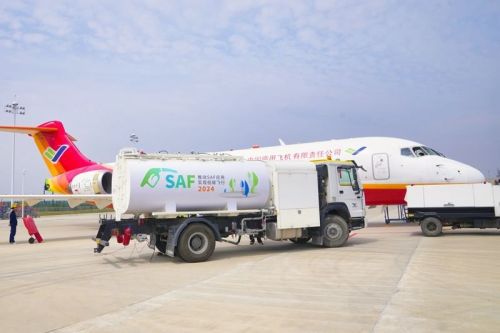
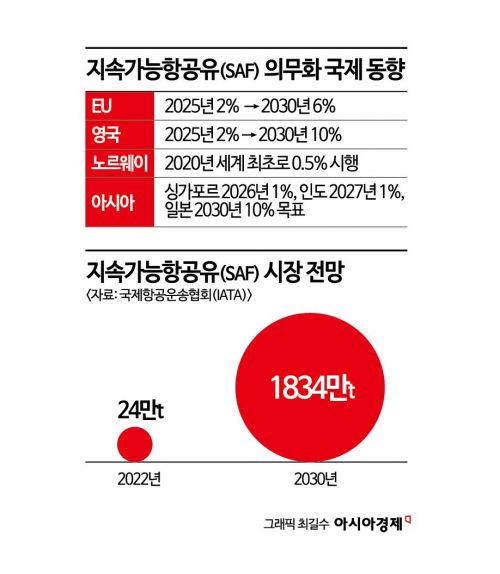
Starting in 2027, the blending of Sustainable Aviation Fuel (SAF) will become mandatory for all international flights departing from airports in South Korea. The government has set the initial blending ratio for SAF at 1%, with plans to gradually increase it to 3-5% by 2030 and 7-10% by 2035.
On September 19, the Ministry of Trade, Industry and Energy and the Ministry of Land, Infrastructure and Transport jointly announced the 'SAF Blending Mandate Roadmap' at a meeting attended by representatives from the refining and aviation industries, as well as related agencies. They also officially launched the public-private consultative body, the 'SAF Alliance,' to oversee the implementation of the new system.
The International Civil Aviation Organization (ICAO) has set a target of achieving Net Zero by 2050 and aims to reduce carbon emissions in the international aviation sector by 5% through SAF by 2030. In response, the European Union (EU) and the United Kingdom have declared this year as the inaugural year for mandatory SAF blending, introducing the obligation ahead of others. The EU plans to start at 2% in 2025 and expand to 70% by 2050, while the UK aims to increase from 2% in 2025 to 22% by 2040.
South Korea announced its SAF expansion strategy in August 2023, and currently, nine domestic airlines are operating some short-haul routes using domestically produced SAF blended at 1%. The new roadmap was developed through a year-long task force meeting starting in September 2024, setting annual mandatory ratios and support measures.
The Ministry of Trade, Industry and Energy will require petroleum refiners and oil importers/exporters to supply blended SAF starting in 2027. Compliance will be assessed based on the proportion of SAF supplied relative to the total volume of aviation fuel supplied for international flights at domestic airports. Initially, to ensure fairness with airlines’ refueling obligations, penalties for non-compliance will be temporarily deferred. When imposed, penalties will be calculated as 150% of the average transaction price for the shortfall during the relevant year.
To ease the burden of compliance, a flexibility mechanism will allow up to 20% of the total obligation to be carried over for up to three years. The government is also considering a system to lower the mandatory ratio in cases of unavoidable circumstances such as natural disasters. After 2030, additional weighting will be given to SAF produced from feedstocks with higher carbon reduction rates. The SAF quality standard will be established by the first half of 2026.
The Ministry of Land, Infrastructure and Transport will require, starting in 2028, that at least 90% of the annual refueling volume for all international flights departing domestic airports be refueled at the departure airport. To support this, a performance management system will be built in 2026-2027, with a pilot operation in the first half of 2028. The same level of penalties as the supply obligation will apply for non-compliance with the refueling requirement.
New airlines will be exempt from the obligation for three years, and airlines unable to meet the refueling requirement due to safety or unavoidable reasons will also be exempt. Similarly, up to 20% of the total obligation can be carried over for up to three years to alleviate the compliance burden.
The government will also strengthen support to establish the SAF industry base. The Ministry of Trade, Industry and Energy will designate SAF as a national strategic technology, providing tax credits of up to 40% for research and development costs and up to 25% for facility investment. Additional incentives for next-generation synthetic fuel development are also under consideration. Policy financial support, designation of key SAF feedstocks as economic security items, and funding for facility investment and feedstock purchases will also be promoted.
To secure stable feedstock supplies, the government will promote the development of new feedstocks such as microalgae and seek tariff concessions for bio-feedstocks not covered by FTA tariff concessions. Support will also be provided for building a global bio-feedstock supply chain, including the creation of a global bio-feedstock map. By 2027, a dedicated Alternative Fuel Center will be established within the Korea Petroleum Quality & Distribution Authority to strengthen specialized support.
The Ministry of Land, Infrastructure and Transport plans to formally request improvements to the international certification system at the 42nd ICAO Assembly so that bio co-products (such as naphtha and diesel) generated during SAF production can be sold without price loss. Currently, only SAF is recognized for international carbon reduction, so co-products can only be sold as general products.
To encourage greater use of SAF, the government has also prepared incentives. Domestic airlines that exceed the mandatory SAF blending ratio for refueling and operations will receive increased bonus points (from 1 point to 3.5 points) during the allocation of international air traffic rights. To reduce the financial burden from SAF blending costs, the government is considering converting the current airport facility fee reductions into direct subsidies to airlines starting in 2027.
Additionally, if passengers voluntarily contribute to SAF funds, airlines will be encouraged to provide various convenience services such as lounge access, preferred seat assignments, and SAF souvenirs.
Alongside the new roadmap, the SAF Alliance has also been officially launched. The Ministry of Land, Infrastructure and Transport, the Ministry of Trade, Industry and Energy, the Korea Transportation Safety Authority, the Korea Petroleum Quality & Distribution Authority, and associations representing the aviation and refining industries have signed a business agreement to support the implementation of the roadmap through ongoing communication, legislation, and policy support.
Lee Wonjoo, Director General for Energy Policy at the Ministry of Trade, Industry and Energy, stated, "The SAF blending mandate is an institutional foundation that addresses the climate crisis and secures the future competitiveness of our top-ranked aviation fuel exports. We will expand SAF production capacity through public-private cooperation to support leadership in the global market."
© The Asia Business Daily(www.asiae.co.kr). All rights reserved.
![User Who Sold Erroneously Deposited Bitcoins to Repay Debt and Fund Entertainment... What Did the Supreme Court Decide in 2021? [Legal Issue Check]](https://cwcontent.asiae.co.kr/asiaresize/183/2026020910431234020_1770601391.png)
















